Series-A funding: How can startups be more attractive for VCs in 2023

Many startup founders struggle to secure funding for the expansion of their companies after raising the Pre-Seed and Seed rounds, especially in 2023.  CB Insights found that only 48% of startups manage to attract Series-A funding, after a Seed round. Fundraising in Series-A is much more challenging and requires a more careful and detailed strategic planning compared to earlier stages. Startups may fall to liquidity bottlenecks if they fail to successfully attract funding on time which may pressure the company to raise at more unfavourable terms.

Fundraising in 2023

Fundraising environment in 2023 is highly affected by the global macroeconomic environment. Thus startups experience additional difficulties to raise funds due to higher degree of selectivity on the investors’ side since they are more reluctant to deploy funds in new opportunities and rather focused on maintaining their existing portfolio startups. In this article, we elaborate on the specifics of Series-A funding rounds today and we also propose some good practices founders can use.  

What is Series-A

After a startup has raised a seed round and made substantial strides toward realizing its objectives and reached certain milestones, such as developing an MVP and growing an initial customer base, it enters one of the most important stages of investment known as Series-A investment round. This stage of financing is meant to assist startups in growing their businesses and achieving their goals. One of the main characteristics of Series-A funding that differs it from previous stages is a readiness to significantly scale its already proven idea and raise capital mainly for business development. Prior to this investment, startups are expected to develop and launch an MVP, then receive feedback from its initial customers as well as gain some market share. It all comes down to a proof in product-market-fit, which has to be achieved in order to qualify for such a round. Investors consider proven traction as a crucial element for startups to receive Series A funding. Accordingly, founders must back up their claims with traction of a developed product, customers as well as strong professional backgrounds and expertise.

Series-A ranges

In order to attract Series A funding, startups must convince investors of their unique value proposition as well as the ability to fulfil commitments and established targets. A couple years ago more than one million in ARR was the minimum threshold for investors to recognise sufficient traction. Today we see plenty companies showing even EUR 3-5m in ARR. Competition for Venture funding become tougher. In the process of many back-to-back 30 min pitches with busy investors, founders must remain calm and present their companies at their best. Typically, a Series-A funding round in Europe ranges between €1.5m and €8m depending on the company’s industry and geographical focus. Series-A funds are primarily used to scale, expand into new markets, acquire key personnel, and create the infrastructure required for mass expansion. 

When to raise a Series-A

We advise entrepreneurs to take into account the following important factors when deciding on when to raise a Series-A round: 

  • Product-market fit – For obtaining Series-A financing, a startup is expected to demonstrate that its product or service has already established product-market fit and that a company targets a large enough, fast-growing, and highly-scalable market.  
  • Proven traction and room for growth – Established initial customer base and the existence of market demand that can be addressed with more investment.
  • Realistic and well-aligned growth strategy – It is essential to develop a well-defined growth strategy using data of the market entry with MVP to indicate investors that the firm has a clear path to scale its product and achieve the next stage of growth.
  • Experienced team – Having a solid and competent team boosts investor confidence and contributes to securing Series-A.
  • Competitive advantage – It is crucial for receiving Series-A funding to demonstrate a superiority of the startup’s product to similar products in the market using data of a launched MVP.  It is also important to show how it will be able to take over the existing market and its competition’s market share.
  • Runway – It is important to have sufficient runway left to not have pressure in the fundraising and negotiation process. Generally investors like to see at least 9 months runway at the start of the fundraising process (with additional 3 months of fundraising readiness prior to the start of the process).  

 What to include in your pitch-deck

As we already mentioned, when conducting due diligence for a Series-A investment round, investors are more selective. As a result, they have higher demands for portfolio startups at that stage. Therefore, for raising a Series-A round founders should approach creation of a pitchdeck special attentiveness. We recommend including certain items in a pitch deck for the given investment stage: 

  • Goal – A short summary of the company and the value it is contributing 
  • Market – Presentation of market trends and its development, including growth estimates. It should also demonstrate existing demand which can be fulfilled by a startup’s product after its scale through a Series A investment round 
  • Problem – Description and proof of a relatable problem and target audience affected by it
  • Solution – Full description of how your product solves an existing problem, and can monetize it 
  • Traction – Especially relevant for a Series A investment round. It is crucial to demonstrate existing achievements of a startup, which can include revenue growth over time, key accounts and their sources (big clients), and key milestones 
  • Competition – a startup should explain why it is different from its competitors and how they can monetize this difference.
  • Financials – Startups must prepare a comprehensive financial plan that is well-aligned with their growth strategy and realistic in its projections as well as based on past performance. At this stage, it is crucial for startups to have growing financials and KPIs.  

How to raise a Series A

The next stage in raising a Series A investment round is to structure documentation and construct a data room. This would consist of all relevant documents that can verify a startup’s legal position, indicate its business model, demonstrate its proven traction as well as present its growth plan. DOWNLOAD a checklist with all relevant due diligence documents here. It is important to align an upcoming investment round with existing shareholders and prepare the terms of a funding round. After that you will start searching for investors that may be interested in investing in a startup. For that purpose, creation of a target long list of prospective investors would be the best tool. Using that investor long list, founders can start contacting potential investors.

Reaching out to potential investors

The fundraising startup must be ready to respond to challenging inquiries. It has to provide more details regarding the company’s development strategy and financial projections during these meetings. To keep investors interested and involved, it is critical follow up with them after each interaction. This stage can be the most difficult for many startup owners. They face limited access to a network of investors, difficulty with approaching investors, pitching, and negotiating favourable terms. The normally short runway makes fundraising even more stressful for founders. That often leads to mistakes along the way due to having to also operate the business. As a result, many startups fail to raise a Series A funding round.  

Getting the right support

Given the current fundraising environment, one of the most effective solutions to overcome the fundraising complexity could be hiring an consultant. The consultant can help with all issues which startup founders are facing during that process. Experience in deal structuring can be very helpful. Downrounds have become the new normal, but they are not a must if you set the terms right. Venionaire Capitals transaction service team (based in London and Vienna) is an entrepreneurial partner of both startups and investors. As an investment company specialized in Venture Capital and Private Equity, we have been supporting more than 100 deals since 2012.

What we offer

We offer valuable advice through due diligence, valuation, deal structuring, and deal negotiating. Our expertise and investor network enable us to provide startups with the necessary support and guidelines to ensure their chances of successfully securing the funding they need to grow and succeed. We dedicate ourselves to helping startups reach their goals. So we welcome them to work with us and benefit from our expertise. 

In addition to our advisory services, Venionaire will always also look into direct investments through its actively managed funds, for the best deals run by its transaction team.  


References: 

Corporate Finance Institute. (2023, February 24). Series A Financing. 

EU-Startups. (2023, February 21). The Startup Funding Journey: A Guide to Pre-Seed, Seed, Series A, B, C, D, and E Funding

Sifted. (2023, March 6). Series A funding for startups: What VCs want to see from founders in 2023. 


Author: Denis Voldman

How the Silvergate and Silicon Valley Bank Insolvency effects crypto

Our analyst and fund management team of Tigris Web3 – Austrian Crypto Fund, managed by Venionaire Investment GmbH – are currently monitoring the market situation. They are of course evaluating possible scenarios for following developments. Most important for our investors and clients, Tigris Web3 has had zero exposure in stablecoins, and no exposure to Silvergate or Silicon Valley Bank. The funds strategy is to reduce counter party risk through usage and investment in decentralized projects. This excludes the investment or cooperation with centralized entities like crypto banks, stablecoin issuers and centralised exchanges. The following article gives a wrap up and analytical interpretation of how the current situation might unfold.

What happened so far?

On the 10th of March, the 18th largest US bank by nominal deposit amount, Silicon Valley Bank, has become insolvent. Thus it ended up in FDIC receivership.

The bank became insolvent due to the inherent nature of the current banking system – the fractional reserve system. A fractional reserve system allows banks to not have full treasury backing, but can mark-to-market their reserves, which in the case of a bank run, makes the bank insolvent. Essentially and summed up to the highest level, this is what SVB faced in the second week of march.

Spillover into crypto markets

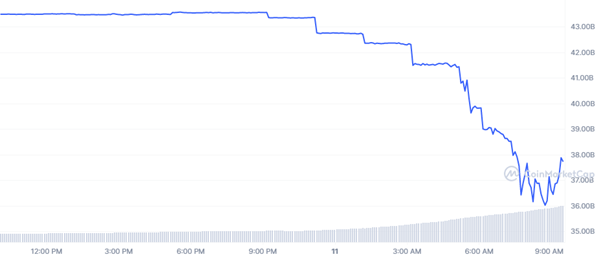
The insolvency of the bank has heavily hit Circle, the company behind the 2nd biggest stablecoin, USDC. USDC, which is fully backed by US Dollar, had 3.3 billion USD worth of collateral on the accounts of the bank. Even though 3.3 billion USD is shy of 8% of the total market capitalization of USDC, the price of the stablecoin, which is supposed to be as the name indicate – stable at 1 USD, started dropping overnight. The insolvency and liquidation of Silvergate earlier this week, a bank heavily involved in crypto markets, who was also a partner of Circle, is adding fuel to the fire.


Figure 1. USDC Market cap (1D Chart) source: coinmarketcap.com

The potential amounts lost on Silvergate are currently unknown. This led to the beginning of a bank run on USDC, with lots of crypto market participants swapping into other stablecoins, large cap crypto currencies or Fiat USD. Naturally, this caused the USDC depeg which at this time is larger than the estimated (potential) gap of collateral caused by the Silicon Valley Bank insolvency.

Another stablecoin project, DAI, has also disconnected in the wake of the scandal. Even though DAI had no exposure to the bank directly, 50% of DAI reserves are backed by USDC as collateral.

Systemic TradFi risks in crypto markets

The irony of this case lies in the fact that theoretically flaws of the traditional finance economy rarely affect crypto projects, as one of their inherent ideological pillar is to create a better, fairer and more resistant system. This case is unique though. The cause of the drop is a systematic counter-party risk. There is no inherent crypto market flaw or fraud at play. One can not blame Circle, as Circle is the most transparent and audited-on-point stable-currency provider. Even Silicon Valley Bank itself can at this point and with the information available so far not been held fully responsible either. Bank runs can happen. In this cause triggered through supposedly poor communication and unlucky timing. Even though their reserves were as conservative as possible, they still tumbled into insolvency due to fractional reserve policy installed by the FED.

Regulatory repercussions

One likely outcome is an even tighter and stronger accelerated approach to the regulation of stablecoins by financial market authorities and central banks – with the ultimate peak of this process being the eventual issuance of CBDCs. Although not very likely, we might even see the FED stepping in in some way in the next days, potentially even taking control of Circle. The meltdown of Luna and UST, and most recently the collapse and alleged fraudulent nature of FTX already previously enforced this step from a regulator’s point of view. Many crypto market participants see this very sceptical due to ideological resons. But increased regulatory security with fully regulated and safe stablecoins creating the ultimate smooth Fiat on- and offramp and DeFi backbone could be one of the necessary triggers for broad adoption of the technology.

Tigris Web3 analysis

Situations like the one with Silicon Valley Bank and Circle enforce our view for the need for decentralized and fully transparent solutions which mitigate counterparty risk. That is one of the main pillars in the investment thesis behind Tigris Web3, a Web3 focused fund managed by Venionaire Investment. Overall we see very low systemic risk at this point for both the portfolio assets and broader thesis of the fund. Circle hast very strong institutional backing. There is too much at stake (both financially and in trustworthiness) compared to what the actual financial damage through the insolvency of Silicon Valley Bank might be. Tigris Web3 is neither invested in USDC, DAI or any other stable coin. Also, we have no funds or accounts with Silicon Valley Bank or Silvergate. If you want to learn more about Tigris Web3, our portfolio assets and projects and investment thesis reach out to david@venionaire.com

Disclaimer

As this situation is currently unfolding, the parties involved are releasing new data and insights on an ongoing basis. This article only reflects the interpretation and knowledge based on information available until 11th March 2023, 10:30am CET. This is no financial advice. Investing in crypto assets is of the highest risk and can lead to a total loss of funds invested.


Authors: David Teufel & Ivo Pernar

Samurai of Tech

A brief historical digression

A Japanese samurai was once a loyal servant and protector, an imperial guard, a warrior with a strict code of honor. They lived according to the “Hagakure”, which contains about 1,300 lessons and dealt with both daily life and the relationship between lord and follower. The traditional warrior nobility of the samurai experienced its heyday in the 11th and 12th centuries A.D. The samurai, originally in the service of the emperor and nobility, became the ruling class of society with the rise of the shogunate and the establishment of a military aristocracy. The demise of the samurai 150 years ago also represents the rise of modern Japan. However, the myth and fascination with these warriors still exists today far beyond the borders of their homeland.

Between past and future

Japan is a country of (supposed) contrasts, performing a daily balancing act between tradition and modernity. While moving between centuries-old shrines and the most modern high-rise architecture, between traditional teahouses and eccentric maid cafés, and yet, despite the apparent contradictions, you can easily find a way between the centuries.

Let’s draw mental parallels and dare this balancing act for our business. Today, our “servants” are our digital or high-tech companions. From artificial intelligence, robots and drones to countless apps, that now make every facet of our daily lives easier. In Japan, you will find a large number of world leading corporations. They almost naturally have large powerful corporate venture vehicles. The few investment banks, some of which manage over 100 corporate venture funds, could be described as shoguns (rulers) in the ecosystem. Perfection is a social and cultural requirement, and this is achieved by specialists. Accordingly, these funds are often managed externally by specialists.

Behind the scenes

Japan’s technology giants are global players, but in Japan itself they like to keep to themselves. To this day, there are hardly any non-Japanese top managers, and the global subsidiaries’ leadership always contain Japanese managers. English as a foreign language is a matter of course for the educated Japanese, but they prefer to do business  in their mother tongue. It is therefore advisable for Western business people to be able to speak at least a few bars.

If we stick to our mental balancing act, these technology giants are the modern samurai of their industries. The innovative leadership of these “Samurai of Tech” goes far beyond Asia. They invest, develop spin-offs together with research institutes and have a strong presence in the international “super hubs” of the startup scene – for example in Israel, Silicon Valley or India. For the corporations, close ties with global startup hubs seem not only practicable, but actually extremely important in terms of their claim to long-term honourable cooperation with innovators. A good reputation ensures access to the best talent and thus the samurai’s superiority in the innovation race.

How to deal with crisis

Right now Europe is just learning to deal with the next and arguably most severe crisis in recent history. Japan has meanwhile perfected living in the crisis. Interest rates are still negative, inflation is not a major issue, the domestic market is strong and the country’s international position is excellent. Japanese are strategists, so it’s not surprising that the appetite for risk to increase activity in Europe – especially venture capital and Web3 – is growing strongly.

In Europe, however, Japanese corporations and corporate venture vehicles are currently hardly present. The European market is considered attractive, but unfortunately also very complex. Various hubs, regional cultural differences, many languages and different laws (depending on the region) in Europe are understandably deterrent. Those who want to be successful therefore ally themselves with strong partners – although this requires some patience. Strong partnerships are based on trust and building this trust does not work overnight.

Building Bridges between Japan and Austria

Venionaire Capital has very good experiences in working with Japanese co-investors and business partners. Attending the City Tech Tokyo Conference and speaking at an official Deloitte side event has greatly strengthened our bi-directional relationship. We are looking forward to a strong delegation from Japan attending the World Venture Forum in Kitzbühel.

You have questions regarding the Japanese market, or would like to find a strong partner for corporate venture funds (full service), or as a scale-up to enter the European market? Please contact our Advisory Team, led by our Managing Partner, Berthold Baurek-Karlic.

Investing Into The Future

Our Venture Partner Peter Augustin and our Investment Director David Teufel in an interview at New Business about the first Austrian crypto fund “Tigris Web3”.

EVSI REPORT Q4 2022 | OUTLOOK FOR Q1 2023 INCREASES

In our EVSI Report Q4 2022, we recorded another decrease in the index actual continuing the trend from Q1 and Q2.

The keys to success in digital transformation for the publishing and media industry

Benjamin Jentzsch, CEO and owner of Linde Verlag and Berthold Baurek-Karlic, CEO at Venionaire. discuss the future potential of digitization for publishers and media companies, as well as the role start-ups will play in this process.

6 Ways To Increase Your Social Media Traffic Without Paying For Ads

In this article, you’ll discover a how you can increase your Social Media traffic without paying for Online Ads.

Crypto Trends 2023

As the year comes to an end Venionaire’s Investment Director David Teufel summarised the crypto trends for 2023.

EU Regulations: DAC7 Implementation and its implications for platform operators

The constant expansion of the digital economy leads automatically to legal changes and adjustments. The 6th Amendment to the EU Mutual Assistance Directive, also known as DAC7, is a significant development in the effort to improve tax transparency and compliance in the digital economy.

Content Creation Success Tips for Linkedin

In this article, you’ll discover a LinkedIn engagement marketing strategy that will improve your content creation process and help you engage with more potential customers.

WHERE TO FIND US

VIENNA, OFFICE (HQ)

Babenbergerstraße 9/12,
A-1010 Vienna, Austria (EU)
office@venionaire.com

SAN FRANCISCO, USA

1355 Market St. #488
San Francisco CA 94103
sfo@venionaire.com

NEW YORK CITY, USA

122 East 37th Street
First Floor
New York, NY 10016
nyc@venionaire.com

LONDON, UK

Gable House, 239 Regents Park Road
London N3 3LF
office@venionaire.com

Luxembourg, LUX

28, Boulevard F.W. Raiffeisen
2411 Luxembourg
office@venionaire.com

LOOKING FOR FUNDING?

FOR STARTUPS

Venionaire Capital exclusively invests through the European Super Angels Club, for more information and application please go to the website. We do not accept direct investment proposals via this website.