Posts

A Decade of Innovation & Digital Transformation: A Look at the Buzzwords and Developments

Over the past 10 years, the world has witnessed a rapid and transformative period of innovation and digital transformation. From groundbreaking technologies to disruptive business models, the last decade has brought forth a multitude of buzzwords and developments that have shaped industries across the globe. In this article, we will delve into some of the most significant advancements and highlight the key buzzwords that have emerged during this transformative period. 

Artificial Intelligence (AI) and Machine Learning

No discussion on digital transformation is complete without mentioning AI and machine learning. These technologies have revolutionized various industries, enabling computers to mimic human intelligence and learn from data. From chatbots and virtual assistants to predictive analytics and autonomous vehicles, AI and machine learning have become essential tools for businesses seeking to gain a competitive edge. 

Internet of Things (IoT)

The IoT refers to the network of physical devices, vehicles, appliances, and other objects embedded with sensors and software that enable them to connect and exchange data. Not only has this interconnectedness paved the way for smart homes, smart cities, and industrial automation. IoT has also played a crucial role in data collection, enabling businesses to gather valuable insights and optimize their operations. 

Cloud Computing

Cloud computing has transformed the way businesses operate and store data. With the ability to access and store data remotely, companies can reduce costs and enhance scalability. Moreover, Cloud-based services offer flexibility, security, and collaboration opportunities, allowing businesses to streamline their operations and focus on their core competencies. 

Big Data and Analytics

The exponential growth of data has given rise to the need for advanced analytics tools and techniques. Big data analytics leverages large datasets to uncover patterns, correlations, and trends, enabling businesses to make data-driven decisions. This has paved the way for personalized marketing, predictive maintenance, and enhanced customer experiences. 

Blockchain Technology

Blockchain technology burst onto the scene with the advent of cryptocurrencies like Bitcoin. However, its potential goes far beyond digital currencies. Blockchain offers a decentralized and transparent approach to record-keeping, enabling secure transactions, supply chain traceability, and smart contracts. Its impact spans industries such as finance, logistics, and healthcare. 

Augmented Reality (AR) and Virtual Reality (VR) 

 AR and VR have transformed the way we interact with digital content and the physical world. AR overlays digital information onto the real world, enhancing experiences in fields like gaming, retail, and education. VR, on the other hand, immerses users in a virtual environment, revolutionizing areas such as training, entertainment, and healthcare. 

The past decade has been a whirlwind of innovation and digital transformation, reshaping industries and revolutionizing the way we live and work. From AI and machine learning to IoT and blockchain, these developments have ushered in a new era of possibilities. As we reflect on the incredible journey of the last 10 years, it’s clear that these buzzwords and advancements will continue to mold the future, presenting both challenges and opportunities for businesses worldwide. Embracing and harnessing these technologies will be crucial for organizations aiming to thrive in an increasingly digital world. 

Join Us at the World Venture Forum 2024 in Kitzbühel 

To celebrate this remarkable decade of progress, exploration, and transformation, we invite you to join us at the 10-year anniversary of the World Venture Forum in 2024, set against the breathtaking backdrop of Kitzbühel. At this prestigious event, thought leaders, innovators, and visionaries from around the globe will gather to dive deeper into these groundbreaking topics, explore emerging trends, and chart the course for the next wave of innovation. Stay tuned for an unforgettable experience that will shape the future of business and technology. See you in Kitzbühel! 

Article Part 4: The Future of Artificial Intelligence – WALL-E or Terminator?

In cooperation with Venionaire Capital, DerBrutkasten.com publishes a four-part article series on the subject of artificial intelligence. We are concentrating on the economic aspects of how AI works to the current research and the future of artificial intelligence.

The fourth and last article will concentrate on how the artificial intelligence will turn out in the future.

According to a quote from Stephen Hawking in The Guardian, Artificial Intelligence will be “either the best, or the worst thing, ever to happen to humanity”. The growing computer performance and Big Data enable machines to become even smarter. In an open letter, therefore, numerous industry leaders, such as Elon Musk or Hawking, call for the prevention of artificial intelligence and the control of the systems.

Musk believes that AI could become an existential threat to people and emphasized the need for legal requirements. Other AI skeptics are worried about the labor market. AI, according to the apprehension, will at least provide a new wave of mass unemployment in the short to medium term.

Joe Lobo, “chief botmaster” at the Startup Inbenta, has a more positive idea of the future of work and artificial intelligence. In a Forbes podcast he explained how technologies create new jobs and people can use their skills for new opportunities. So far, the development showed that AI systems complement human workers more than replace them. AI skeptics and enthusiasts, however, agree that jobs will change and new forms of employment will arise.

Whether advocates or adversaries, it is certain, in AI will be further invested and researched. In the end it is in our hands whether we end up with a terminator or a Wall-E.

However, to an artificial superintelligence it is in any case still a long way, as we described it in the second part of our series. In the third part, we also showed that the research and development of artificial intelligence was not a linear process, but had to repeatedly record ascensions and declines. The economic impacts of AI, which we dealt with in the first part, are equally interesting for start-ups and early-stage investors.

For the whole article click here.


The top 15 AI Deals in Europe

The marketplace for artificial intelligence (AI) technologies is thriving. Beyond the hype and the intensive media attention, the numerous start-ups and internet companies racing to acquire them, we can observe that private companies are increasing their investment and adoption to these technologies.

To complement the article series on artificial intelligence we would like to outline the 15 biggest deals on artificial intelligence start-ups in Europe.

[sociallocker id=”10980″]


1. Kreditech                                 


Location: Hamburg, Germany
Funding Amount: USD 162.590.000
Webpage: kreditech.com

Provider of a lending as a service (Laas) based credit-scoring platform designed to improve financial freedom for the under-banked by the use of technology. The company’s lending as a service (Laas) based credit-scoring platform identifies and scores individuals online, decides and instantly pays out loans, based on 15,000 data points, providing banking products (instalment loans, microloans, credit cards, electronic wallets) to customers in emerging markets.


2. BenevolentAI


Location: London, United Kingdom
Funding Amount: UDS 100.000.000
Webpage: benevolent.ai

Provider of artificial intelligence technology intended to transform the process of pharmaceutical research and development. The company’s self-learning artificial intelligence and machine learning capabilities focuses on the disease areas of inflammation, neurodegeneration, orphan diseases and rare cancers as well as Judgment Augmented Cognition System (JACS), enabling human health, bio science and information technology sectors to analyse vast quantities of scientific information for the advancement of scientific discovery and applying it to real world problems.


3. Alteryx


Location: Broomfield, Colorado
Funding Amount: USD 85.000.000
Webpage: alteryx.com

Alteryx is the leader in self-service data analytics


4. Blue Yonder


Location: Karlsruhe, Germany
Funding Amount: USD 75.000.000
Webpage: blue-yonder.com

Provider of Big Data analytics and predictive applications. The company offers a cloud-based scalable platform with machine-learning algorithms. The enterprise’s platform automates decision-making in real time and supplies precise forecasts. It is also used in dynamic pricing and in customer analyses.


5. Darktrace


Location: London, United Kingdom
Funding Amount: USD 64.000.000
Webpage: darktrace.com

Provider of cyber threat defense systems designed to detect and respond to previously unidentified threats. The company’s cyber threat defense systems include detecting emerging cyber-threats and to proactively defend against in-progress cyber-attacks, enabling clients to defend against evolving threats that bypass all other systems.


6. Arago


Location: Frankfurt am Main, Germany
Funding Amount: USD 55.000.000
Webpage: arago.co

Provider of information technology automation services. The company develops artificial intelligence software for banking and telecommunication sectors. Its products include AutoPilot, CloudPilot, DocMe, BuildMe and MARS-O-matic and its services include WebFarm and CloudFarm.


7. Blippar


Location: India, Turkey, United States, United Kingdom
Funding Amount: USD 54.000.000
Webpage: blippar.com

Provider of augmented reality software for smartphones. The company offers a platform that enables users to turn images into interactive Web experiences, through image-recognition technology.


8. Cambridge Quantum Computing


Location: Cambridge, United Kingdom
Funding Amount: USD 50.000.000
Webpage: cambridgequantum.com

Provider of tools for the commercialization of quantum computers. The company provides cryptography, financial, medicinal, biotech and big data services.


9. Quid


Location: San Francisco, United States of America
Funding Amount: USD 39.000.000
Webpage: quid.com

Provider of a visualization platform designed to offer text-based data analysis. The company’s visualization platform combines search, premium data and high-performance algorithms from news articles, blog posts, company profiles and patents to create visualizations of markets, trends and cultural phenomena, enabling businesses to analyze investment trends, gain competitive intelligence, map innovation as well as make decisions that matter.


10. Rapid Miner


Location: Boston, Massachusetts
Funding Amount: USD 36.000.000
Webpage: rapidminer.com

Provider of data science platform designed to offer predictive analytics built on an open stack. The company’s data science platform allows to build software for real data science, fast and simple, unifies data preperation, machine learning and model deployment, enabling companies to drive revenue, reduce costs and avoid risks.


11. Withings


Location: Issy-les-Moulineaux, France
Funding Amount: USD 33.830.000
Webpage: withings.com

Developer of digital health and wellness smart devices and applications. The company offers software and devices that enable people to monitor and track their personal health data.


12. Nanigans

Location: Boston, Massachusetts
Funding Amount: USD 32.850.000

Developer of an advertising automation software. The company’s online platform offers programmatic media buying, predictive revenue optimization and real-time business intelligence.


13. Graphcore


Location: London, United Kingdom
Funding Amount: USD 30.000.000
Webpage: graphcore.ai

Developer of a processor designed to accelerate machine intelligence learning. The company’s intelligence processing unit emphasizes massively parallel, low-precision floating-point computing and provides higher compute density than other solutions, and the C++ programming framework provides seamless interface to standard machine learning frameworks, with simple integration for existing applications written for Tensorflow, enabling researchers to explore machine intelligences across a much broader front than current solutions.


14. Pyramid Analytics


Location: Amsterdam, The Netherlands
Funding Amount: USD 30.000.000
Webpage: pyramidanalytics.com

Provider of a business intelligence platform designed to simplify the access to information to help organizations optimize their business. The company’s business intelligence platform provides delivers intuitive enterprise level Business Intelligence through an integrated, scalable dashboard and analytic application for all types of business users, providing them with modules that can be accessed through a single, web-based interface.


15. Celonis


Location: New York, United States of America
Funding Amount: USD 27.500.000
Webpage: celonis.com

Celonis offers the most advanced Process Mining tool for analysing & visualizing business processes.


As we might have seen in this article, Europe has a fast growing Artificial Intelligence Industry most of them being in the data analytics market. AI is transforming every industry and process, and Europe is leading the way.


[/sociallocker]

Article Part 3: The history of AI – From the “AI Winter” to the final breakthrough

In cooperation with Venionaire Capital, DerBrutkasten.com publishes a four-part article series on the subject of artificial intelligence. We are concentrating on the economic aspects of how AI works to the current research and the future of artificial intelligence.

In the first article we described “Artificial Intelligence (AI)” as the ability of a machine to learn and adapt from its own experience. The second article was about the basis concept of AI and in the third part, we will provide an overview of research, trends and leading companies in the field.

Artificial intelligence is often seen as a new world conquered just by brave pioneers from Silicon Valley. In reality, however, the subject had a lot of ups and downs. The breakthrough seemed only a matter of time, but the researchers underestimated the problem that words can have different meanings in different contexts. The US Government cancelled the financing and this this period was referred to as “AI Winter” in analogy to the concept of “nuclear winter”.

Historically, there have always been such drought periods. The result of financial incidences were fewer research activities. Over and over again there were deep and then high phases (“AI Sommer”).

After a difficult situation in the early 1990s, the AI industry was finally recovering in the 2000s. The upturn was supported not so much by governments but by tech companies such as Google, Facebook, Apple, Amazon, Microsoft or the Chinese company Baidu.  The basis for the rapidly growing commercial interest are the computer systems that now enable the broad use of AI technologies for the first time.

The search engine giant Google is one of the leading companies when it comes to the topic of artificial intelligence. The main focus of their research (see research.google.com) is Machine Learning, Natural Language Understanding, the entire health care system, the perceptive abilities of machines, robotics and, interestingly, the creation of music and art. Thereby “deep learning” plays a very important role, for example Google’s Alpha Go, which clearly defeated the professional Go player Fan Hui and later Lee Sedol.

The question that is important to investors is, of course, whether the high phase is only a hype or sustainable. In contrast to the past, AI is already being used in everyday life.


For the whole article click here.


Article Part 2: Comprehend, Sense, Act – The basis concept of AI

In cooperation with Venionaire Capital, DerBrutkasten.com publishes a four-part article series on the subject of artificial intelligence. We are concentrating on the economic aspects of how AI works to the current research and the future of artificial intelligence.

In the first article we described “Artificial Intelligence (AI)” as the ability of a machine to learn and adapt from its own experience. In this article we want to get deeper in the matter. AI consists of diverse technologies that are the result of a combination of three elements: comprehend, sense and act.

Language Processing and knowledge representation are important for comprehend.  Natural Language Processing (NLP) combines technologies that are able to understand and generate speech in spoken or written form. Knowledge representation helps to communicate knowledge and facilitate subsequent decision-making, for example digital assistants.

Sense includes machine vision, voice recognition and further processing in sensors. This makes it possible to capture, identify, analyze and process the input information from cameras, microphones or other sensors.

Once information is collected through comprehending and sense, the logical third step is action. This is mainly used in industrial robotics, as Amazons show impressively.

These are the three pillars of the artificial intelligence According to Stuart Russel and Peter Norvig machines must also have specific abilities to act as a human being. Known in this context is the Turing Test from 1950, where a human questioner talkes with two unknown conversation partners. One of them is a person, the other one is a machine. If the questioner does not suceed in telling which of them is the machine, the machine wins. This test is now more than half a century old and we are still at the beginning of the development.


For the whole article click here.


Article Part 1: Economic Growth through Artificial Intelligence

In cooperation with Venionaire Capital, DerBrutkasten.com publishes a four-part article series on the subject of artificial intelligence.  We are concentrating on the economic aspects of how AI works to the current research and the future of artificial intelligence.

The first part shows the economic growth through artificial intelligence. While most people still associate the terminator with artificial intelligence, it has long become a key technology. Also Austrian Startups in cooperation with the ÖFAI (Austrian Research Institute for Artificial Intelligence) contribute to this growth with Voicebots and Chatbots such as Yodel.io.

The International Data Corporation sees the US market potential for artificial intelligence in three years at approximately 34 billion euros and the contribution to the economic growth only in Germany will be 1.6%. This is an important argument for investors and caused 2016 investments in the amount of 5 billion Euros. Although there is a clear distance between the USA and Europe, the number of completed deals in Europe is rising. For example the largest financing round in 2017 concluded the German company Kreditech with about 138 billion Euros. The amounts of Austrian startups like FRUX, Kiwi Security or Cortical.io are clearly smaller. Sales will increase enormously between 2016 and 2025 even if there are warnings about the current development for example from Elon Musk.

For the whole article click here.


The Corporate Startup Engagement of Austrian Companies

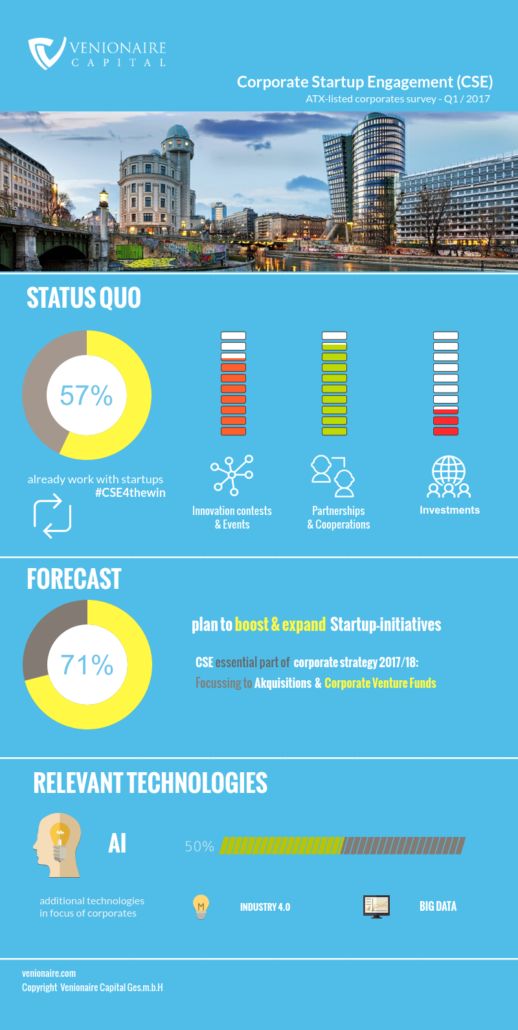
Venionaire Capital asked in the Austrian Trade Index (ATX) listed companies about their corporate startup engagement with surprising results: Every second company already works with startups and about two-thirds of the companies regularly participate in innovation and startup challenges in order to find new business ideas. Corporates identified Artificial Intelligence (AI) as particularly important.


Collaboration between corporates and startups in Austria is in the forefront, as a recent survey of the consulting and investment company Venionaire Capital among the largest Austrian companies revealed. More than half of all surveyed companies have already worked together with startups. Especially innovation competitions, such as the annual “Innovation to Company” startup challenges developed in cooperation with the Vienna Chamber of Commerce, are particularly popular. With this great interest in startups, Austria follows an international trend.


Note:
Agreeing on a valuation is one of the most critical point for a good corporate startup relation. We developed a startup valuation tool to help with that.

[hubspot type=cta portal=5314519 id=bc2a7bcd-bcee-4a08-960b-b43a6cea4bfe]


As a study by the business school INSEAD and “500 startups” from the year 2016 shows, more than two-thirds of the international top 100 companies deal with this topic. Global players, however, are not only looking to work but also invest in startups. Austrian companies were still hesitant in the past regarding early stage investments, but changes are emerging.


Enterprises want to intensify startup activities

A good proportion of the surveyed companies would like to invest in startups in selected cases, which is, for example, possible through a partnership with the European Super Angels Club. Companies are also thinking about their own accelerators and corporate venture funds: “Corporates do not shy away with their accelerator and innovation hub programs from working with partners from complementary industries, as it is the case with Talent Garden in Vienna. Regarding corporate venture funds, openness depends very much on the extent of the strategic orientation of the corporate”, explains Berthold Baurek-Karlic, founder and CEO of Venionaire Capital. Our survey shows, that all companies, which have already worked with startups, want to intensify their startup activities. Companies with no startup engagement yet, see it as a potential part of their 2017 digitization campaign.


Reduce costs, increase innovation

The motivation for working with startups coincides with the global study from INSEAD and 500 start-ups: Established companies expect from a corporate startup engagement (1) more innovative ideas, (2) fewer innovation costs, (3) the possibility to test new products, and (4) mitigate the threats of new digital business models. Austrian corporates show a high interest in Artificial Intelligence as well as in big data and Industry 4.0 ( digitization of machines, infrastructure and buildings).


Positive reinforcement

The Austrian startup ecosystem is like a snowball – once moved, it now gains quickly more substance and speed, says Baurek-Karlic: “The on-going professionalization of the startup teams brings a new interest of investors and corporates, whose interest encourages new founders, who in turn attract new players on the market. Especially in our advisory activities for the “Innovation to Company” startup challenge and other projects with companies such as A1, AccorHotels, Microsoft Austria, New Frontier Group, Austrian Post, Raiffeisen, Uniqa or Verbund, show us, that startups getting more and more attention. These potentials should be leveraged at a pan-European level, which is why we were involved from the very beginning with Talent Garden in Vienna and the founding of the European Super Angels Club.”


WHERE TO FIND US

VIENNA, OFFICE (HQ)

Babenbergerstraße 9/12,
A-1010 Vienna, Austria (EU)
office@venionaire.com

SAN FRANCISCO, USA

1355 Market St. #488
San Francisco CA 94103
sfo@venionaire.com

NEW YORK CITY, USA

122 East 37th Street
First Floor
New York, NY 10016
nyc@venionaire.com

LONDON, UK

Gable House, 239 Regents Park Road
London N3 3LF
office@venionaire.com

MUNSBACH, LUX

3 rue Gabriel Lippmann
5365 Munsbach
office@venionaire.com

LOOKING FOR FUNDING?

FOR STARTUPS

Venionaire Capital exclusively invests through the European Super Angels Club, for more information and application please go to the website. We do not accept direct investment proposals via this website.