Posts

Asia VC: Capital Rotation, Hard-Tech Sovereignty, and the New Cross-Border Playbook

This article offers a focused insight into one of the core mechanisms shaping markets in 2026. The full Market Outlook 2026 provides the broader, integrated context across macro, public markets, private capital and digital assets.

Asia’s VC rebound is not a return to globalised beta. Instead, it reflects a rotation toward ecosystems that can host long-term capital under tighter cross-border conditions.

The rebound is selective, not cyclical

You can see Asia’s venture recovery in the headline figures. However, the composition is more decision-useful. Total Asian VC funding reached USD 73.6bn across 4,308 transactions. Moreover, late-stage and technology-growth rounds carry meaningful weight.

Implication: capital is likely to keep favouring maturity signals. That means later-stage scale-up capacity and fewer, higher-impact bets. It also means less broad-based early-stage risk appetite.

Capital has returned – but only where scale, structure, and exit pathways are already legible.

Geopolitics rewires the investment filter

The report frames 2026 as a period of shifting geopolitical realities. As a result, cross-border strategies recalibrate and investors become more selective.

Implication: underwriting in Asia increasingly shifts from “market size first” to friction management. Therefore, policy credibility and regulatory clarity matter more. Likewise, investors prefer repeatable pathways for capital and exits.

Hard-tech sovereignty replaces platform scaling

The report describes a 2025 reset for China’s VC scene. It also notes a more active government role. In that context, capital flows into strategic “hard tech”. Examples include semiconductors, aerospace, quantum, and advanced AI.

Implication: for China-linked exposure, the question changes. Investors move from “can it scale fast?” to “can it compound inside a sovereignty-first priority set?”. Consequently, timelines can extend and execution matters more.

Japan and Singapore as institutionalisation plays

The report positions Japan as a beneficiary of reform and DeepTech strength. It also points to momentum in automation and robotics.

Implication: Japan can screen as an “institutionalisation” market. Governance, reform, and DeepTech depth can support deployment conditions. Still, the return profile may look less momentum-driven.

The report describes Singapore as a scale-up gateway. It highlights a globally competitive business climate and “regional expansion readiness”.

Implication: Singapore strengthens as a platform for scaling and funding across Asia. In particular, this holds when investors prioritise regulatory clarity and repeatable cross-border setups.

Dual domiciliation becomes a core structuring choice

The report notes a growing number of startups exploring relocation or dual domiciliation. It highlights this dynamic especially for China-linked companies. The stated aim is access to neutral capital markets, hedging political risk, and unlocking international expansion routes.

Implication: domicile becomes part of the investment thesis. Therefore, terms, governance, and exit planning move up the checklist. Investors will also test whether cross-jurisdiction operation adds avoidable financing friction.

In Asia, institutional readiness – not innovation alone – determines where global capital can stay invested.

“Institutional readiness” as the practical filter

The report makes its framing explicit for 2026. It highlights ecosystems that combine regulatory clarity, executional talent, and scalable infrastructure. It also calls out those that “match innovation with institutional readiness”.

Implication: the investable edge shifts from the most innovative companies to the most financeable ecosystems. In other words, capital prefers places where it can deploy, scale, and repatriate with fewer surprises.

The report describes India’s upside as tied to improved regulatory throughput. It also emphasises a specific unlock: simplifying visa, tax, and capital repatriation frameworks. The goal is converting international interest into sustained investment flows.

Implication: India’s opportunity set may expand if friction falls. However, allocations remain sensitive to whether throughput improvements materialise in practice.

What this means for investors in 2026

Asia is less a single VC bucket and more a portfolio of regimes. Accordingly, the report points to rotation toward jurisdictions and hubs that combine policy and regulatory clarity with scale-up infrastructure.

Implication: the winning playbook looks less like rebound chasing and more like structuring for durability. Therefore, investors map geopolitical exposure explicitly. They also build jurisdiction-aware governance. Finally, they plan financing for episodic exit windows rather than smooth reopening.

To explore the full regional frameworks, capital flows, and structural filters shaping Asia and global venture markets in 2026, download the complete Market Outlook 2026 report.
Middle East & Africa in 2026: The Two-Speed VC Model

This article offers a focused insight into one of the core mechanisms shaping markets in 2026. The full Market Outlook 2026 provides the broader, integrated context across macro, public markets, private capital and digital assets.

In 2026, the Middle East & Africa venture ecosystem no longer reads as a single growth story. Instead, it operates as a two-speed capital-formation model with three clearly defined roles: Israel acts as the innovation engine, the UAE serves as the late-stage capital hub, and Saudi Arabia builds the early-stage system. As a result, capital moves deliberately across stages rather than evenly across geographies.

Two-speed VC, one region

Capital formation, not just deal flow

At the core of the region’s dynamics lies how capital is organised, not simply how much is deployed. Therefore, the Market Outlook 2026 frames the Middle East less as a commodity-linked macro narrative and more as a capital-allocation system, where execution, funding structure, and sequencing drive outcomes.

Moreover, this distinction matters in a global environment shaped by selective liquidity and episodic exits. Regions that clearly separate innovation generation, scale financing, and ecosystem construction gain an advantage. In the Middle East & Africa, these functions increasingly operate as distinct but connected layers.

Israel: the innovation anchor

Israel remains the region’s innovation anchor. Venture activity concentrates on early- and late-stage rounds rather than technology-growth mega-financings. Consequently, the ecosystem prioritises pipeline renewal and disciplined scale-up instead of volume-driven expansion.

From a capital-formation perspective, Israel supplies validated technology and repeat founders into the wider regional system. Rather than absorbing the largest pools of capital, it generates assets that investors can finance, internationalise, or partner elsewhere in the region.

UAE: the late-stage capital hub

By contrast, the UAE occupies a structurally different position. Venture activity shows a clear tilt toward late-stage and technology growth rounds, supported by sovereign participation and cross-border inflows. As a result, the UAE functions as the region’s scale capital hub, not as a pure startup factory.

In practical terms, the UAE absorbs companies that have already cleared early execution risk and now require larger cheques, institutional governance, and global connectivity. This role grows in importance in a higher-rate environment, where late-stage capital becomes scarcer and more selective worldwide.

Saudi Arabia: early-stage build-out under Vision 2030

Saudi Arabia forms the third pillar of the model through early-stage ecosystem construction at scale. Venture activity focuses on seed and early-stage rounds. At the same time, this focus aligns with Vision 2030’s emphasis on founder capacity, domestic innovation hubs, and long-term infrastructure rather than immediate scale.

Importantly, this is not a late-stage catch-up story. Instead, it reflects a sequencing strategy: first build depth, then enable scale. In capital-formation terms, Saudi Arabia invests in optionality by expanding the base of investable companies so that later-stage capital can deploy domestically over time rather than arrive structurally from abroad.

Sovereign capital as the connective tissue

Sovereign capital binds this two-speed model together. Rather than smoothing cycles indiscriminately, sovereign participation allows the region to pursue long-dated investment agendas even as global financial conditions tighten.

Sovereign capital is the glue

At the same time, sovereign capital differentiates roles across the system. It supports early-stage system building in Saudi Arabia, enables late-stage scale in the UAE, and anchors confidence around innovation output across the region.

Why the model matters in 2026

In a year when private markets face liquidity filters and selective exits, the Middle East & Africa stands out for structural clarity. Capital does not attempt to do everything everywhere. Instead, the region operates as a multi-node system, where innovation, scaling, and ecosystem depth rely on different channels and move at different speeds.

Ultimately, the key question for investors is not whether activity will continue. Rather, it is how effectively capital can move between these nodes as conditions change. That question — centred on sequencing, funding tolerance, and execution — sits at the heart of the Market Outlook 2026.

This article highlights one mechanism shaping venture markets in 2026. The full Market Outlook 2026 places it within the broader context of global liquidity, private-market selectivity, and regional capital rotation.

Latin America in 2026 – A Post-Boom Market That Has Learned Discipline

This article offers a focused insight into one of the core mechanisms shaping markets in 2026. The full Market Outlook 2026 provides the broader, integrated context across macro, public markets, private capital and digital assets.

Latin American venture capital is no longer trading on momentum. The region has moved into a post-boom phase defined by stabilisation rather than acceleration. Capital is flowing again, but it is doing so with far clearer constraints. The result is a disciplined cycle: broad entrepreneurial activity at the early end of the market, paired with a narrow funnel for scale-up capital.

Stabilisation is back – boom logic is not.

This matters because it changes how risk is priced. In earlier cycles, growth capital was abundant and forgiving. In 2026, capital is available, but only where operating resilience and scale-readiness are already visible.

Broad Pipeline, Narrow Capital Gate

One of the defining features of the current Latin American VC setup is the contrast between deal count and capital concentration.

Company formation remains active. Seed and early-stage rounds account for a large share of transactions, signalling a wide pipeline and ongoing entrepreneurial energy across the region. At the same time, a disproportionate share of deployed capital is concentrated in a small number of technology growth and late-stage deals.

Broad pipeline – selective scale-up capital.

This is not a contradiction. It reflects a market that is rebuilding from the bottom up while reserving growth capital for companies that have already demonstrated durability through volatility.

Mechanism:

  • Early-stage activity rebuilds optionality.
  • Growth capital acts as a filter, not a catalyst.
  • Scale is funded selectively, not assumed.

Brazil as Anchor, Not Exception

Within this structure, Brazil continues to function as the region’s anchor market. Its role is not simply a matter of size, but of balance.

Brazil combines:

  • A deep early-stage pipeline.
  • Repeated exposure to operating volatility.
  • A growing set of scale-ups that have survived multiple funding and macro cycles.

This combination makes Brazil structurally attractive in a disciplined environment. It is not immune to volatility, but it produces companies that are built for it. As a result, growth capital in Latin America increasingly concentrates around Brazilian platforms rather than being spread evenly across the region.

Macro Tailwinds Without a Boom Reset

The macro backdrop into 2026 is improving, but not in a way that reopens the door to indiscriminate risk-taking.

Following an extended period of tight financial conditions, lower local interest rates are easing pressure at the margin. This supports valuation visibility and operating planning, but it does not recreate boom dynamics. Instead, macro tailwinds act as an enabler for selective deal-making rather than a trigger for broad repricing.

In practice, this means:

  • Better conditions for refinancing and follow-ons in strong companies.
  • Limited tolerance for leverage or growth-at-all-costs strategies.
  • A renewed focus on capital efficiency as a prerequisite for scale.

Where Capital Still Shows Conviction

Within this disciplined cycle, sector preferences remain tightly linked to structural demand rather than narrative appeal.

Across the region, investor attention continues to cluster around:

  • FinTech, reflecting persistent gaps in financial access, payments, and SME financing.
  • AgroTech, aligned with productivity, food security, and climate resilience.
  • HealthTech, driven by demand for scalable, technology-enabled healthcare access.

What unites these themes is not rapid growth alone, but their ability to compound value within complex operating environments. In a market where volatility is the norm, resilience becomes a competitive advantage.

What to Watch Next

The key question for Latin American venture capital is not whether activity will recover, but how far up the stack confidence will travel.

Watchpoints for 2026 include:

  • Whether growth capital widens beyond a handful of scale-ups.
  • How consistently macro easing translates into realised exits rather than improved sentiment alone.
  • Whether early-stage breadth begins to convert into a deeper, more repeatable scale-up layer.

For now, the signal is clear: Latin America has exited the boom, but it has not exited the game. The market is functioning again – with discipline.

This article captures one mechanism shaping Latin American venture capital in 2026. The Market Outlook 2026 connects this regional dynamic with global capital flows, exit conditions, and cross-asset signals.

Download the full report to explore how selectivity, liquidity, and scale interact across regions in the year ahead.

Europe’s VC reset – recovery without a cycle reset

This article offers a focused insight into one of the core mechanisms shaping markets in 2026. The full Market Outlook 2026 provides the broader, integrated context across macro, public markets, private capital and digital assets.

Europe’s venture environment has moved into a recovery phase characterised by improving activity and clearer thematic focus – while remaining structurally selective rather than broadly risk-on.

This distinction matters. A rebound in funding and sentiment does not automatically translate into unconstrained growth. Outcomes remain tied to liquidity, exit capacity, and the ability to scale beyond early success.

Rebound, not risk-on – liquidity still rules.


Rebound numbers – activity returns, selectivity persists

European venture activity recovered in 2025, reaching USD 65.9 bn across 3,784 transactions. Capital deployment, however, remained uneven across stages:

  • Late-stage: USD 26.6 bn across 781 deals
  • Early-stage: USD 18.8 bn across 662 deals
  • Technology growth: USD 13.7 bn across 83 deals
  • Seed and angel: USD 6.7 bn across 2,258 deals

Sentiment indicators stayed above neutral throughout the year, pointing to renewed confidence without a return to indiscriminate allocation.

Mechanism: Recovery is taking place inside a constrained capital regime – where liquidity and realisation pathways determine which companies can convert momentum into durable outcomes.

Thematic specialisation – depth as Europe’s advantage

Europe’s recovery is underpinned by thematic concentration rather than broad-based exposure. Capital continues to cluster around areas with established regional depth:

  • Targeted AI specialisation, moving beyond general experimentation
  • Applied AI and infrastructure layers such as compute, data tooling, chips, and AI safety
  • ClimateTech and the wider energy transition

Into 2026, the shift is from horizontal technology narratives toward domain-specific applications and infrastructure that can justify selective capital deployment.

Mechanism: Specialisation supports recovery only when it creates defensible scaling paths – not when it simply accelerates early validation.

The scale gap – Europe’s unresolved champion problem

A persistent structural constraint remains Europe’s difficulty in building global champions.

Innovation is strong – scaling champions is the gap.

Venture-backed companies frequently achieve technical and commercial validation but are absorbed before reaching full scale, resulting in the export of intellectual property and long-term value creation.

The emergence of new unicorns in 2025 signals renewed formation capacity, but does not resolve the scaling bottleneck on its own. Without sufficient late-stage capital and liquidity mechanisms, exits risk becoming the default outcome rather than a strategic choice.

Late-stage growth capital and secondaries are therefore positioned as structurally important tools for extending holding periods and supporting scale.

Mechanism: Recovery strengthens the pipeline – but without deeper scaling infrastructure, it reinforces the same pattern it seeks to overcome.

What to watch in 2026

The binding variable is not sentiment, but realisation.

Key questions:

  • Do exit channels broaden beyond episodic windows?
  • Do secondaries normalise as a structural liquidity instrument?
  • Do barriers to scale meaningfully decline, enabling value to compound locally rather than being exported?

Why this matters

Europe’s VC reset is not a cyclical replay. It combines recovery with selectivity – while leaving the central challenge unresolved: scaling champions instead of exporting IP.

The broader framework that connects venture dynamics to liquidity, exits, and the cross-asset environment sits beyond this mechanism view.

The North America VC shape: broad seed, narrow scale

This article offers a focused insight into one of the core mechanisms shaping markets in 2026. The full Market Outlook 2026 provides the broader, integrated context across macro, public markets, private capital and digital assets.

North America’s venture market holds two truths at once: high deal activity at the earliest stages and heavy capital concentration at scale. In practice, seed and angel rounds create volume, while the market’s real “yes/no” decisions happen later, where fewer rounds absorb most of the dollars.

As a result, that barbell structure matters in 2026 because it changes what “momentum” looks like. At the same time, a busy pipeline can coexist with a narrow set of winners. Ultimately, the question is not whether companies can start, but whether they can graduate into the part of the market where outcomes are priced.

AI concentrates capital – broad seed activity continues, but late-stage conviction rounds dominate.

AI as the market’s gravity well – and a concentration amplifier

At the centre of the North American venture market sits AI. In particular, capital clusters around the parts of the stack that are harder to replicate – infrastructure, compute, chips, data tooling, and robotics – and, by contrast, becomes more selective elsewhere.

Consequently, in a gravity-well regime, “sector rotation” happens inside venture itself. Rather than following ideas alone, funding increasingly follows durability. Therefore, the closer a business model is to defensible infrastructure and real-world deployment, the easier it becomes to justify large cheques.

2026: from deployment to capital justification

Into 2026, the market shifts from capital deployment to capital justification. After a year defined by mega-rounds, investors now expect tangible outcomes – revenue growth, defensible moats, and credible paths to profitability.

In effect, this shift turns proof into a financing input. Accordingly, execution quality becomes a pricing factor – and “why this capital, at this valuation, right now?” emerges as a core underwriting question across stages.

Exit visibility improves – liquidity remains uneven

On the one hand, exit visibility improves: an IPO window reopens and M&A provides an additional route to realisation, thereby broadening the outcomes companies can actively position for.

On the other hand, liquidity remains uneven – particularly for mid-tier and earlier-stage companies. Therefore, this is where 2026 gets practical: companies and investors need a plan that assumes exits can happen, but not on command.

2026 demands proof – capital justification, exit readiness, and uneven liquidity decide outcomes.

Financing adapts as proof thresholds rise

In a proof-driven regime, the financing toolkit expands. Specifically, alternative structures move into focus – including venture debt, structured equity, and secondary transactions – as flexible ways to support portfolio companies without relying solely on traditional equity rounds.

Importantly, the point is not financial engineering for its own sake. Instead, it is about matching company timelines to imperfect liquidity and, in turn, protecting optionality when the market rewards evidence over narrative.

What to watch in 2026

For example, where does “capital justification” show up first – in pricing, terms, or follow-on selectivity? Additionally, does the AI gravity well widen the gap between scaled platforms and the mid-tier? Finally, do alternative structures improve runway and optionality – or simply delay the hard reset?

Why this matters for 2026 decision-making

Overall, North America remains the centre of gravity – but the bar is moving. Capital does not disappear; instead, it becomes more conditional. In 2026, proof, discipline, and exit readiness are what turn attention into outcomes.

If you want the full integrated context – including the broader regime logic that sits behind this shift across public markets, private capital, and digital assets – then download the complete Market Outlook 2026.

Venionaire DealMatrix Multiples: Valuation Multiples Built for Private Markets

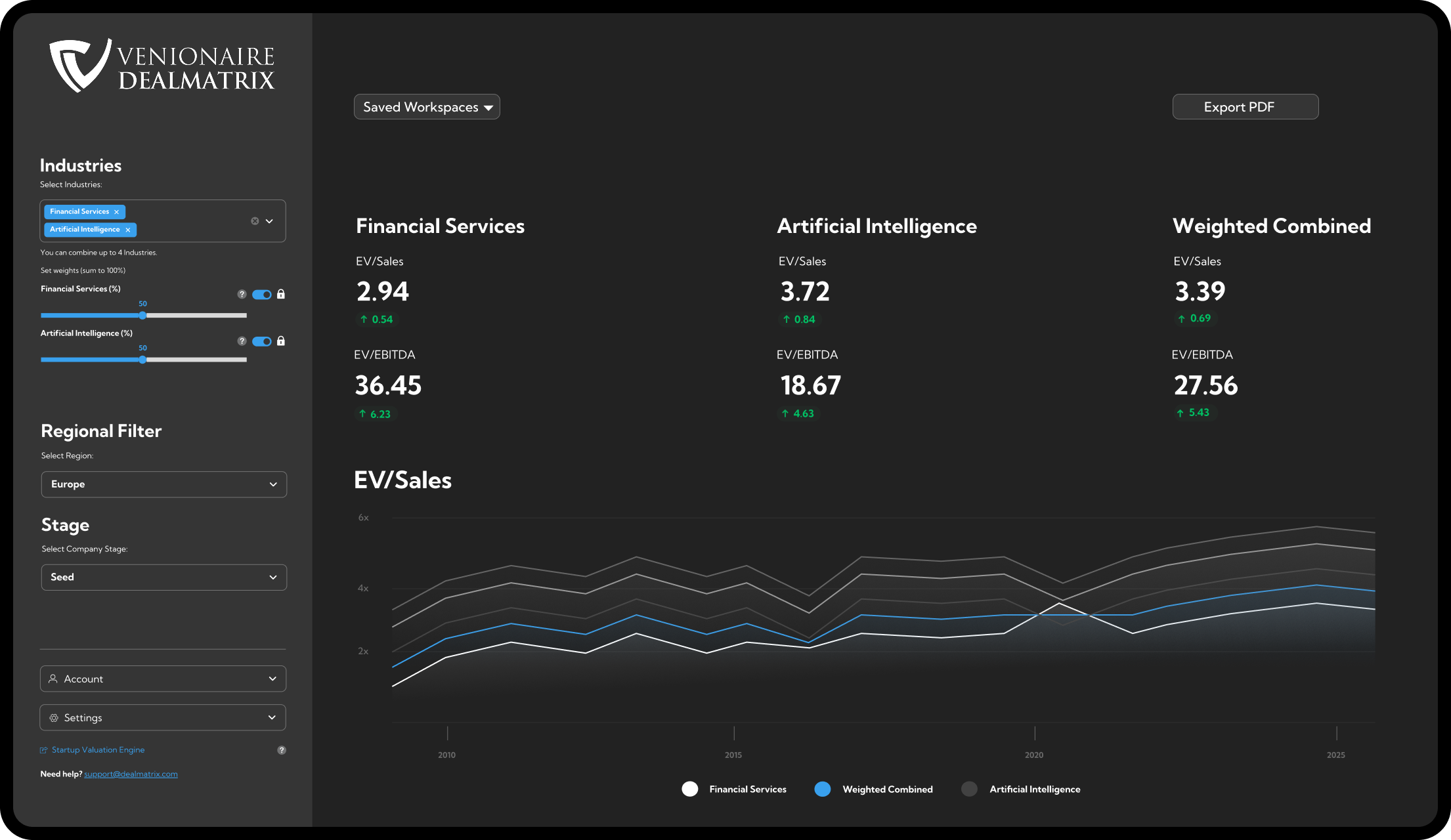
Venionaire DealMatrix, subsidiary of Venionaire Capital, has launched Venionaire DealMatrix Multiples, providing private-market EV/Sales and EV/EBITDA valuation multiples that can be explored by sector, stage, and region.

Venionaire-DealMatrix-Multiples-Mockup-2

Figure 1: Venionaire DealMatrix Multiples

The launch builds on Venionaire Capital’s long-standing activity across Venture Capital, Private Equity, and M&A, where valuation decisions are routinely made in environments characterized by limited transparency and high contextual dependency.


The challenge: valuation without a private-market framework

Across private markets, pricing decisions are still largely anchored in experience, precedent transactions, and public-market multiples. Not because these tools are ideal, but because there has been no widely available alternative designed specifically for private companies.

Private transactions are rarely disclosed, deal terms are negotiated bilaterally, and pricing varies significantly by sector, company stage, and geographic context. As a result, comparability is limited and valuation discussions often rely on narrative rather than a shared analytical foundation.


Why public-market multiples fall short

Public-market multiples became the default reference due to their availability and structure. However, they reflect a fundamentally different environment—one shaped by liquidity, scale, standardized reporting, and immediate exitability.

These characteristics rarely apply to private companies. Applying public multiples to private transactions therefore requires subjective adjustment, which introduces inconsistency when used systematically across deals.


Building a private-market methodology

Venionaire DealMatrix Multiples were developed to address this structural gap.

Instead of adapting public-market benchmarks, the methodology was built from the ground up around private-market characteristics. The result is a framework for calculating EV/Sales and EV/EBITDA multiples for private companies, structured by:

  • sector

  • company stage

  • geographic region

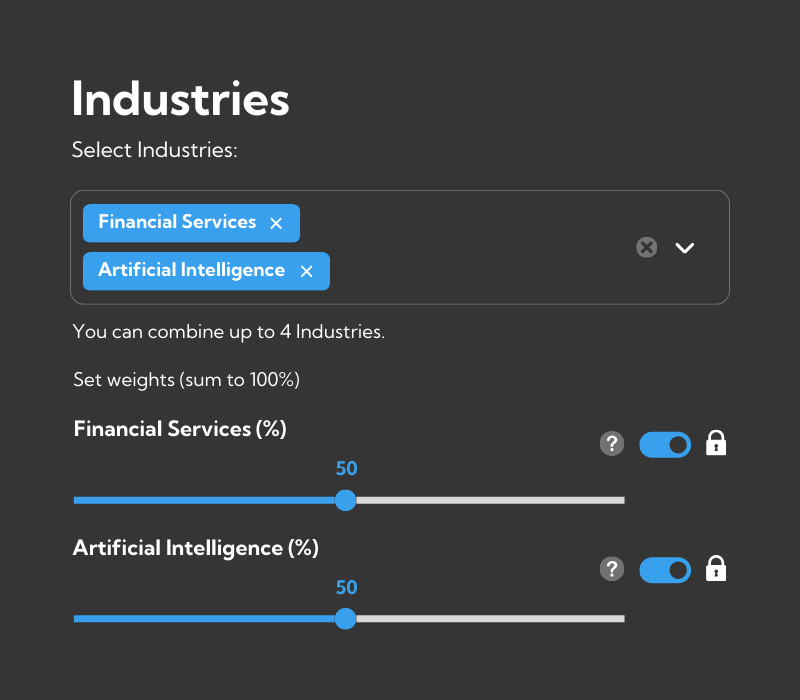
DealMatrix_Multiples_Industries

Figure 2: Industries Filter


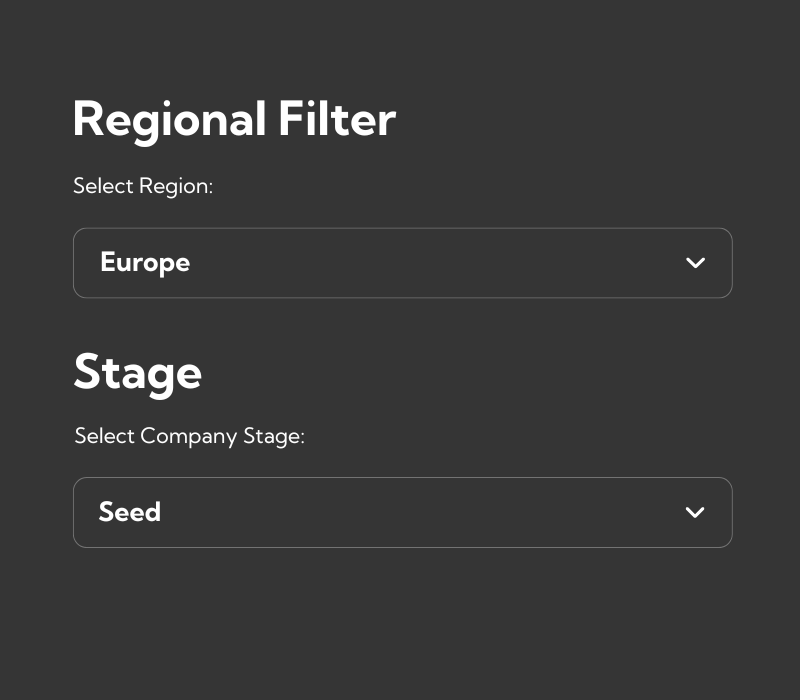
DealMatrix_Multiples_Region_Stage

Figure 3: Regional & Stage Filter


Public-market data serves as a starting point for peer-group identification, but is systematically contextualized using macroeconomic indicators and proprietary private-market datasets accumulated through Venionaire’s work in Venture Capital, Private Equity, and M&A.


Launching Venionaire DealMatrix Multiples

Venionaire DealMatrix Multiples are now live. They are designed to support valuation discussions, deal screening, and comparative analysis by providing structure where private markets have traditionally relied on fragmented benchmarks and individual experience.

To introduce the product, the DealMatrix team has prepared a short video demonstrating how the platform works and how private-market multiples can be explored in practice.

Venionaire Capital Market Outlook 2026: The Year of Selective Opportunity

With the Venionaire Capital Market Outlook 2026, Venionaire Capital provides a concise, cross-asset assessment of public markets, private markets, and digital assets. The report explains how macroeconomic forces shape risks and opportunities as fiscal policy extends the cycle and the margin for error narrows.

The global investment environment entering 2026 is not defined by recession, but by constraint. Growth continues, yet inflation remains persistent, interest rates stay structurally higher, and volatility becomes a permanent feature of markets.

Our central message is clear: the cycle continues, but the rules have changed.

The Five Structural Forces Shaping 2026

Against this backdrop, Venionaire Capital identifies five structural forces that will shape investment outcomes in 2026:

  1. The Macro Regime: From Policy Rates to the Term Premium

The main macro challenge in 2026 is not weak growth, but inflation that remains higher for longer. As growth continues, inflation pressure, especially in wages and services, can return.

Even without new rate hikes, higher real yields affect asset prices. Bond markets are now driven more by government issuance and inflation expectations than by central bank decisions.

Long-term assets are more sensitive to yields, and valuation discipline matters across all asset classes.

  1. Public Markets: Concentration Risk Meets Capex Reality

Stock markets are still dominated by a small number of AI-driven mega-cap companies. However, investors are shifting focus from growth and scale to capital efficiency, monetisation, and balance sheet strength.

High concentration and stretched valuations, especially in the U.S., increase the importance of relative value and diversification.

What matters more in this phase is not sheer market exposure, but the quality of earnings and underlying valuation levels.

  1. Private Markets: Recovery with a Liquidity Filter

Private equity and venture sentiment has improved, but capital remains selective. While the European Venture Sentiment Index stayed positive through 2025, rising confidence is translating into targeted investments rather than broad risk-taking. For 2026, the main constraint is realisation pathways.

Although exits are improving, liquidity remains uneven, especially for earlier-stage and mid-tier companies, increasing the relevance of secondaries, structured equity, and venture debt.

Successful private-market strategies focus on exit readiness, capital efficiency, realistic timelines, and active liquidity management rather than relying on a single IPO window.

  1. Regional VC Outlook: Leadership Broadens Beyond One Geography

Venture capital leadership is broadening beyond a single geography. North America remains the global center, but the focus shifts from funding growth to proving profitability and defensible business models.

Europe shows a cautious recovery with strong thematic depth, yet faces the challenge of scaling global champions. Latin America continues to stabilise, led by Brazil, while the Middle East expands through sovereign-backed ecosystems. In Asia, capital concentrates where regulation, execution, and infrastructure align.

Venture capital is becoming more regional and differentiated, making local market dynamics and exit pathways increasingly important.

  1. Crypto: From Narrative to Infrastructure

Crypto in 2026 is shifting from speculation toward real financial infrastructure. Stablecoins, tokenised real-world assets, institutional DeFi, AI-driven on-chain settlement, and broader access via ETFs and indices are driving adoption. As utility increases, opportunities expand, but regulatory execution and credibility remain the key risks. 
 
The opportunity set expands as crypto adoption shifts from speculation toward infrastructure, while regulatory execution and credibility risks remain the central challenges.

Venionaire Capital Market Outlook 2026: Bottom Line

The opportunity is real, but the game has changed.

2026 is not about chasing every opportunity, but about choosing carefully, understanding risks, and focusing on quality, realism, and structure.

Risk assets can grind higher, yet leadership is narrower, valuations matter more, and the discount rate is no longer a sideshow.

Investors who adapt to higher structural volatility and regime-driven rotations will be best positioned to navigate the year ahead.


Disclaimer 

This publication is issued by Venionaire Capital AG. All rights to the content of this document—including text, data, charts, tables, images, and design—are reserved. Any copying, redistribution, extraction, or other use (in whole or in part) is not permitted without the prior written approval of Venionaire Capital AG, unless explicitly allowed by mandatory law. The material isprovided for general information only. It is not prepared with regard to any individual’s investment objectives, financial situation, or particular needs, and it does not constitute investment research within the meaning of applicable regulations. While Venionaire Capital AG has prepared this publication with reasonable care and may refer to sources considered reliable, norepresentation or warranty is made as to the accuracy, completeness, or continued validity of the information. Views, estimates, and forward-looking statements reflect the situation at the time of writing and may change without notice. 

Nothing in this publication constitutes financial, investment, legal, tax, or accounting advice, nor should it be understood as an offer or solicitation to buy or sell any asset or instrument. This includes, without limitation, digital assets/crypto-assets, tokens, derivatives, or securities. Markets for digital assets may be volatile and involve significant risk, including the risk ofpartial or total loss. Past performance is not indicative of future results. Readers should make their own assessment and seek independent professional advice where appropriate. 

Venionaire Capital AG shall not be responsible for any loss or damage arising from the use of this publication or from reliance on any information contained herein, to the fullest extent permitted by law. 

© 2026 Venionaire Capital AG. All rights reserved. 

Venture Capital Outlook 2025: Recovery and Innovation

As we enter 2025, the venture capital (VC) landscape is poised for growth. After a challenging period, the VC market is showing signs of recovery, with increasing deployment and an emphasis on high-quality startups. This article explores the key trends and opportunities in venture capital for 2025. 

2024: A Year of Recovery 

In 2024, venture capital deployment grew by 20% year-over-year, driven by strong private equity returns, the end of cash runways set in 2022, and the maturation of high-quality startups. These elements have created a favorable environment for VC investment, signaling that the market is ready to accelerate. A thorough analysis of 2024 and its implications is available in the latest European Venture Sentiment Index (EVSI) Report, which our Analyst Team conducts quarterly. 

Rising Valuations 

Valuations in venture capital are continuing to climb, especially in the U.S., where AI-driven companies are leading the way. The dominance of artificial intelligence (AI) means that top-tier startups are commanding premium valuations. While this presents opportunities for investors, it also brings challenges, as higher valuations require careful evaluation to avoid overpaying for potential investments. 

The IPO Resurgence 

A key development for VC in 2025 is the expected resurgence of IPOs. After a dip in recent years, the U.S. IPO market is projected to bounce back, with PE-backed IPOs leading the way. Additionally, in a favorable scenario, as many as 20 unicorns—companies valued at over $1 billion—could go public, with a total valuation exceeding $117.5 billion. This offers VC investors the potential for significant liquidity events. 

Europe is also seeing a healthy pipeline of IPOs, which provides more exit opportunities for VC-backed companies. The return of IPOs could be a crucial strategy for VC firms to achieve substantial returns. 

Emerging Sectors: Key Areas for Investment 

As we look toward 2025, several sectors stand out for their growth potential. These industries are drawing substantial VC interest and are expected to see significant innovation. 

AI: Transforming Industries 

AI remains a dominant force in venture capital, reshaping industries such as healthcare, finance, and energy. In 2024, one-third of global VC dollars were invested in AI startups, showcasing the sector’s growing importance. In 2025, new AI technologies, particularly agent-based applications and generative AI, will unlock new opportunities, offering advanced solutions to complex problems in areas like law, medicine, and software development. The declining need for capital, as seen with Deepseek, will play a crucial role in 2025. As a result, AI model development becomes increasingly cost-effective. Companies like Q.ANT, a leading developer of photonic AI chips, are revolutionizing energy efficiency and reducing capital requirements in the AI sector.

For VC investors, focusing on companies that prioritize outcome-driven solutions over traditional software models will be key to capturing long-term growth. 

Life Sciences: A Hotbed for Innovation 

The life sciences sector is expected to see significant growth in 2025, driven by breakthroughs in biotechnology, genomics, and drug discovery. Moreover, AI is playing a critical role in accelerating drug development and improving healthcare outcomes. As more life sciences companies adopt AI technologies for drug discovery and diagnosis, the sector presents lucrative opportunities for VC investment. 

The convergence of AI and life sciences could lead to faster innovation and improved therapies, making this a vital area for venture capital firms to explore. 

Renewable Energy: The Future of Sustainability 

Renewable energy is a key focus for VC investment in 2025. With global clean energy goals, particularly in India and the EU, sectors like solar, wind, and geothermal are seeing increased funding. Geothermal energy is especially exciting due to its potential for reliable, scalable energy production. Circular economy is also a promising sector for 2025. Therefore, we at Venionaire are particularly excited about the EU InvestCEC project. We are responsible for setting up a circular economy alternative investment fund. InvestCEC will develop a replicable model for the initiation of circular economy projects in cities and regions, that will improve collaboration between entrepreneurs, investors and policy makers. The project will be tested in pilot city Klagenfurt am Wörthersee.

Additionally, energy storage technologies, such as battery innovations, are growing rapidly, with increased interest in clean hydrogen and sustainable aviation fuels. These sectors align with global sustainability goals and offer substantial opportunities for venture capital. 

Global VC Landscape: Emerging Markets 

Geographically, venture capital is expanding into emerging markets, particularly in Asia-Pacific. India is quickly becoming a major hub for VC, thanks to its growing middle class and thriving tech ecosystem. The country offers strong opportunities for startups in AI, fintech, and other high-growth sectors. 

In Europe, middle-market VC deals are on the rise, particularly in the EUR 100 million to EUR 5 billion range. This segment remains a core part of European venture capital, attracting increasing investor interest. 

A Dynamic Market Ahead 

Venture capital in 2025 is set for an exciting year, driven by rising valuations, a resurgence in IPO activity, and a strong focus on high-growth sectors like AI, life sciences, and renewable energy. While opportunities abound, VC firms will need to carefully navigate the landscape, balancing innovation and geographical diversification with prudent investment strategies. 

With an eye on these emerging trends and sectors, venture capital firms are well-positioned to thrive in 2025 and beyond. 

Listen to all the new trends and market developments in the first episode of Venionaire Insights:

WHERE TO FIND US

VIENNA, OFFICE (HQ)

Babenbergerstraße 9/12,
A-1010 Vienna, Austria (EU)
office@venionaire.com

SAN FRANCISCO, USA

1355 Market St. #488
San Francisco CA 94103
sfo@venionaire.com

NEW YORK CITY, USA

122 East 37th Street
First Floor
New York, NY 10016
nyc@venionaire.com

LONDON, UK

Gable House, 239 Regents Park Road
London N3 3LF
office@venionaire.com

Luxembourg, LUX

28, Boulevard F.W. Raiffeisen
2411 Luxembourg
office@venionaire.com

LOOKING FOR FUNDING?

FOR STARTUPS

Venionaire Capital exclusively invests through the European Super Angels Club, for more information and application please go to the website. We do not accept direct investment proposals via this website.