
Posts

From Cuts to Supply: How Duration Became the New Volatility

This article offers a focused insight into one of the core mechanisms shaping markets in 2026. The full Market Outlook 2026 provides the broader, integrated context across macro, public markets, private capital and digital assets.

For most of the past decade, fixed income lived inside one dominant story: central banks would eventually cut, yields would fall, and duration would behave. That framing no longer explains the world described in the Market Outlook 2026.

The key shift is stated plainly: “The defining fixed-income theme of 2026 is not where policy rates go next, but how markets price duration risk.”

In other words, the question is moving from direction to absorption – who holds duration, at what price, and with how much tolerance for volatility.

Not about cuts – about duration pricing.

Duration is back – and it is the volatility driver

Fixed income volatility is increasingly shaped by a different mix of forces than the simple “next central bank decision”. The drivers are bond supply, inflation compensation, and investor tolerance for duration.

This matters because those forces do not fade just because policy rates stop rising. When supply is heavy and inflation persistence remains a constraint, the long end can reprice even in an environment where growth still holds up.

From policy dominance to the supply channel

A central constraint on sentiment is inflation persistence. Inflation appears to have bottomed in 2025 at levels still meaningfully above pre-pandemic norms, with services and wages singled out as the areas to watch.

With inflation persistence as the backdrop, the market impact flows through a repricing of term premia, which lifts long-end yields and tightens financial conditions even without overt policy tightening.

That takes the market into a regime where the long end behaves less like a passive reflection of “future cuts” and more like a live referendum on credibility, inflation risk, and duration supply.

Curve pressure and the hurdle rate reset

The investment implication is explicit:

  • curve steepening pressure persists
  • long-duration complacency is penalised
  • higher risk-free yields raise the hurdle rate across assets

These are not abstract statements. They are a redefinition of what “risk” means in portfolios.

When the risk-free anchor is higher and less stable at the long end, the discount rate becomes a gatekeeper across markets – not only in rates, but in how equities, private assets, and growth narratives are priced.

Higher hurdle rates – more dispersion and selectivity across assets.

Why duration repricing spills into equities and private markets

The broader cross-asset setup is continued expansion with rate-driven pricing and rising selectivity.

In public equities, it describes a bifurcation – leadership concentrated in AI-centric mega-cap technology, with selective rotation elsewhere. The point here is not the equity story itself, but the rate story underneath it: when duration risk reprices, dispersion rises and the market becomes less forgiving of valuation stretch.

In private markets, the same constraint shows up through the cost of capital and the exit environment. The state of public markets feeds into private outcomes via discount rates, multiples, and the exit window.

The one question for 2026: who warehouses duration?

If you want one question that captures the shift, it is this:

Who is willing to hold long-duration exposure – and at what price – when supply, inflation compensation, and term premia are the active variables?

That question sits behind the macro framing of narrower margins for error and more structural volatility.

Signals to watch in 2026 – signals, not predictions

Mechanisms matter more than headlines:

  • Inflation persistence and its pathway into term premia and the long end.
  • The market’s capacity to absorb bond supply without higher inflation compensation.
  • Whether duration tolerance holds up when volatility resurfaces.
  • Whether curve dynamics remain a source of cross-asset repricing pressure.

Bottom line

In this framework, 2026 is not defined by a single “cut cycle” narrative. It is defined by how duration risk is priced in a world where supply and inflation compensation matter – and where that pricing sets the hurdle rate for everything else.

If you want the integrated view – how this supply-driven duration regime connects to global equities, private-market liquidity filters, regional capital cycles, and digital assets – the full Market Outlook 2026 is built to connect those dots.
Venionaire DealMatrix Multiples: Valuation Multiples Built for Private Markets

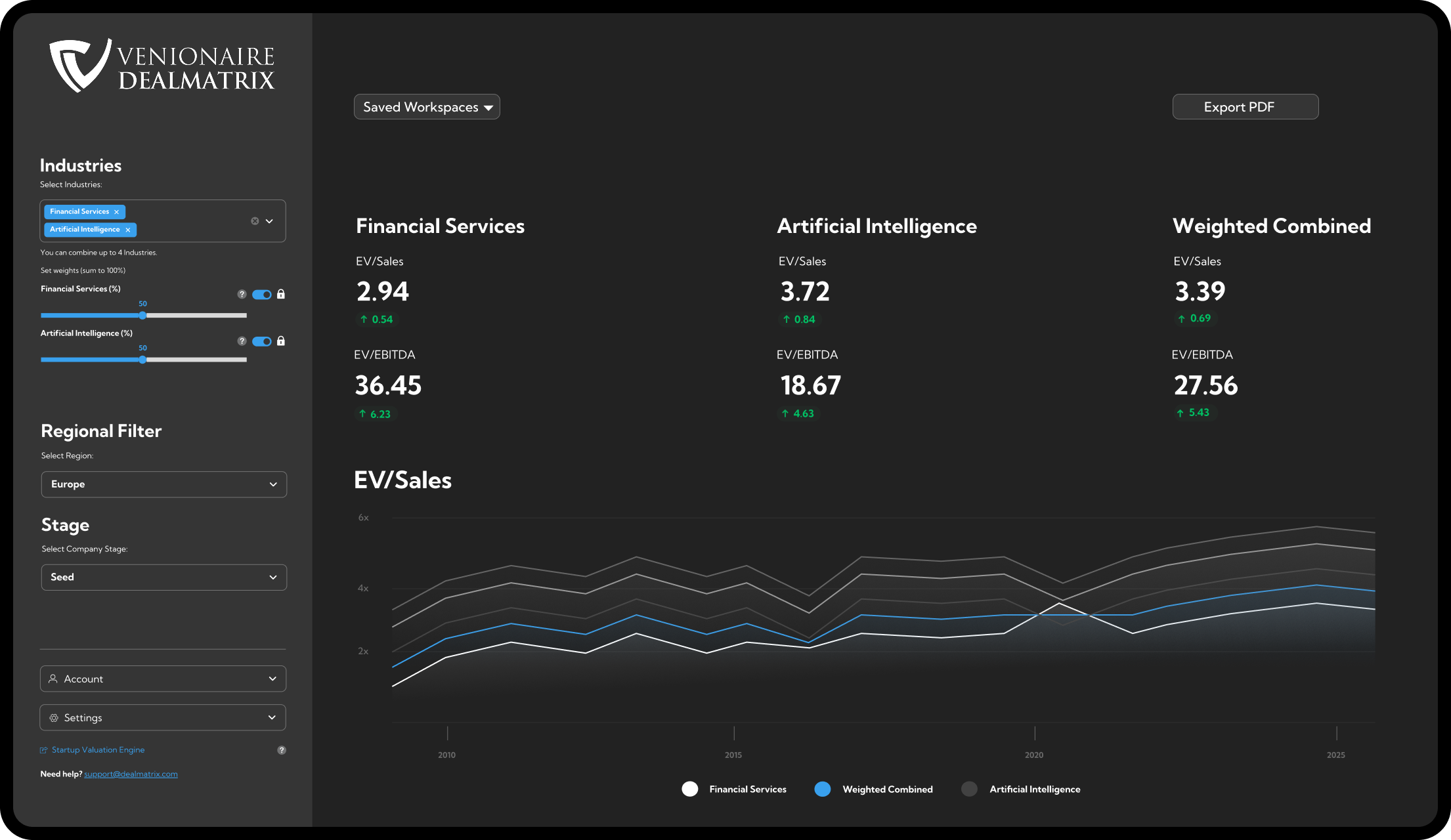
Venionaire DealMatrix, subsidiary of Venionaire Capital, has launched Venionaire DealMatrix Multiples, providing private-market EV/Sales and EV/EBITDA valuation multiples that can be explored by sector, stage, and region.

Venionaire-DealMatrix-Multiples-Mockup-2

Figure 1: Venionaire DealMatrix Multiples

The launch builds on Venionaire Capital’s long-standing activity across Venture Capital, Private Equity, and M&A, where valuation decisions are routinely made in environments characterized by limited transparency and high contextual dependency.


The challenge: valuation without a private-market framework

Across private markets, pricing decisions are still largely anchored in experience, precedent transactions, and public-market multiples. Not because these tools are ideal, but because there has been no widely available alternative designed specifically for private companies.

Private transactions are rarely disclosed, deal terms are negotiated bilaterally, and pricing varies significantly by sector, company stage, and geographic context. As a result, comparability is limited and valuation discussions often rely on narrative rather than a shared analytical foundation.


Why public-market multiples fall short

Public-market multiples became the default reference due to their availability and structure. However, they reflect a fundamentally different environment—one shaped by liquidity, scale, standardized reporting, and immediate exitability.

These characteristics rarely apply to private companies. Applying public multiples to private transactions therefore requires subjective adjustment, which introduces inconsistency when used systematically across deals.


Building a private-market methodology

Venionaire DealMatrix Multiples were developed to address this structural gap.

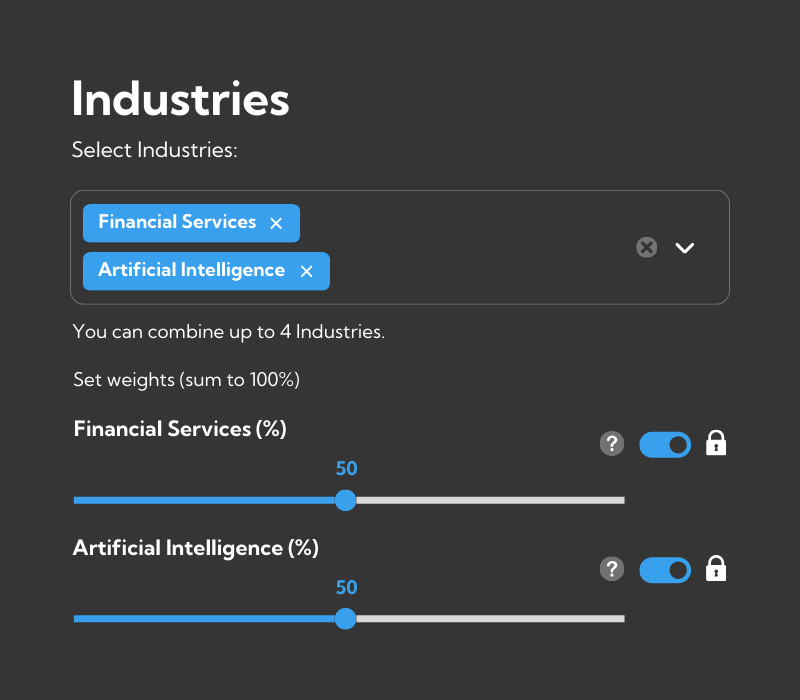
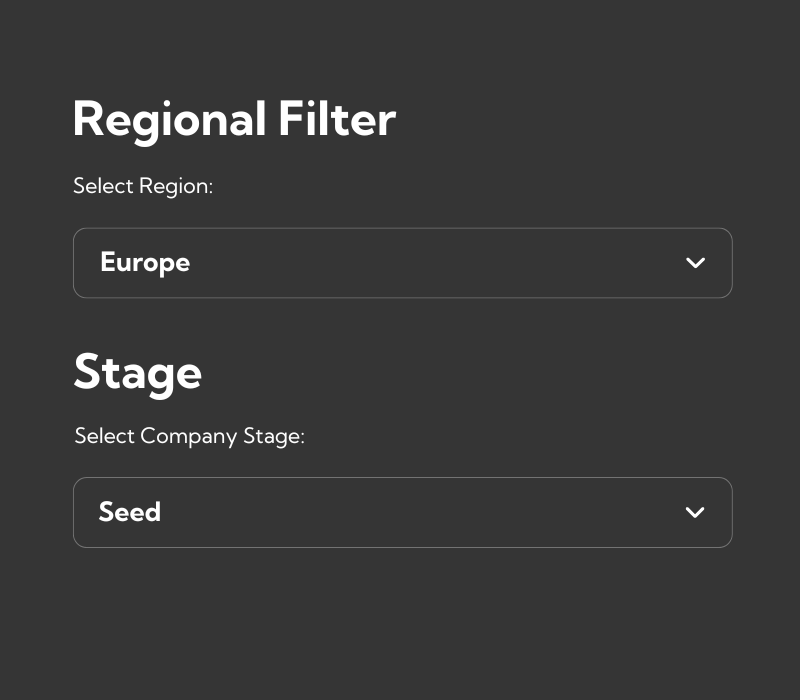
Instead of adapting public-market benchmarks, the methodology was built from the ground up around private-market characteristics. The result is a framework for calculating EV/Sales and EV/EBITDA multiples for private companies, structured by:

  • sector

  • company stage

  • geographic region

DealMatrix_Multiples_Industries

Figure 2: Industries Filter


DealMatrix_Multiples_Region_Stage

Figure 3: Regional & Stage Filter


Public-market data serves as a starting point for peer-group identification, but is systematically contextualized using macroeconomic indicators and proprietary private-market datasets accumulated through Venionaire’s work in Venture Capital, Private Equity, and M&A.


Launching Venionaire DealMatrix Multiples

Venionaire DealMatrix Multiples are now live. They are designed to support valuation discussions, deal screening, and comparative analysis by providing structure where private markets have traditionally relied on fragmented benchmarks and individual experience.

To introduce the product, the DealMatrix team has prepared a short video demonstrating how the platform works and how private-market multiples can be explored in practice.

Venionaire DealMatrix launches “Venionaire DealMatrix Multiples” – time series-based PE and VC valuation multiples filtered by sector, company phase, and region

Venionaire DealMatrix, a subsidiary of Venionaire Capital, announces the launch of Venionaire DealMatrix Multiples. The new product provides private equity and venture capital multiples (EV/Sales and EV/EBITDA) covering over 140 sectors, allowing granular filtering by company stage from pre-seed to Series E and global regions, and tracking their development over time.

The Discount-Rate Constraint: Why the Term Premium Became 2026’s Gatekeeper

This article offers a focused insight into one of the core mechanisms shaping markets in 2026. The full Market Outlook 2026 provides the broader, integrated context across macro, public markets, private capital and digital assets.

The Discount-Rate Constraint: Why the Term Premium Became 2026’s Gatekeeper

In 2026, markets can keep moving – and still become far more selective. The base case is continued expansion, but pricing is rate-driven; leadership broadens and selectivity rises across public and private markets.

One line captures the hinge point of the year: this is primarily a discount-rate problem, not an earnings problem.

2026 is a discount-rate year, not an earnings year

What “discount-rate problem” means in practice

Earnings do not “stop mattering.” What changes is the price investors are willing to pay for them when the cost of capital resets. With sticky inflation lifting term premia, the discount rate becomes the binding constraint.

Inflation persistence ? higher term premia ? higher long-end yields

A central constraint on sentiment is inflation persistence; inflation appears to have bottomed in 2025 at levels still meaningfully above pre-pandemic norms.

As growth firms into 2026, the balance of risks shifts from disinflation surprises to renewed upside pressure, particularly in services and wages. The knock-on effect is direct: inflation persistence feeds into higher term premia, which lift long-end yields and tighten financial conditions even without overt policy tightening.

This is not framed as a growth-scare dynamic. It is a discount-rate constraint – especially for duration-heavy, consensus-long segments (explicitly: AI, BioTech, CleanTech) that have little buffer against higher real yields.

From “cuts” to “supply”: why duration becomes the new volatility

The key rates-regime shift is stated plainly: “The defining fixed-income theme of 2026 is not where policy rates go next, but how markets price duration risk.”

As easing cycles stall and growth remains resilient, the baton passes from central banks to fiscal authorities. Volatility moves from “the next decision” to bond supply, inflation compensation, and investor tolerance for duration.

At the headline level, fixed income volatility increasingly reflects those forces rather than “simply the next central-bank decision.”

The implication is equally clear: curve steepening pressure persists, long-duration complacency is penalised, and higher risk-free yields raise the hurdle rate across assets.

The “buffer test”: why markets become less forgiving

The year becomes a buffer test: markets are increasingly less forgiving of narrative excess, valuation stretch, or policy missteps. Risk assets can grind higher, but leadership becomes more selective and volatility more structural rather than episodic.

At the top level, the setup is summarised as higher dispersion and a shift from broad beta exposure to selective leadership.

Concentration meets capex reality: the discipline phase of the AI cycle

Public equities are described as bifurcated between AI-centric mega-cap technology leaders and a selective rotation into European and industrial tech franchises.

The concentration and capex scale are quantified:

  • The Magnificent Seven accounted for 34–35% of the S&P 500 market cap in 2025.
  • Hyperscaler AI infrastructure spending is estimated around $400bn in 2025 (roughly +70% YoY) and forecast to exceed $500bn in 2026.
  • Part of the buildout is increasingly debt-financed, with major Big Tech issuers raising >$120bn in new debt in 2025 to support AI and cloud infrastructure.

Alongside those numbers sits the “phase shift”: the AI investment cycle is entering its next stage, where markets increasingly demand capital discipline, monetisation evidence, and capex efficiency – not just scale.

Selectivity is structural across public and private markets

Why this constraint cascades into private-market outcomes

The same gatekeeper shows up in private outcomes via three anchors: (i) the discount rate that anchors valuations, (ii) the multiples that reset private marks, and (iii) the state of the exit window (IPO and M&A confidence).

On exits, the pattern is explicit: not a smooth reopening, but episodic windows.

This connects directly to the private-market setup described as “recovery with a liquidity filter”: sentiment remains constructive but selective; improving sentiment pairs with targeted capital allocation rather than broad risk-taking; the key constraint is realisation pathways; and liquidity remains uneven – especially for mid-tier and earlier-stage companies – raising the importance of secondaries, structured equity, and venture debt as bridging tools.

Signals to watch in 2026 (signals, not predictions)

Watch mechanisms (not slogans):

  • Inflation persistence feeding into higher term premia and long-end yields.
  • Duration risk being priced through supply, inflation compensation, and duration tolerance.
  • Ongoing curve-steepening pressure and punishment of long-duration complacency.
  • Higher dispersion and a shift from beta to selective leadership.
  • A private-market recovery that stays constrained by liquidity and realisation pathways.
  • Exit windows that open in episodic bursts rather than staying continuously “open.”

A practical checklist for 2026 decision-making

The macro constraint translates into an operating playbook, including:

  • Underwrite duration honestly (assume exits can happen, but not “on schedule”).
  • Build exit readiness as an operating system (clean reporting, credible unit economics, cap-table/terms hygiene).
  • Use structure to create asymmetric outcomes, where downside protection can be more valuable than paying for upside multiple expansion.
  • Treat liquidity as a value-creation lever (secondaries, structured equity, selective venture debt as tools in 2026).

Bottom line

The base case is continued expansion – paired with a tighter pricing regime. In that world, the discount rate becomes the gatekeeper: it shapes valuations, filters leadership, and determines how forgiving the exit environment can be.

If you want the integrated view – how the discount-rate constraint connects to rates, equities, private-market liquidity, and regional dynamics – the full Market Outlook 2026 is built to connect those dots.
Venionaire Capital Market Outlook 2026: The Year of Selective Opportunity

With the Venionaire Capital Market Outlook 2026, Venionaire Capital provides a concise, cross-asset assessment of public markets, private markets, and digital assets. The report explains how macroeconomic forces shape risks and opportunities as fiscal policy extends the cycle and the margin for error narrows.

The global investment environment entering 2026 is not defined by recession, but by constraint. Growth continues, yet inflation remains persistent, interest rates stay structurally higher, and volatility becomes a permanent feature of markets.

Our central message is clear: the cycle continues, but the rules have changed.

The Five Structural Forces Shaping 2026

Against this backdrop, Venionaire Capital identifies five structural forces that will shape investment outcomes in 2026:

  1. The Macro Regime: From Policy Rates to the Term Premium

The main macro challenge in 2026 is not weak growth, but inflation that remains higher for longer. As growth continues, inflation pressure, especially in wages and services, can return.

Even without new rate hikes, higher real yields affect asset prices. Bond markets are now driven more by government issuance and inflation expectations than by central bank decisions.

Long-term assets are more sensitive to yields, and valuation discipline matters across all asset classes.

  1. Public Markets: Concentration Risk Meets Capex Reality

Stock markets are still dominated by a small number of AI-driven mega-cap companies. However, investors are shifting focus from growth and scale to capital efficiency, monetisation, and balance sheet strength.

High concentration and stretched valuations, especially in the U.S., increase the importance of relative value and diversification.

What matters more in this phase is not sheer market exposure, but the quality of earnings and underlying valuation levels.

  1. Private Markets: Recovery with a Liquidity Filter

Private equity and venture sentiment has improved, but capital remains selective. While the European Venture Sentiment Index stayed positive through 2025, rising confidence is translating into targeted investments rather than broad risk-taking. For 2026, the main constraint is realisation pathways.

Although exits are improving, liquidity remains uneven, especially for earlier-stage and mid-tier companies, increasing the relevance of secondaries, structured equity, and venture debt.

Successful private-market strategies focus on exit readiness, capital efficiency, realistic timelines, and active liquidity management rather than relying on a single IPO window.

  1. Regional VC Outlook: Leadership Broadens Beyond One Geography

Venture capital leadership is broadening beyond a single geography. North America remains the global center, but the focus shifts from funding growth to proving profitability and defensible business models.

Europe shows a cautious recovery with strong thematic depth, yet faces the challenge of scaling global champions. Latin America continues to stabilise, led by Brazil, while the Middle East expands through sovereign-backed ecosystems. In Asia, capital concentrates where regulation, execution, and infrastructure align.

Venture capital is becoming more regional and differentiated, making local market dynamics and exit pathways increasingly important.

  1. Crypto: From Narrative to Infrastructure

Crypto in 2026 is shifting from speculation toward real financial infrastructure. Stablecoins, tokenised real-world assets, institutional DeFi, AI-driven on-chain settlement, and broader access via ETFs and indices are driving adoption. As utility increases, opportunities expand, but regulatory execution and credibility remain the key risks. 
 
The opportunity set expands as crypto adoption shifts from speculation toward infrastructure, while regulatory execution and credibility risks remain the central challenges.

Venionaire Capital Market Outlook 2026: Bottom Line

The opportunity is real, but the game has changed.

2026 is not about chasing every opportunity, but about choosing carefully, understanding risks, and focusing on quality, realism, and structure.

Risk assets can grind higher, yet leadership is narrower, valuations matter more, and the discount rate is no longer a sideshow.

Investors who adapt to higher structural volatility and regime-driven rotations will be best positioned to navigate the year ahead.


Disclaimer 

This publication is issued by Venionaire Capital AG. All rights to the content of this document—including text, data, charts, tables, images, and design—are reserved. Any copying, redistribution, extraction, or other use (in whole or in part) is not permitted without the prior written approval of Venionaire Capital AG, unless explicitly allowed by mandatory law. The material isprovided for general information only. It is not prepared with regard to any individual’s investment objectives, financial situation, or particular needs, and it does not constitute investment research within the meaning of applicable regulations. While Venionaire Capital AG has prepared this publication with reasonable care and may refer to sources considered reliable, norepresentation or warranty is made as to the accuracy, completeness, or continued validity of the information. Views, estimates, and forward-looking statements reflect the situation at the time of writing and may change without notice. 

Nothing in this publication constitutes financial, investment, legal, tax, or accounting advice, nor should it be understood as an offer or solicitation to buy or sell any asset or instrument. This includes, without limitation, digital assets/crypto-assets, tokens, derivatives, or securities. Markets for digital assets may be volatile and involve significant risk, including the risk ofpartial or total loss. Past performance is not indicative of future results. Readers should make their own assessment and seek independent professional advice where appropriate. 

Venionaire Capital AG shall not be responsible for any loss or damage arising from the use of this publication or from reliance on any information contained herein, to the fullest extent permitted by law. 

© 2026 Venionaire Capital AG. All rights reserved. 

Venture Capital Outlook 2025: Recovery and Innovation

As we enter 2025, the venture capital (VC) landscape is poised for growth. After a challenging period, the VC market is showing signs of recovery, with increasing deployment and an emphasis on high-quality startups. This article explores the key trends and opportunities in venture capital for 2025. 

2024: A Year of Recovery 

In 2024, venture capital deployment grew by 20% year-over-year, driven by strong private equity returns, the end of cash runways set in 2022, and the maturation of high-quality startups. These elements have created a favorable environment for VC investment, signaling that the market is ready to accelerate. A thorough analysis of 2024 and its implications is available in the latest European Venture Sentiment Index (EVSI) Report, which our Analyst Team conducts quarterly. 

Rising Valuations 

Valuations in venture capital are continuing to climb, especially in the U.S., where AI-driven companies are leading the way. The dominance of artificial intelligence (AI) means that top-tier startups are commanding premium valuations. While this presents opportunities for investors, it also brings challenges, as higher valuations require careful evaluation to avoid overpaying for potential investments. 

The IPO Resurgence 

A key development for VC in 2025 is the expected resurgence of IPOs. After a dip in recent years, the U.S. IPO market is projected to bounce back, with PE-backed IPOs leading the way. Additionally, in a favorable scenario, as many as 20 unicorns—companies valued at over $1 billion—could go public, with a total valuation exceeding $117.5 billion. This offers VC investors the potential for significant liquidity events. 

Europe is also seeing a healthy pipeline of IPOs, which provides more exit opportunities for VC-backed companies. The return of IPOs could be a crucial strategy for VC firms to achieve substantial returns. 

Emerging Sectors: Key Areas for Investment 

As we look toward 2025, several sectors stand out for their growth potential. These industries are drawing substantial VC interest and are expected to see significant innovation. 

AI: Transforming Industries 

AI remains a dominant force in venture capital, reshaping industries such as healthcare, finance, and energy. In 2024, one-third of global VC dollars were invested in AI startups, showcasing the sector’s growing importance. In 2025, new AI technologies, particularly agent-based applications and generative AI, will unlock new opportunities, offering advanced solutions to complex problems in areas like law, medicine, and software development. The declining need for capital, as seen with Deepseek, will play a crucial role in 2025. As a result, AI model development becomes increasingly cost-effective. Companies like Q.ANT, a leading developer of photonic AI chips, are revolutionizing energy efficiency and reducing capital requirements in the AI sector.

For VC investors, focusing on companies that prioritize outcome-driven solutions over traditional software models will be key to capturing long-term growth. 

Life Sciences: A Hotbed for Innovation 

The life sciences sector is expected to see significant growth in 2025, driven by breakthroughs in biotechnology, genomics, and drug discovery. Moreover, AI is playing a critical role in accelerating drug development and improving healthcare outcomes. As more life sciences companies adopt AI technologies for drug discovery and diagnosis, the sector presents lucrative opportunities for VC investment. 

The convergence of AI and life sciences could lead to faster innovation and improved therapies, making this a vital area for venture capital firms to explore. 

Renewable Energy: The Future of Sustainability 

Renewable energy is a key focus for VC investment in 2025. With global clean energy goals, particularly in India and the EU, sectors like solar, wind, and geothermal are seeing increased funding. Geothermal energy is especially exciting due to its potential for reliable, scalable energy production. Circular economy is also a promising sector for 2025. Therefore, we at Venionaire are particularly excited about the EU InvestCEC project. We are responsible for setting up a circular economy alternative investment fund. InvestCEC will develop a replicable model for the initiation of circular economy projects in cities and regions, that will improve collaboration between entrepreneurs, investors and policy makers. The project will be tested in pilot city Klagenfurt am Wörthersee.

Additionally, energy storage technologies, such as battery innovations, are growing rapidly, with increased interest in clean hydrogen and sustainable aviation fuels. These sectors align with global sustainability goals and offer substantial opportunities for venture capital. 

Global VC Landscape: Emerging Markets 

Geographically, venture capital is expanding into emerging markets, particularly in Asia-Pacific. India is quickly becoming a major hub for VC, thanks to its growing middle class and thriving tech ecosystem. The country offers strong opportunities for startups in AI, fintech, and other high-growth sectors. 

In Europe, middle-market VC deals are on the rise, particularly in the EUR 100 million to EUR 5 billion range. This segment remains a core part of European venture capital, attracting increasing investor interest. 

A Dynamic Market Ahead 

Venture capital in 2025 is set for an exciting year, driven by rising valuations, a resurgence in IPO activity, and a strong focus on high-growth sectors like AI, life sciences, and renewable energy. While opportunities abound, VC firms will need to carefully navigate the landscape, balancing innovation and geographical diversification with prudent investment strategies. 

With an eye on these emerging trends and sectors, venture capital firms are well-positioned to thrive in 2025 and beyond. 

Listen to all the new trends and market developments in the first episode of Venionaire Insights:

How to Sell Like an American: Embracing Boldness in Marketing

Marketing strategies in Europe and the United States have historically followed different approaches. While both regions are home to incredible innovation, the cultural and strategic differences in marketing practices and how to sell are clear. Subsequently, European companies can learn from the bold, story-driven marketing style that has propelled many American brands to success. 

How to sell: A Cautious Approach vs. Bold Vision in Marketing 

Alexander Oswald, President of the Austrian Marketing Association, who brings over 30 years of marketing experience—including a decade spent at Nokia during its peak—points out that marketing in Europe tends to be more cautious. European companies often prioritize data, facts, and scientific approaches in their marketing strategies. While this data-driven style has its benefits, it can lead to a reluctance to take risks and to avoid bold, visionary marketing tactics. As a result, European companies sometimes struggle to connect emotionally with consumers and deliver impactful messages. 

In contrast, American marketing is defined by confidence and boldness. American companies are known for selling not just products, but stories, dreams, and ideas. This “bold vision” approach sets American marketing apart. Instead of focusing solely on technical details, American marketers prioritize creating emotional connections with their audiences. They focus on the possibilities, the future, and the experience of using their product or service. 

This difference is evident when comparing brands like Apple to many European counterparts. Apple doesn’t just sell a phone—they sell an experience, a lifestyle, a transformation. They create a sense of belonging to something innovative and powerful. While European brands often excel in technical quality, they sometimes struggle to create that same emotional resonance with their customers. 

The Power of Storytelling in Marketing 

One of the areas where European companies can learn from the American approach is storytelling. American marketing often revolves around creating a compelling narrative that captivates audiences emotionally. It’s not just about presenting facts or product features; it’s about making consumers feel something. This is where European marketing can improve. 

In the past, many European brands relied on straightforward, fact-based marketing. They would focus on details—such as product capabilities, comparisons to competitors, and market fit. While these aspects are important, they don’t always capture the imagination of consumers. 

On the other hand, American marketers excel at creating emotional stories. Whether it’s the thrill of innovation, the promise of improvement, or the sense of belonging to something greater, American brands tap into emotions that resonate deeply with their audience. By focusing on the “why” rather than just the “what,” American companies succeed in building passionate customer bases, not just transactions. 

How European Companies Can Improve Their Marketing 

To compete on a global scale, European companies need to embrace a shift toward more bold, visionary marketing strategies. Instead of focusing solely on product features and specifications, they should prioritize the experience their products or services offer. By highlighting the emotional benefits of their offerings, European brands can create stronger consumer connections and foster long-lasting relationships. 

A critical part of this transformation is adopting a more customer-centric approach. European companies need to think from the consumer’s perspective: What problem is being solved? What emotional need is being met? How can the brand inspire and engage the audience? 

A Call to Action for European Marketers 

In today’s competitive global market, it’s essential for European companies to evolve their marketing strategies. It’s not enough to just promote product features or focus on technical correctness. Companies must craft compelling stories that resonate emotionally with their customers. 

By adopting a bolder, more visionary marketing strategy—one that emphasizes storytelling and emotional engagement—European companies can unlock new growth opportunities. The key is to shift from merely selling products to selling experiences, dreams, and possibilities. 

As we’ve seen with American brands, successful marketing is not just about presenting facts. It’s about creating a story that captures the imagination and makes consumers feel part of something bigger. European companies that embrace this mindset shift will position themselves for greater success—leading with vision, passion, and emotional connection, rather than simply following data and numbers. 

To learn more about how European marketing can evolve and how storytelling plays a key role in this transformation, listen to our latest podcast episode with Alexander Oswald, where we dive deeper into these topics. 


AI Race – How Europe is trying to catch up

Artificial Intelligence (AI) is poised to be a defining force in the global economy for years to come. While the United States has taken a leading role in the AI race, and Chinese startup DeepSeek shook the industry by launching its R1 Large Language Model, Europe faces challenges in keeping pace. This disparity raises concerns about potential dependencies and competitiveness. 

The European AI Landscape 

Despite Europe’s rich pool of talent, esteemed research institutions, and a technology-friendly industrial base, the continent lags in AI investments. In 2023, private venture capitalists in the U.S. invested approximately €67 billion in AI development. On the contrary, Europe, including the UK, saw only €11 billion in similar investments. This significant gap suggests that without strategic interventions, Europe risks falling further behind, leading to increased dependency on external technologies. 

Recent Initiatives and Investments 

Recognizing these challenges, European leaders have initiated substantial investments to bolster the continent’s AI capabilities: 

The InvestAI Initiative: Launched by the European Commission, this initiative aims to mobilize €200 billion for AI investments across Europe. A portion of this fund is dedicated to establishing AI gigafactories. Furthermore, the factories specialize in training complex AI models, to enhance Europe’s infrastructure and competitiveness. 

National Commitments: France has unveiled plans to invest €109 billion in AI, focusing on infrastructure development and computing clusters. This move is designed to position Europe as a formidable player in the global AI race, currently dominated by the U.S. and China. 

In 2024, European AI companies raised nearly €3 billion through 137 deals, which is about 35% more than the year before. French companies took the top spot in terms of countries, securing over €1.3 billion across 14 deals (almost half of all AI investments in Europe in 2024). German companies followed in second place with €910.3 million raised over 23 deals, while the UK ranked third with €318.1 million raised over 33 deals. 

You can follow the latest AI deals with Venionaire DealMatrix’ Deals Monitor. 

The Role of Venionaire Capital 

At Venionaire Capital, we recognize the critical need for Europe to not only retain but also nurture its AI talent and enterprises. Our commitment is to support and invest in promising AI startups. Moreover, we are providing them with the necessary resources and guidance to thrive within Europe. By fostering innovation and facilitating access to capital, we aim to create an environment where AI companies can flourish, reducing the allure of relocation to more investment-rich regions. 

Europe stands at a crossroads in the AI sector. While challenges persist, the recent surge in investments and strategic initiatives offers a pathway to revitalizing Europe’s position in the global arena. Through collaborative efforts between governments, investors, and the tech community, Europe can lead in AI innovation and application. 

How a potential Trade War impacts European Venture Capital Markets

A Temporary Truce, but Uncertainty Remains 

Recent geopolitical developments have put the global economy on edge. President Donald Trump has agreed to pause the imposition of 25% tariffs on Canada and Mexico for 30 days, temporarily averting an economic showdown with its North American neighbors. Canada, in turn, has committed to reinforcing its border to curb migration and fentanyl trafficking, while Mexico has deployed troops to its northern border in exchange for the US limiting the flow of guns into Mexico. However, tensions remain high, as a 10% tariff on Chinese imports has taken effect, leading Beijing to retaliate with its own set of tariffs, including 15% on coal and liquefied natural gas and 10% on crude oil and agricultural machinery. 

While these developments primarily impact North America and China, they hold significant implications for Europe—particularly for European venture capital (VC) markets. If a trade war emerges, it could lead to investment shifts, supply chain realignments, and increased volatility, all of which could reshape how capital flows into European startups. 

How a Trade War Could Affect European VC Markets 

  1. Increased Investment Diversion to Europe

With escalating trade tensions between the US and its key partners, global investors may look to Europe as a more stable alternative. The European market’s relatively consistent trade policies could make it a preferred destination for capital that might otherwise have been allocated to North America or China.

  • European startups, particularly in technology, manufacturing, and consumer goods, could attract more funding as investors seek alternatives to US-China supply chains.
  • VC firms looking to hedge against North American volatility may shift their focus to promising European innovations.
  1. Supply Chain Realignment Could Benefit European Startups

Tariffs on North American and Chinese trade could push companies to reconfigure their supply chains, which would open new opportunities for European startups in logistics, automation, and alternative supply solutions.

  • Startups specializing in AI-driven logistics, nearshoring solutions, and supply chain automation may see increased demand.
  • Europe-based manufacturers and fintech firms facilitating alternative trade routes may benefit from the restructuring of global supply chains.
  1. More Expensive US Imports Could Favor European Competitors

Higher tariffs on US goods would increase costs for American exports, making European companies more competitive in global markets. This could create growth opportunities for European startups that compete with US firms in regions like Asia and Latin America.

  • European tech and consumer startups may gain market share as price-sensitive buyers opt for non-US alternatives.
  • Sectors such as renewable energy, automotive, and digital commerce could experience a surge in demand as US competitors struggle with tariff-driven price increases.
  1. Market Volatility and Risk Aversion

A worsening trade war could have destabilizing effects on the global economy. A 1.2% projected GDP hit in the UScould lead to investor caution, affecting capital flow into high-risk European startups.

  • Early-stage startups in high-risk sectors like deep tech and biotech could find it harder to raise funds.
  • However, risk-averse investors may prioritize resilient sectors such as AI, cybersecurity, and renewable energy, where Europe has strong market positioning.
  1. A Stronger Euro and New Trade Agreements

If trade tensions weaken the US dollar, the Euro could strengthen, boosting purchasing power for European startups. Additionally, new trade agreements within Europe could enhance market access and investor confidence.

  • European startups may find it easier to import resources and expand into regions previously dominated by US companies.
  • Trade realignments could redirect VC investment to sectors benefiting from Europe’s more stable trading environment.

The Bottom Line: A Mixed But Potentially Positive Outlook for European VC 

While a full-scale trade war remains uncertain, its effects on European venture capital markets could be a double-edged sword. On one hand, increased investment inflows, supply chain realignment, and European competitiveness could create a boom for startups and VC firms. On the other, market volatility and cautious investor sentiment could pose challenges, especially for high-risk sectors.

Ultimately, Europe has the potential to emerge as a relative winner, attracting capital from investors seeking stability and opportunities beyond US-China tensions. However, flexibility, adaptability, and strategic planningwill be key for VC firms navigating this evolving landscape.

Monkee and Biome Diagnostics Shine in Top Startup Ranking

Staying at the forefront of venture capital requires an eye for groundbreaking opportunities. Venionaire Capital and Venionaire Ventures S.à r.l., manager of the EXF Alpha S.C.S fund for the European Super Angels Club (ESAC), are excited to see two of the fund’s standout portfolio companies, Monkee and Biome Diagnostics, recognized as top Austrian startups for their innovation. Both were featured in the recent issue of trend, one of Austria’s leading business publications, showcasing their contributions to their respective fields. 

Monkee and Biome Diagnostics: Leading in Innovation 

Monkee, ranked 4th, is transforming personal finance with its “Save Now, Buy Later” platform that promotes healthy saving habits without relying on credit. Meanwhile, Biome Diagnostics, ranked 10th, is advancing personalized medicine with products like myBioma for gut health analysis and BiomeOne for predicting immunotherapy responses. Both startups exemplify impactful innovation in their respective markets and demonstrate the effectiveness of Venionaire Capital’s strategic investment approach. 

Insight into the Evaluation Process 

The list of the 150 most innovative companies in Austria represents a redefined view of the national business scene. Compiled by trend. in partnership with the German market research firm Statista, the process involved over 25,000 individual assessments. Moreover, the ranking featured the top 10 ATX companies, the 20 best international firms with Austrian subsidiaries, the 20 leading startups, and 100 other innovative businesses led by Alpla. 

Patents were an important criterion, but the assessment extended beyond that. The process included surveys of 9,000 employees and consultation with 400 innovation experts. 

The Final Scores 

A 40-member expert jury, comprised of seasoned business consultants, patent attorneys, and startup specialists, played a crucial role. Their evaluations held significant weight in the final scores. This jury provided invaluable insights into product and process innovation, as well as innovation culture, offering a comprehensive view beyond standard metrics. 

Venionaire Capital’s Focus on Growth and Innovation 

Venionaire Capital is dedicated to nurturing forward-thinking startups through the EXF Alpha S.C.S fund managed by Venionaire Ventures S.à r.l. The recognition of Monkee and Biome Diagnostics highlights the effectiveness of this strategy. Supporting companies that push boundaries reinforces Venionaire’s commitment to fostering progress in various industries. 

Acknowledgments like these emphasize the dedication of portfolio companies and the strategic acumen of Venionaire Capital. The firm looks forward to enabling more innovative solutions and creating value for its investors. 


WHERE TO FIND US

VIENNA, OFFICE (HQ)

Babenbergerstraße 9/12,
A-1010 Vienna, Austria (EU)
office@venionaire.com

SAN FRANCISCO, USA

1355 Market St. #488
San Francisco CA 94103
sfo@venionaire.com

NEW YORK CITY, USA

122 East 37th Street
First Floor
New York, NY 10016
nyc@venionaire.com

LONDON, UK

Gable House, 239 Regents Park Road
London N3 3LF
office@venionaire.com

MUNSBACH, LUX

3 rue Gabriel Lippmann
5365 Munsbach
office@venionaire.com

LOOKING FOR FUNDING?

FOR STARTUPS

Venionaire Capital exclusively invests through the European Super Angels Club, for more information and application please go to the website. We do not accept direct investment proposals via this website.