A Decade of Innovation & Digital Transformation: A Look at the Buzzwords and Developments

Over the past 10 years, the world has witnessed a rapid and transformative period of innovation and digital transformation. From groundbreaking technologies to disruptive business models, the last decade has brought forth a multitude of buzzwords and developments that have shaped industries across the globe. In this article, we will delve into some of the most significant advancements and highlight the key buzzwords that have emerged during this transformative period. 

Artificial Intelligence (AI) and Machine Learning

No discussion on digital transformation is complete without mentioning AI and machine learning. These technologies have revolutionized various industries, enabling computers to mimic human intelligence and learn from data. From chatbots and virtual assistants to predictive analytics and autonomous vehicles, AI and machine learning have become essential tools for businesses seeking to gain a competitive edge. 

Internet of Things (IoT)

The IoT refers to the network of physical devices, vehicles, appliances, and other objects embedded with sensors and software that enable them to connect and exchange data. Not only has this interconnectedness paved the way for smart homes, smart cities, and industrial automation. IoT has also played a crucial role in data collection, enabling businesses to gather valuable insights and optimize their operations. 

Cloud Computing

Cloud computing has transformed the way businesses operate and store data. With the ability to access and store data remotely, companies can reduce costs and enhance scalability. Moreover, Cloud-based services offer flexibility, security, and collaboration opportunities, allowing businesses to streamline their operations and focus on their core competencies. 

Big Data and Analytics

The exponential growth of data has given rise to the need for advanced analytics tools and techniques. Big data analytics leverages large datasets to uncover patterns, correlations, and trends, enabling businesses to make data-driven decisions. This has paved the way for personalized marketing, predictive maintenance, and enhanced customer experiences. 

Blockchain Technology

Blockchain technology burst onto the scene with the advent of cryptocurrencies like Bitcoin. However, its potential goes far beyond digital currencies. Blockchain offers a decentralized and transparent approach to record-keeping, enabling secure transactions, supply chain traceability, and smart contracts. Its impact spans industries such as finance, logistics, and healthcare. 

Augmented Reality (AR) and Virtual Reality (VR) 

 AR and VR have transformed the way we interact with digital content and the physical world. AR overlays digital information onto the real world, enhancing experiences in fields like gaming, retail, and education. VR, on the other hand, immerses users in a virtual environment, revolutionizing areas such as training, entertainment, and healthcare. 

The past decade has been a whirlwind of innovation and digital transformation, reshaping industries and revolutionizing the way we live and work. From AI and machine learning to IoT and blockchain, these developments have ushered in a new era of possibilities. As we reflect on the incredible journey of the last 10 years, it’s clear that these buzzwords and advancements will continue to mold the future, presenting both challenges and opportunities for businesses worldwide. Embracing and harnessing these technologies will be crucial for organizations aiming to thrive in an increasingly digital world. 

Join Us at the World Venture Forum 2024 in Kitzbühel 

To celebrate this remarkable decade of progress, exploration, and transformation, we invite you to join us at the 10-year anniversary of the World Venture Forum in 2024, set against the breathtaking backdrop of Kitzbühel. At this prestigious event, thought leaders, innovators, and visionaries from around the globe will gather to dive deeper into these groundbreaking topics, explore emerging trends, and chart the course for the next wave of innovation. Stay tuned for an unforgettable experience that will shape the future of business and technology. See you in Kitzbühel! 

Crypto Markets prepare for movements as SEC Ripple judgement comes closer

The ongoing legal battle between Ripple and the U.S. Securities and Exchange Commission (SEC) has been closely monitored by the cryptocurrency industry and our Tigris Web3 team. This lawsuit is significant because it could determine whether XRP is a security or not, which could have implications for other cryptocurrencies and the markets in general. In the latest development, Ripple has claimed that the SEC suffered a setback in the lawsuit. That could potentially lead to a favorable outcome for Ripple.

Dispute over XRP’s Security Status

Ripple has denied the SEC’s allegations that XRP is a security and has argued that it is a digital currency like Bitcoin and Ethereum. However, the SEC claims that Ripple raised $1.3 billion through unregistered sales of XRP, which is a significant amount. The outcome of this case could have far-reaching consequences for the cryptocurrency industry.

Potential Favorable Outcome for Ripple

Ripple’s claims that the SEC failed to convince the court to obtain internal documents from Ripple regarding XRP’s security status could be significant. The documents in question could provide evidence that Ripple acted in good faith and did not intentionally violate securities laws. This could potentially lead to a favorable outcome for Ripple in the lawsuit. Additionally, Ripple predicted that the summary judgment in the case would be delivered in 2023, which provides some clarity on the timeline for the legal battle. Some experts and advisors of our fund even see a judgment before July very realistic.

Implications for the Cryptocurrency Industry

If the judge rules in favor of Ripple in the summary judgment, it would establish legal precedent that XRP is not a security. This would be a significant win for the cryptocurrency industry as a whole, as it would provide greater clarity on the regulatory status of cryptocurrencies. It could also lead to increased adoption of XRP.

Uncertainty Remains

However, it is important to note that the outcome of the case is still uncertain. The judge could rule in favor of the SEC in the summary judgment, or the case could proceed to trial. Additionally, even if the judge rules in favor of Ripple, the SEC could still appeal the decision. It is likely that the legal battle between Ripple and the SEC will continue for some time. We cannot yet determine the ultimate outcome.

In conclusion, the legal battle between Ripple and the SEC is a significant development in the cryptocurrency industry. The outcome of this case could have implications for the global crypto industry and market. While Ripple’s latest claims could potentially have increased the chances for a more favourable outcome for the company, the situation remains completely uncertain as there are no official statements published yet. The industry – incl. our Tigris Web3 crypto fund management team – will be closely monitoring the case as it unfolds.

Layers Of Decentralization

In todays globalized world, centralized web2 players take an ever more important part in our lives. By using the data their users give away eagerly and with consent, they are able to influence which news we read online, which content we consume, which ads trick us into buying things we don’t really need and many other business models. The vision of a decentralized web3 challenges business models of data-driven internet giants. It aims to give back data ownership to individual users. Unfortunately, decentralization in itself does not only bring benefits to users. It also comes with a whole new set of challenges, risks and attack angles.

Exploiting a concept.

Decentralization is occasionally being used as a keyword or concept to cover up projects embedded within a global grey zone of anonymous “DAOs” that are trying to evade any form of legal responsibility for damaging and self-enriching behaviour, or to straight up exploit the lack of legislation to set up and commit fraud. Rug Pulls and deliberately installed backdoors to exploit, hack and steal users assets are unfortunately not an isolated instance in the world of crypto assets.

One of the most famous and blunt cases was the (claimed to be) “decentralized and trustless network” Squid Game Token. Claiming to be part of a bigger soon to be launched blockchain gaming application, it created an immense wave of hype. Even mainstream media fired it up, and eventually it ended up as a massive rug pull when user noticed there was no way to exit from the project and all of a sudden the liquidity pools were drained. But how can such a disaster happen with a “decentralized” and “DAO governed” project?

What is “Decentralization”?

The three main pillars of blockchain technology are immutability, transparency, and decentralization. Even though all of them are in the end equally important to the concept, the decentralization pillar is often misunderstood. Digital assets tend to be (if we count out certain outliers such as Tether or very early stage projects) decentralized. That simply means that a certain number of validators draw a blockchain consensus. That effectively eliminates “centralized” counterparty risk and exploitation by this centralized entity.

Despite most commonly known digital assets formally being decentralized, there are big differences in their level of decentralization. Decentralized Autonomous Organisations (DAOs) serve as a backbone for the decentralized economy. They receive a lot of attention in the sphere of decentralization and decentralized governance. Decentralized Autonomous Organisations have formed more or less naturally and gained attention as a response to very high counterparty risk in the poorly regulated and supervised digital asset ecosystem. A good example of counterparty risk that has caused a sizeable financial woe to investors is the recent case of FTX. In this case customer assets were either gambled away or seized in bankruptcy proceedings.

What the concept of DAO is trying to do differently is that it allows full transparency over the whole project. That includes treasury of foundations, staked assets, assets bonded in smart contracts, and self-custodianship over personal assets. You can interact with open and transparent protocols. You can also commit to changing and improving the product. However, the private keys remain under your control.

Centralization risk of Decentralized Autonomous Organizations

Even though DAOs are here to reduce counter-party risk and create trustless networks managed by an open and transparent governing body, sadly cases like Squid Game Token are still happening due to their close connection with the projects and the lack of decentralization at their core. Decentralized Autonomous Organizations function on a basis of vote proposals and voting to apply changes on the blockchain. The more assets an individual has staked, the more votes the individual has. As DAO functions on the Proof of Stake mechanism. One or a few stakeholders can highly centralize the voting power by making the whole protocol centralized in its core.

In case DAO governs the protocol, but de facto has highly centralized voting power on a single entity, the entity can run changes however they see fit. Liquidity pools can be drained, rewards can be locked, and tokenomics proposals can be rigged in the favor of the controlling group.

Not every ‘relatively centralized’ DAO intends to engage in fraudulent behavior

The main problem with a high level of decentralization is, besides the fragmented thus slower network, the cost to run the network. Decentralization requires a higher number of validators. They will need a financial incentive to run the hardware, as well as stake themselves or in delegated PoS attract (aka share financial incentives with) a significant sum of assets to become qualified validators. The cost is a primary reason why a lot of projects opt for a more centralized type of governance until the project gains sufficient traction and becomes self-sustaining with a larger number of validators. Once the project has sufficient traction and revenue generation, it is financially feasible to keep the high number of validators content and committed to the project.

The best alpha potential lies with early-stage projects. These projects tend to be more centralized due to limitations in sharing financial incentives with many validators. Therefore, filtering out good and harmful projects is crucial.

In the beginning of the project, high level decentralisation allows the team to fix the issues and add features far faster than it would otherwise while operating much leaner. But there is always this risk of things going in the wrong direction. The path between an “efficient” early stage, and centralization being too high of a risk can be very narrow.

The way one can reduce this specific potential risks is to perform a strict due diligence process. This process consists of deep research of numerous parts of the project. KYC of the team behind the project, genesis token supply distribution, governance functionality design, decentralization ramp up roadmap, tokenomics proposals, governance proposals, initial asset distribution plan, and many more. Anybody carrying out this type of DD could have easily avoided falling into a trap such as Squid Game Token.

Do you want to know more about our internal approach to research and how the fund operates and analyze? Hit us up!

Author: David Teufel

The promises of Web3: Decentralized finance & NFTS – exploring the future of internet

The promises of Web3: Decentralized finance & NFTS – exploring the future of internet

The Internet has undoubtedly come a long way since its inception. From static web pages to dynamic content, the evolution of the Internet has been remarkable. Right now, we are witnessing a new wave of innovation with the emergence of Web3. Web3 promises to revolutionize the way we interact with the Internet. In this blog article, Venionaire Capital’s Venture Partner and Internet Pioneer Peter Augustin will explain the differences between Web1, Web2 and its youngest sibling Web3 as well as the promises of the latter. 

We also have a video about the development from Web1 to Web3 with our AI educational video expert, Amanda Intelli:

Web1 and Web2: Back to the roots 

In Web1, websites were static, and the only information available was what the website owner provided. Thus it was more or less some kind of a digital business card online. There was no possibility for a two-way communication and users could not interact with the website or its content. With the rise of Web2 websites became more dynamic and operators could interact with users. Social Media platforms like Facebook or Twitter enabled user to like, comment and share content. Thanks to the “like button”, suddenly the internet became a more interactive space.  

However, Web2 has its limitations regarding digital property. Emails were not encrypted, and big data companies like Google could access and literally read our data without our consent. Of course, their motive was not spying on us like some kind of secret service, but because our lives are interesting for them from an advertising and marketing perspective. We have all experienced these re-marketing methods, haven’t we? You search for any product online and suddenly you see ads for this kind of product on every site you visit online. That can be kind of annoying.

For the user Web1 and especially Web2 means the loss of ownership of his data. This is, where Web3 comes in. 

Web3: The Promises and Potential of Cryptography 

The next logical step after Web1 and Web2 is Web3 and it promises to eliminate the limitation of its predecessors. Web3 is finally enabling digital ownership through using blockchain encryption technology, commonly known as “crypto” (short for “cryptography”). 

Cryptography is for sure not an invention of our century. It has been around for thousands of years and is based on mathematical principles. For a long time cryptography was used almost exclusively by secret services to communicate securely and safely. With the rise of Web1 and even more Web2, being online became an eventually almost permanent status. The internet found its way into every household and every smartphone. This development finally created the need for public E2EE (end-to-end encryption) and decentralized networks, thus creating an environment in which digital property can be owned, traded and most important protected. Nonetheless, the responsibility for secure storage of the “private key” that grants access to all digital assets lies in the hands of the data owners. Unquestionably they must handle it like their valuables or important documents in a secure location.

Innovations in Web3 Technology: NFTs and Smart Contracts

Bitcoin is well known to the wider public, and also NFTs are a popular example of how Web3 technology can be used. Remember the previous example about Google having access to our emails? One way to keep your emails away from Google’s goggles (pun intended!) would be converting your emails into NFTs. So every single email is a NFT, a non-fungible token that could be stored on decentralized cloud services. 

Another innovation based on Web3 are smart contracts. They have evolved from other projects, like Ethereum. Smart contracts are digital contracts that are processed between participants on the blockchain. One business area that smart contracts have enabled is called “decentralized finance” (DeFi). This is like a digital bank that processes contracts through blockchain technology rather than human processors. The customers use their wallets to interact with this digital bank.  

Challenges of Web3 

The biggest challenge in Web3 will be to make the user experience as simple as possible and the handling as similar as possible to its predecessors. At the same time, it is crucial to highlight the users’ responsibility that comes with holding digital property. Losing your private key (or the seed phrase that you need to recover it), you might lose access to data without any possibility to recover it. Likewise, the use of smart contracts or DeFi is only recommended after thorough code audits. As contracts are binding, they have to be checked before they are concluded – and in Web3 and Smart Contracts “Code is Law”. 

The future of Web3 

Web3 will not only create new professions like custodians, whose responsibility will be to keep private keys safe or code auditors, who check smart contracts for fraudulent content or errors. It has the potential to disrupt industries like banking, insurance and notary services. Real estate transactions could be completely represented on the blockchain using NFTs and Defi and even government agencies might shift use cases to the blockchain. The possibilities are almost endless. 

In Conclusion 

Web3 promises to revolutionize the way we interact with the Internet. Encryption technology enables secure ownership of digital property, and smart contracts enable new business opportunities. However, it is essential to understand the responsibilities that come with holding digital property and to ensure thorough code audits before entering into smart contracts or DeFi. With Web3, new professions will emerge, and industries will be disrupted. The future of the Internet is exciting, and Web3 is at the forefront of this revolution. 

How the Silvergate and Silicon Valley Bank Insolvency effects crypto

Our analyst and fund management team of Tigris Web3 – Austrian Crypto Fund, managed by Venionaire Investment GmbH – are currently monitoring the market situation. They are of course evaluating possible scenarios for following developments. Most important for our investors and clients, Tigris Web3 has had zero exposure in stablecoins, and no exposure to Silvergate or Silicon Valley Bank. The funds strategy is to reduce counter party risk through usage and investment in decentralized projects. This excludes the investment or cooperation with centralized entities like crypto banks, stablecoin issuers and centralised exchanges. The following article gives a wrap up and analytical interpretation of how the current situation might unfold.

What happened so far?

On the 10th of March, the 18th largest US bank by nominal deposit amount, Silicon Valley Bank, has become insolvent. Thus it ended up in FDIC receivership.

The bank became insolvent due to the inherent nature of the current banking system – the fractional reserve system. A fractional reserve system allows banks to not have full treasury backing, but can mark-to-market their reserves, which in the case of a bank run, makes the bank insolvent. Essentially and summed up to the highest level, this is what SVB faced in the second week of march.

Spillover into crypto markets

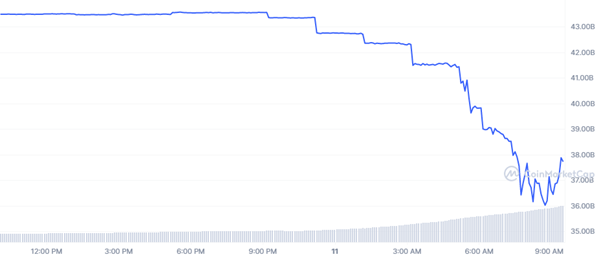
The insolvency of the bank has heavily hit Circle, the company behind the 2nd biggest stablecoin, USDC. USDC, which is fully backed by US Dollar, had 3.3 billion USD worth of collateral on the accounts of the bank. Even though 3.3 billion USD is shy of 8% of the total market capitalization of USDC, the price of the stablecoin, which is supposed to be as the name indicate – stable at 1 USD, started dropping overnight. The insolvency and liquidation of Silvergate earlier this week, a bank heavily involved in crypto markets, who was also a partner of Circle, is adding fuel to the fire.


Figure 1. USDC Market cap (1D Chart) source: coinmarketcap.com

The potential amounts lost on Silvergate are currently unknown. This led to the beginning of a bank run on USDC, with lots of crypto market participants swapping into other stablecoins, large cap crypto currencies or Fiat USD. Naturally, this caused the USDC depeg which at this time is larger than the estimated (potential) gap of collateral caused by the Silicon Valley Bank insolvency.

Another stablecoin project, DAI, has also disconnected in the wake of the scandal. Even though DAI had no exposure to the bank directly, 50% of DAI reserves are backed by USDC as collateral.

Systemic TradFi risks in crypto markets

The irony of this case lies in the fact that theoretically flaws of the traditional finance economy rarely affect crypto projects, as one of their inherent ideological pillar is to create a better, fairer and more resistant system. This case is unique though. The cause of the drop is a systematic counter-party risk. There is no inherent crypto market flaw or fraud at play. One can not blame Circle, as Circle is the most transparent and audited-on-point stable-currency provider. Even Silicon Valley Bank itself can at this point and with the information available so far not been held fully responsible either. Bank runs can happen. In this cause triggered through supposedly poor communication and unlucky timing. Even though their reserves were as conservative as possible, they still tumbled into insolvency due to fractional reserve policy installed by the FED.

Regulatory repercussions

One likely outcome is an even tighter and stronger accelerated approach to the regulation of stablecoins by financial market authorities and central banks – with the ultimate peak of this process being the eventual issuance of CBDCs. Although not very likely, we might even see the FED stepping in in some way in the next days, potentially even taking control of Circle. The meltdown of Luna and UST, and most recently the collapse and alleged fraudulent nature of FTX already previously enforced this step from a regulator’s point of view. Many crypto market participants see this very sceptical due to ideological resons. But increased regulatory security with fully regulated and safe stablecoins creating the ultimate smooth Fiat on- and offramp and DeFi backbone could be one of the necessary triggers for broad adoption of the technology.

Tigris Web3 analysis

Situations like the one with Silicon Valley Bank and Circle enforce our view for the need for decentralized and fully transparent solutions which mitigate counterparty risk. That is one of the main pillars in the investment thesis behind Tigris Web3, a Web3 focused fund managed by Venionaire Investment. Overall we see very low systemic risk at this point for both the portfolio assets and broader thesis of the fund. Circle hast very strong institutional backing. There is too much at stake (both financially and in trustworthiness) compared to what the actual financial damage through the insolvency of Silicon Valley Bank might be. Tigris Web3 is neither invested in USDC, DAI or any other stable coin. Also, we have no funds or accounts with Silicon Valley Bank or Silvergate. If you want to learn more about Tigris Web3, our portfolio assets and projects and investment thesis reach out to david@venionaire.com

Disclaimer

As this situation is currently unfolding, the parties involved are releasing new data and insights on an ongoing basis. This article only reflects the interpretation and knowledge based on information available until 11th March 2023, 10:30am CET. This is no financial advice. Investing in crypto assets is of the highest risk and can lead to a total loss of funds invested.


Authors: David Teufel & Ivo Pernar

Samurai of Tech

A brief historical digression

A Japanese samurai was once a loyal servant and protector, an imperial guard, a warrior with a strict code of honor. They lived according to the “Hagakure”, which contains about 1,300 lessons and dealt with both daily life and the relationship between lord and follower. The traditional warrior nobility of the samurai experienced its heyday in the 11th and 12th centuries A.D. The samurai, originally in the service of the emperor and nobility, became the ruling class of society with the rise of the shogunate and the establishment of a military aristocracy. The demise of the samurai 150 years ago also represents the rise of modern Japan. However, the myth and fascination with these warriors still exists today far beyond the borders of their homeland.

Between past and future

Japan is a country of (supposed) contrasts, performing a daily balancing act between tradition and modernity. While moving between centuries-old shrines and the most modern high-rise architecture, between traditional teahouses and eccentric maid cafés, and yet, despite the apparent contradictions, you can easily find a way between the centuries.

Let’s draw mental parallels and dare this balancing act for our business. Today, our “servants” are our digital or high-tech companions. From artificial intelligence, robots and drones to countless apps, that now make every facet of our daily lives easier. In Japan, you will find a large number of world leading corporations. They almost naturally have large powerful corporate venture vehicles. The few investment banks, some of which manage over 100 corporate venture funds, could be described as shoguns (rulers) in the ecosystem. Perfection is a social and cultural requirement, and this is achieved by specialists. Accordingly, these funds are often managed externally by specialists.

Behind the scenes

Japan’s technology giants are global players, but in Japan itself they like to keep to themselves. To this day, there are hardly any non-Japanese top managers, and the global subsidiaries’ leadership always contain Japanese managers. English as a foreign language is a matter of course for the educated Japanese, but they prefer to do business  in their mother tongue. It is therefore advisable for Western business people to be able to speak at least a few bars.

If we stick to our mental balancing act, these technology giants are the modern samurai of their industries. The innovative leadership of these “Samurai of Tech” goes far beyond Asia. They invest, develop spin-offs together with research institutes and have a strong presence in the international “super hubs” of the startup scene – for example in Israel, Silicon Valley or India. For the corporations, close ties with global startup hubs seem not only practicable, but actually extremely important in terms of their claim to long-term honourable cooperation with innovators. A good reputation ensures access to the best talent and thus the samurai’s superiority in the innovation race.

How to deal with crisis

Right now Europe is just learning to deal with the next and arguably most severe crisis in recent history. Japan has meanwhile perfected living in the crisis. Interest rates are still negative, inflation is not a major issue, the domestic market is strong and the country’s international position is excellent. Japanese are strategists, so it’s not surprising that the appetite for risk to increase activity in Europe – especially venture capital and Web3 – is growing strongly.

In Europe, however, Japanese corporations and corporate venture vehicles are currently hardly present. The European market is considered attractive, but unfortunately also very complex. Various hubs, regional cultural differences, many languages and different laws (depending on the region) in Europe are understandably deterrent. Those who want to be successful therefore ally themselves with strong partners – although this requires some patience. Strong partnerships are based on trust and building this trust does not work overnight.

Building Bridges between Japan and Austria

Venionaire Capital has very good experiences in working with Japanese co-investors and business partners. Attending the City Tech Tokyo Conference and speaking at an official Deloitte side event has greatly strengthened our bi-directional relationship. We are looking forward to a strong delegation from Japan attending the World Venture Forum in Kitzbühel.

You have questions regarding the Japanese market, or would like to find a strong partner for corporate venture funds (full service), or as a scale-up to enter the European market? Please contact our Advisory Team, led by our Managing Partner, Berthold Baurek-Karlic.

Investing Into The Future

Our Venture Partner Peter Augustin and our Investment Director David Teufel in an interview at New Business about the first Austrian crypto fund “Tigris Web3”.

Crypto Trends 2023

As the year comes to an end Venionaire’s Investment Director David Teufel summarised the crypto trends for 2023.

EU Regulations: DAC7 Implementation and its implications for platform operators

The constant expansion of the digital economy leads automatically to legal changes and adjustments. The 6th Amendment to the EU Mutual Assistance Directive, also known as DAC7, is a significant development in the effort to improve tax transparency and compliance in the digital economy.

Tear down the borders – About european cross-border digital signature legislation

Professional investment vehicles’ management teams are confronted with the need to sign a variety of legal documents on at least a weekly (if not daily) basis. Knowing this administrative necessity ourselves (and knowing about all the different business models out there having to do the same), we took the time to dive into the current state of digitization of signatures – and ended up investing in one company tackling this vertical.

WHERE TO FIND US

VIENNA, OFFICE (HQ)

Babenbergerstraße 9/12,
A-1010 Vienna, Austria (EU)
office@venionaire.com

SAN FRANCISCO, USA

1355 Market St. #488
San Francisco CA 94103
sfo@venionaire.com

NEW YORK CITY, USA

122 East 37th Street
First Floor
New York, NY 10016
nyc@venionaire.com

LONDON, UK

Gable House, 239 Regents Park Road
London N3 3LF
office@venionaire.com

MUNSBACH, LUX

3 rue Gabriel Lippmann
5365 Munsbach
office@venionaire.com

LOOKING FOR FUNDING?

FOR STARTUPS

Venionaire Capital exclusively invests through the European Super Angels Club, for more information and application please go to the website. We do not accept direct investment proposals via this website.