CRYPTO INSIGHTS #3 – The Anticipated Impact of Bitcoin Halving 2024 and its Tigris Web3 Crypto Fund

Get ready for the upcoming Bitcoin Halving, expected on Wednesday, April 17, 2024, marking its fourth iteration since Bitcoin’s inception. With the block height set at 840,000, this event will witness a reduction in the block reward from 6.25 to 3.125 Bitcoin per validated block. The implications of this event on the crypto market as a whole, as well as on Venionaire’s crypto fund, “Tigris Web3,” are of great interest to analysts and enthusiasts alike.  


Crypto Market Impact 

Throughout history, Bitcoin Halving events have triggered significant shifts in for the crypto world, tweakening Bitcoin’s supply and demand dynamics. The reduction in block rewards slows the creation of new Bitcoins, potentially driving up the value of existing Bitcoins due to increased scarcity. Previous halvings created a bullish sentiment in the market, with Bitcoin’s price experiencing notable increases following previous halving events. 


Analyst Expectations 

Analysts hold diverse views on the 2024 Bitcoin Halving. Optimists believe that the reduced block reward will lead to a supply shock, driving up the price of Bitcoin. Historical data supports this view, as previous halving events have resulted in significant price rallies. Following this logic, Venionaire’s analysts expect strong upwards BTC price movements in 2024 up to a new all-time high. There are counter arguments as well – we’d like to mention that pessimistic analysts fear that the market has already priced in the halving event, potentially limiting its immediate impact on Bitcoin’s price. 


Nonetheless, the consensus among analysts is that the long-term impact of the halving will be positive, solidifying Bitcoin’s position as a store of value and further growing interest from both private, as well as institutional investors. 


Implications for Tigris Web3 

As an active player in the crypto investment landscape, Venionaire is well-positioned to leverage the potential opportunities presented by the upcoming Bitcoin Halving. Our crypto fund „Tigris Web3” with its focus on web3 & DeFi blockchain technologies eyes benefits from the increased interest and potential price appreciation of Bitcoin and other price correlated assets. The increased attention for web3 and Blockchain driven by the halving and potentially the long-awaited Bitcoin ETF by Blackrock, will boost the whole sector and let us expect sectore-wide growth. 


Venionaire’s Tigris Web3 Crypto Fund, recently set a new high watermark boasting a YTD 2023 performance (since 01.01.2023) exceeding +80%. Forecasts suggest further significant growth driven by these market dynamics. Management expects to attract both existing and new investors who recognize the significance of the Bitcoin Halving, the momentum of the Bitcoin ETF, and its potential impact on the crypto market. By strategically managing its portfolio and capitalizing on market trends, Venionaire strives hard to provide investors with lucrative returns while navigating the evolving the web3 and crypto landscape. 


The Bitcoin Halving 2024 is expected to have a profound impact on the crypto market. While the specific price movements remain uncertain, historical precedents and analyst expectations point towards positive effects for Bitcoin and the overall crypto market. Venionaire Capital’s Tigris Web3 Crypto Fund strategically positions itself to seize the opportunities arising by the halving, attracting investors who seek exposure to the potential benefits of this significant event. As the crypto market further evolves, Venionaire’s expertise and strategic approach will play a crucial role in navigating the changing dynamics of the industry. 

COMPLIANCE & GOVERNANCE INSIGHTS #1 – Unlocking Sustainable Finance: Demystifying the SFDR Framework

In the world of finance, keeping up with regulations and acronyms is a big task. One such acronym that has been making waves in the European financial landscape is SFDR, short for the Sustainable Finance Disclosure Regulation. But what exactly is SFDR, and why should you care about it? In this article, we’ll give you a comprehensive overview of the world of SFDR. To be specific, we focus on its objectives, its impact, and the challenges it presents to financial institutions.  

We also have a video about the SFDR Framework, in which Amanda Intelli, AI Video Assistant at Venionaire Capital, is explaining its relevancy to financial institutions:


SFDR: The Pillar of Sustainable Finance 

The Sustainable Finance Disclosure Regulation (SFDR) is a central component of the EU Sustainable Finance Package, forming one of the ten essential actions outlined in the EU’s Sustainable Finance Action Plan. Alongside regulations like Taxonomy Regulation, EU Benchmark Regulation, EU Ecolabel Regulation, and Corporate Sustainability Reporting Directive, SFDR plays a crucial role in reshaping the financial landscape. 


Who Does SFDR Affect? 

The reach of SFDR extends to all financial market participants and financial advisors within the EU. Even financial entities based outside the EU that market their products to EU clients are subject to its provisions. This includes banks, asset managers, insurers, reinsurers, and a wide range of investment products, such as alternative investment funds (AIFs), undertakings in collective investment in transferable securities (UCITs), and insurance-based investments. 


The Ambitious Goals of SFDR 

SFDR is driven by a set of ambitious objectives that include: 

  1. Reorienting Capital Flows: The regulation aims to redirect capital flows towards sustainable investments, facilitating sustainable and inclusive economic growth.
  2. Managing Financial Risks: SFDR seeks to address financial risks stemming from climate change, resource depletion, environmental degradation, and social issues. By doing so, it enhances the resilience of financial markets.
  3. Fostering Transparency: It promotes transparency and long-term thinking in financial and economic activities, aligning them with sustainability goals. 


SFDR’s Impact on Financial Product Classification 

Under SFDR, financial products are classified into three categories: 

  1. Article 6 Strategies: These strategies either integrate ESG (Environmental, Social, and Governance) risk considerations into their investment decisions or explain why sustainability risk is not relevant. They do not meet the additional criteria of Article 8 or Article 9.
     
  2. Article 8 Strategies (Light Green): These strategies promote environmental and/or social characteristics and may invest in sustainable investments but sustainable investing is not their core objective.

  3. Article 9 Strategies (Dark Green): These strategies have a primary objective of sustainable investment. 


Peeling Back the Layers: Levels of Disclosure 

The EU SFDR introduces three distinct levels of disclosure for investment products concerning ESG considerations and sustainable investing: 

  • Article 6 Products: They must disclose how sustainability risks are integrated into their investment decisions and also assess the potential impacts of sustainability risks on financial product returns. 
  • Article 8 and Article 9 Products: These categories provide in-depth details on various sustainability and ESG topics, enabling investors to make informed decisions. 
  • Principal Adverse Indicators (PAI) Statement: Shedding Light on Impact 


A Principal Adverse Indicators (PAI) statement is an annual report that financial institutions provide. It outlines their consideration of relevant PAIs in their investment decisions related to sustainability factors. Furthermore, a PAI represents any impact of investment decisions or advice resulting in a negative effect on sustainability factors. This includes environmental, social, employee concerns, human rights, anti-corruption, and anti-bribery matters. 


Challenges in the Private Equity Sector 


In the realm of private equity, there undoubtedly is a growing recognition that ESG factors can offer a competitive edge. However, private equity funds face a unique challenge in sourcing ESG data from their holdings, as this information is often not publicly available. Consequently, many private equity funds find themselves categorized as Article 6 funds, highlighting the need for improved ESG data accessibility in the sector. 


In conclusion, SFDR is more than just an acronym. It represents a paradigm shift in the world of finance, where sustainability is at the forefront. By understanding its objectives, impact, and the challenges it poses, financial institutions can better navigate this new landscape and contribute to a more sustainable future. 


Download Infographic PDF

CRYPTO INSIGHTS #2 – Unlocking the Web3 Revolution: Akash Network’s Vision for Decentralized Cloud Computing

Step into the captivating world of “Crypto Insights,” an illuminating blog series brought to you by Venionaire’s pioneering Tigris Web3 team. Venture into the frontiers of the Web3 landscape and decentralized finance (DeFi). We unveil the freshest blockchain innovations and unveil the hidden treasures nestled within the heart of the Tigris Web3 fund portfolio. For example, last edition was about two prominent players in our Tigris Web3 fund portfolio: THORChain and THORSwap. In this edition of “Crypto Insights” we turn our attention to one of our fund portfolio investments with Akash Network. This permissionless and decentralized marketplace for cloud computing resources is gaining significant attention in 2023 due to the growing demand-supply gap for high-performance computing power in an increasingly AI-driven digital environment. Let’s dive into what makes Akash Network unique. 


Paving the Way for Decentralized Web3 Cloud Services 

Akash‘s vision aligns well with the Web3 vision and thus with Venionaire’s strategy for the Tigris Web3 Fund. It is improbable, that the majority of Web3 will rely on AWS servers. A shift towards more decentralized, censor ship resistant services with reduced counter party risk fits the narrative much better. Combine this with lower costs, full flexibility, more efficient hardware resources and Akash becomes a strong contender in the cloud market. The founding and core development team around Greg Osuri bring strong conviction and extensive experience to the project. Initial traction since launch has been undoubtly promising, indicating early product-market fit. As a Web3-enabling technology, Akash is in a very good position to onboard customers in the Web3 space. Revenue and adoption might therefore grow in tandem with the adoption of Web3 services and products. Meanwhile, convincing and onboarding typical Web2 customers might be more challenging. Moreover, it requires further improvements in user experience and smoothness of onboarding to the service. 


Challenging the OG Web2 giants. 

Internet Pioneers might remember the time when personal dedicated machines hosted websites. These times are long gone. Cloud Computing, once an innovative and revolutionary technology has become the norm. It replaced personally owned and operated servers and data centers for the vast majority of websites and web apps. Today, nearly everything we interact with on the internet is hosted. The three major cloud computing providers: Amazon Web Services, Google Cloud and Microsoft Azure store all data, including yours and mine. These internet giants have a firm grip on the most important single mean of collaboration, communication, knowledge sourcing and commerce platform of the 21st century. Paying for digital services, be it your company’s B2B CRM platform, your project management tool or your favorite music or video streaming platform, has become normal. But many people are not aware that a significant portion of every dollar spent on any of these services goes directly to one of our three cloud giants. 

If one of these (or even worse – all three) went offline, the internet would effectively stop functioning. Furthermore, this would have massive repercussions across various fields of society. The dominating providers may also decide to blacklist certain services, apps, websites or organizations from using their services. As a result, this effectively cuts them off from the internet. 


Akash Network: Democratizing the Internet 

This is where Akash Network comes into play, aiming to disrupt the status quo by challenging the OG Web2 giants. Imagine that Amazon, Microsoft and Google are the “hotels” of the internet. They are highly specialized and asset and capital intensive offering massive capacity etc. Akash Network then is the Airbnb alternative. 

It allows anyone to rent out their unused computing power through a reversed auction system on a permissionless, sovereign, decentralized governed and open-source blockchain based network. Millions of PCs and servers sit idle or underutilized. Akash enables their owners to convert this idle infrastructure into passive income streams. The network is governed by the AKT token stakers in a typical delegated proof-of-stake governance DAO. This and the permissionless nature of offering and acquiring computing space severely limits the influence single parties have on the network, potentially making the internet more censorship resistant. Bad actors can be held accountable, as providers are incentivized to not be associated with these parties. In severe cases the AKT governance has the possibility to step in. AKT stakers receive rewards containing a share of the revenue generated by the network. They are also rewarded for securing and validating the blockchain. 


Expanding to GPU Computing and introducing the AI Supercloud 

In Q3 2023 Akash Network launched its GPU computing marketplace. The growing demand for AI-powered, cloud hosted applications such as Bard, Chat GPT, Dall-E, Midjourney, et al., has led to a surge in research and development for all sorts of Artificial Intelligence services. Training and furthermore running these models, require a completely new and unprecedented level of computing power. As demand exceeds supply, prices for AI specialized GPU computing resources skyrocketed. Sometimes they are rarely available at all for smaller companies and startups. With the introduction of its GPU „AI Supercloud“, Akash is addressing this market opportunity. Especially the thousands of GPU crypto miners, which partially became obsolete with Ethereum’s shift from proof of work to proof of stake, might be interesting targets for this new GPU marketplace. 


If you would like to know more about Blockchain innovations, Tigris Web3 or other Fund Portfolio Investments David Teufel, our investment director at Venionaire Capital, can contact you. Just fill out the form below.

CRYPTO INSIGHTS #1 – THORChain’s Streaming Swaps: A Revolution in Decentralized Finance

Step into the captivating world of “Crypto Insights,” an illuminating blog series brought to you by Venionaire’s pioneering Tigris Web3 team. Venture into the frontiers of the Web3 landscape and decentralized finance (DeFi). We unveil the freshest blockchain innovations and unveil the hidden treasures nestled within the heart of the Tigris Web3 fund portfolio. 

THORChain’s Streaming Swaps: A DeFi Revolution

Welcome to another enlightening edition of “Crypto Insights,” an illuminating series brought to you by Venionaire’s Tigris Web3 team. In this edition, we’ll delve into the thrilling realm of the Web3 space, shedding light on the groundbreaking blockchain innovations that are shaping the future of finance. Today, we’re excited to unravel the captivating stories of two prominent players in our Tigris Web3 fund portfolio: THORChain and THORSwap. These dynamic entities have ignited the crypto realm with surging trading volumes, propelling their native tokens to remarkable heights. As these projects continue to garner attention with soaring trading volumes and noteworthy price movements, let’s journey into their worlds and unveil the reasons behind their success. 

Tackling DeFi Challenges 

Decentralized Finance (DeFi) in general offers many advantages over Centralized Finance (CeFi). However, one of its major problems since its inception has been operational and technical risks. Those risks relate to a variety of wrappers, bridges, and smart contracts necessary. These are needed due to a lack of native cross-chain interoperability and multiple inefficiencies. These inefficiencies arise due to high trading fees, transactional costs, and high slippage because of shallow liquidity. As a result, larger traders and funds like us rely more on Centralized Exchanges, Brokers, and OTC trades than we as DeFi and Web3 “natives” would prefer. 

At Venionaire, we’re dedicated to harnessing the potential of DeFi, and in our quest for optimal swap paths, we’ve immersed ourselves in a myriad of Decentralized Exchanges. Among these, THORChain and THORSwap stand tall, embodying the innovation and efficiency we believe in. In the vast expanse of the Web3 universe, THORChain and THORSwap have emerged as shining stars. These dynamic technologies have gained significant momentum within our Tigris Web3 fund portfolio. That makes them more than just investments – they’re a testament to our foresight and believe in this revolutionary landscape.

THORChain’s Galactic Rise

THORChain, a pivotal component of our portfolio, has captured the attention of many as it introduces a decentralized paradigm shift to finance (DeFi). Besides the capital efficiency of THORChain due to its Continuous Liquidity Pool model and its strong tokenomics, which creates natural demand for RUNE, THORChains native token, we were equally bullish on the planned development Roadmap. One of these planned features recently hit the ground running, secretly revolutionizing Decentralized Finance. Addiitonally, it led to a small (but at this stage probably temporary) bull run for both RUNE and THOR tokens. 

Powered by cutting-edge blockchain technology, THORChain disrupts traditional financial models by enabling and facilitating direct peer-to-peer interactions. Its decentralization empowers users to transact autonomously, bypassing intermediaries and fostering transparency. In simple terms, it enables users to engage in financial activities without relying on intermediaries like banks. This DeFi approach unlocks unprecedented opportunities for users to take control of their financial autonomy and foster transparency. Our investment in THORChain aligns seamlessly with our ideals of autonomy and transparency, amplifying our enthusiasm for its growth. As of now, THORChain stands at a remarkable +55%. While we are acutely aware of the pronounced volatility inherent in the crypto sector, we are fortunate to have seasoned experts within our team adept at navigating these fluctuations.

THORSwap’s Ascension in the Crypto Realm

In the symphony of DeFi and complementing THORChain’s ascendancy, we find THORSwap. This is an essential and harmonious counterpart in our Tigris Web3 fund portfolio. THORSwap contributes to the DeFi ecosystem by providing a platform for seamless asset swapping. Unlike before, where a single swap had to meet all liquidity needs at once, streaming enables the distribution of liquidity needs across multiple moments. This allowes arbitrageurs to rectify prices during the swap. It leads to more precise price execution with much lower slippage. Simultaneously, it circumvents multiple in- and outbound chain gas fees from splitting into several manual transactions. 

Imagine being able to trade various tokens effortlessly, all while enjoying the security and efficiency of blockchain technology. This innovative approach not only enhances convenience but also empowers users to participate in a borderless global financial landscape. 

Why We’re Enthusiastic About These Technologies

Our unwavering belief in the Web3 revolution for sure drives our investment choices. THORChain and THORSwap embody our commitment to autonomy, transparency, and innovation and contribute to enabling users taking over control. With these technologies users can modify sub-swaps over time using two parameters, based on their intent of either price or time optimization: 

  • Swap Interval: This determines the time gap between sub-swaps. It is measured in THORChain blocks, each approximately 6 seconds long. This interval allows arbitrage opportunities between sub-swaps, keeping pools continuously balanced. This prevents capital shortages during swaps. 
  • Swap Count: Users can specify how many sub-swaps should occur within the original swap amount. More sub-swaps result in smaller swap sizes for each leg, minimizing slippage in each sub-swap. 

This approach enhances THORChain’s capital efficiency without altering Total Value Locked (TVL). For instance, a Streaming Swap with a count of 10 makes the sub-swap/pool ratio ten times better than a single large swap, effectively enlarging the pool’s appearance. Similarly, a Streaming Swap with a count of 100 makes the pool seem a hundred times larger. 

Unlocking High-Volume Trades and Cost Savings

Streaming Swaps facilitate larger trades on THORChain and allow substantial traders to pay as low as 5 basis points in liquidity fees. That makes THORChain more appealing for sizable on-chain trades. This change aims to attract a broader user base, particularly those trading over $100k. Trades with $1m plus in value were completed within 2 hours, with lower transaction costs compared to major Centralized Exchanges. As fund managers, we’re thrilled to attest that this groundbreaking feature seamlessly enhances our operations on-chain. It liberates us from reliance on external intermediaries, and concurrently unlocking substantial cost savings. 

As passionate advocates of the Web3 revolution, it’s no surprise that we’re invested in these groundbreaking technologies. THORChain and THORSwap mirror the ideals we hold dear – autonomy, transparency, and innovation. By investing in projects that align with these values, we contribute to the transformation of traditional finance into a more accessible, efficient, and decentralized system. As these projects flourish, they reinforce our dedication to transforming traditional finance into a more accessible, efficient, and decentralized entity.  

Increased Volume proving early product-market fit 

We are not the only ones happy to use Streaming Swaps. Presently, fees surpass block rewards, highlighting THORChain’s increased activity. Introducing Streaming Swaps strategically attracts users who typically trade larger amounts, securing THORChain’s position as a leading swap route. The main direct DEX and User Interface built on THORChain, THORSwap saw a massive increase in Trading Volume as well as revenue generated. THORSwap’s native token THOR was able to capitalize on that with a price increase of roughly 300% since the introduction of the Streaming Swap feature. With an innovative lending product lurking around the corner, we stay bullish, and we stay invested in both THORChain (RUNE) and THORSwap (THOR). 

Embracing the Future

Our journey exemplifies the commitment to exploring, understanding, and investing in the future of finance. These technologies are more than just financial assets. They embody a movement that challenges the status quo and embraces the potential of decentralized systems. Our involvement with these projects reflects our dedication to pushing the boundaries of what’s possible in the ever-evolving Web3 landscape. 

Our Tigris Web3 fund portfolio stands as a testament to our unwavering dedication to progress, innovation, and transformative change. Join “Crypto Insights” again for more exciting revelations from the world of Web3, where possibilities are endless, and the future is now. If you are interested in learning more about our other portfolio investments, our strategy, and the Tigris Web3 Fund in general, contact us at tw3@venionaire.com. 

A Decade of Innovation & Digital Transformation: A Look at the Buzzwords and Developments

Over the past 10 years, the world has witnessed a rapid and transformative period of innovation and digital transformation. From groundbreaking technologies to disruptive business models, the last decade has brought forth a multitude of buzzwords and developments that have shaped industries across the globe. In this article, we will delve into some of the most significant advancements and highlight the key buzzwords that have emerged during this transformative period. 

Artificial Intelligence (AI) and Machine Learning

No discussion on digital transformation is complete without mentioning AI and machine learning. These technologies have revolutionized various industries, enabling computers to mimic human intelligence and learn from data. From chatbots and virtual assistants to predictive analytics and autonomous vehicles, AI and machine learning have become essential tools for businesses seeking to gain a competitive edge. 

Internet of Things (IoT)

The IoT refers to the network of physical devices, vehicles, appliances, and other objects embedded with sensors and software that enable them to connect and exchange data. Not only has this interconnectedness paved the way for smart homes, smart cities, and industrial automation. IoT has also played a crucial role in data collection, enabling businesses to gather valuable insights and optimize their operations. 

Cloud Computing

Cloud computing has transformed the way businesses operate and store data. With the ability to access and store data remotely, companies can reduce costs and enhance scalability. Moreover, Cloud-based services offer flexibility, security, and collaboration opportunities, allowing businesses to streamline their operations and focus on their core competencies. 

Big Data and Analytics

The exponential growth of data has given rise to the need for advanced analytics tools and techniques. Big data analytics leverages large datasets to uncover patterns, correlations, and trends, enabling businesses to make data-driven decisions. This has paved the way for personalized marketing, predictive maintenance, and enhanced customer experiences. 

Blockchain Technology

Blockchain technology burst onto the scene with the advent of cryptocurrencies like Bitcoin. However, its potential goes far beyond digital currencies. Blockchain offers a decentralized and transparent approach to record-keeping, enabling secure transactions, supply chain traceability, and smart contracts. Its impact spans industries such as finance, logistics, and healthcare. 

Augmented Reality (AR) and Virtual Reality (VR) 

 AR and VR have transformed the way we interact with digital content and the physical world. AR overlays digital information onto the real world, enhancing experiences in fields like gaming, retail, and education. VR, on the other hand, immerses users in a virtual environment, revolutionizing areas such as training, entertainment, and healthcare. 

The past decade has been a whirlwind of innovation and digital transformation, reshaping industries and revolutionizing the way we live and work. From AI and machine learning to IoT and blockchain, these developments have ushered in a new era of possibilities. As we reflect on the incredible journey of the last 10 years, it’s clear that these buzzwords and advancements will continue to mold the future, presenting both challenges and opportunities for businesses worldwide. Embracing and harnessing these technologies will be crucial for organizations aiming to thrive in an increasingly digital world. 

Join Us at the World Venture Forum 2024 in Kitzbühel 

To celebrate this remarkable decade of progress, exploration, and transformation, we invite you to join us at the 10-year anniversary of the World Venture Forum in 2024, set against the breathtaking backdrop of Kitzbühel. At this prestigious event, thought leaders, innovators, and visionaries from around the globe will gather to dive deeper into these groundbreaking topics, explore emerging trends, and chart the course for the next wave of innovation. Stay tuned for an unforgettable experience that will shape the future of business and technology. See you in Kitzbühel! 

Crypto Markets prepare for movements as SEC Ripple judgement comes closer

The ongoing legal battle between Ripple and the U.S. Securities and Exchange Commission (SEC) has been closely monitored by the cryptocurrency industry and our Tigris Web3 team. This lawsuit is significant because it could determine whether XRP is a security or not, which could have implications for other cryptocurrencies and the markets in general. In the latest development, Ripple has claimed that the SEC suffered a setback in the lawsuit. That could potentially lead to a favorable outcome for Ripple.

Dispute over XRP’s Security Status

Ripple has denied the SEC’s allegations that XRP is a security and has argued that it is a digital currency like Bitcoin and Ethereum. However, the SEC claims that Ripple raised $1.3 billion through unregistered sales of XRP, which is a significant amount. The outcome of this case could have far-reaching consequences for the cryptocurrency industry.

Potential Favorable Outcome for Ripple

Ripple’s claims that the SEC failed to convince the court to obtain internal documents from Ripple regarding XRP’s security status could be significant. The documents in question could provide evidence that Ripple acted in good faith and did not intentionally violate securities laws. This could potentially lead to a favorable outcome for Ripple in the lawsuit. Additionally, Ripple predicted that the summary judgment in the case would be delivered in 2023, which provides some clarity on the timeline for the legal battle. Some experts and advisors of our fund even see a judgment before July very realistic.

Implications for the Cryptocurrency Industry

If the judge rules in favor of Ripple in the summary judgment, it would establish legal precedent that XRP is not a security. This would be a significant win for the cryptocurrency industry as a whole, as it would provide greater clarity on the regulatory status of cryptocurrencies. It could also lead to increased adoption of XRP.

Uncertainty Remains

However, it is important to note that the outcome of the case is still uncertain. The judge could rule in favor of the SEC in the summary judgment, or the case could proceed to trial. Additionally, even if the judge rules in favor of Ripple, the SEC could still appeal the decision. It is likely that the legal battle between Ripple and the SEC will continue for some time. We cannot yet determine the ultimate outcome.

In conclusion, the legal battle between Ripple and the SEC is a significant development in the cryptocurrency industry. The outcome of this case could have implications for the global crypto industry and market. While Ripple’s latest claims could potentially have increased the chances for a more favourable outcome for the company, the situation remains completely uncertain as there are no official statements published yet. The industry – incl. our Tigris Web3 crypto fund management team – will be closely monitoring the case as it unfolds.

Layers Of Decentralization

In todays globalized world, centralized web2 players take an ever more important part in our lives. By using the data their users give away eagerly and with consent, they are able to influence which news we read online, which content we consume, which ads trick us into buying things we don’t really need and many other business models. The vision of a decentralized web3 challenges business models of data-driven internet giants. It aims to give back data ownership to individual users. Unfortunately, decentralization in itself does not only bring benefits to users. It also comes with a whole new set of challenges, risks and attack angles.

Exploiting a concept.

Decentralization is occasionally being used as a keyword or concept to cover up projects embedded within a global grey zone of anonymous “DAOs” that are trying to evade any form of legal responsibility for damaging and self-enriching behaviour, or to straight up exploit the lack of legislation to set up and commit fraud. Rug Pulls and deliberately installed backdoors to exploit, hack and steal users assets are unfortunately not an isolated instance in the world of crypto assets.

One of the most famous and blunt cases was the (claimed to be) “decentralized and trustless network” Squid Game Token. Claiming to be part of a bigger soon to be launched blockchain gaming application, it created an immense wave of hype. Even mainstream media fired it up, and eventually it ended up as a massive rug pull when user noticed there was no way to exit from the project and all of a sudden the liquidity pools were drained. But how can such a disaster happen with a “decentralized” and “DAO governed” project?

What is “Decentralization”?

The three main pillars of blockchain technology are immutability, transparency, and decentralization. Even though all of them are in the end equally important to the concept, the decentralization pillar is often misunderstood. Digital assets tend to be (if we count out certain outliers such as Tether or very early stage projects) decentralized. That simply means that a certain number of validators draw a blockchain consensus. That effectively eliminates “centralized” counterparty risk and exploitation by this centralized entity.

Despite most commonly known digital assets formally being decentralized, there are big differences in their level of decentralization. Decentralized Autonomous Organisations (DAOs) serve as a backbone for the decentralized economy. They receive a lot of attention in the sphere of decentralization and decentralized governance. Decentralized Autonomous Organisations have formed more or less naturally and gained attention as a response to very high counterparty risk in the poorly regulated and supervised digital asset ecosystem. A good example of counterparty risk that has caused a sizeable financial woe to investors is the recent case of FTX. In this case customer assets were either gambled away or seized in bankruptcy proceedings.

What the concept of DAO is trying to do differently is that it allows full transparency over the whole project. That includes treasury of foundations, staked assets, assets bonded in smart contracts, and self-custodianship over personal assets. You can interact with open and transparent protocols. You can also commit to changing and improving the product. However, the private keys remain under your control.

Centralization risk of Decentralized Autonomous Organizations

Even though DAOs are here to reduce counter-party risk and create trustless networks managed by an open and transparent governing body, sadly cases like Squid Game Token are still happening due to their close connection with the projects and the lack of decentralization at their core. Decentralized Autonomous Organizations function on a basis of vote proposals and voting to apply changes on the blockchain. The more assets an individual has staked, the more votes the individual has. As DAO functions on the Proof of Stake mechanism. One or a few stakeholders can highly centralize the voting power by making the whole protocol centralized in its core.

In case DAO governs the protocol, but de facto has highly centralized voting power on a single entity, the entity can run changes however they see fit. Liquidity pools can be drained, rewards can be locked, and tokenomics proposals can be rigged in the favor of the controlling group.

Not every ‘relatively centralized’ DAO intends to engage in fraudulent behavior

The main problem with a high level of decentralization is, besides the fragmented thus slower network, the cost to run the network. Decentralization requires a higher number of validators. They will need a financial incentive to run the hardware, as well as stake themselves or in delegated PoS attract (aka share financial incentives with) a significant sum of assets to become qualified validators. The cost is a primary reason why a lot of projects opt for a more centralized type of governance until the project gains sufficient traction and becomes self-sustaining with a larger number of validators. Once the project has sufficient traction and revenue generation, it is financially feasible to keep the high number of validators content and committed to the project.

The best alpha potential lies with early-stage projects. These projects tend to be more centralized due to limitations in sharing financial incentives with many validators. Therefore, filtering out good and harmful projects is crucial.

In the beginning of the project, high level decentralisation allows the team to fix the issues and add features far faster than it would otherwise while operating much leaner. But there is always this risk of things going in the wrong direction. The path between an “efficient” early stage, and centralization being too high of a risk can be very narrow.

The way one can reduce this specific potential risks is to perform a strict due diligence process. This process consists of deep research of numerous parts of the project. KYC of the team behind the project, genesis token supply distribution, governance functionality design, decentralization ramp up roadmap, tokenomics proposals, governance proposals, initial asset distribution plan, and many more. Anybody carrying out this type of DD could have easily avoided falling into a trap such as Squid Game Token.

Do you want to know more about our internal approach to research and how the fund operates and analyze? Hit us up!

Author: David Teufel

The promises of Web3: Decentralized finance & NFTS – exploring the future of internet

The promises of Web3: Decentralized finance & NFTS – exploring the future of internet

The Internet has undoubtedly come a long way since its inception. From static web pages to dynamic content, the evolution of the Internet has been remarkable. Right now, we are witnessing a new wave of innovation with the emergence of Web3. Web3 promises to revolutionize the way we interact with the Internet. In this blog article, Venionaire Capital’s Venture Partner and Internet Pioneer Peter Augustin will explain the differences between Web1, Web2 and its youngest sibling Web3 as well as the promises of the latter. 

We also have a video about the development from Web1 to Web3 with our AI educational video expert, Amanda Intelli:

Web1 and Web2: Back to the roots 

In Web1, websites were static, and the only information available was what the website owner provided. Thus it was more or less some kind of a digital business card online. There was no possibility for a two-way communication and users could not interact with the website or its content. With the rise of Web2 websites became more dynamic and operators could interact with users. Social Media platforms like Facebook or Twitter enabled user to like, comment and share content. Thanks to the “like button”, suddenly the internet became a more interactive space.  

However, Web2 has its limitations regarding digital property. Emails were not encrypted, and big data companies like Google could access and literally read our data without our consent. Of course, their motive was not spying on us like some kind of secret service, but because our lives are interesting for them from an advertising and marketing perspective. We have all experienced these re-marketing methods, haven’t we? You search for any product online and suddenly you see ads for this kind of product on every site you visit online. That can be kind of annoying.

For the user Web1 and especially Web2 means the loss of ownership of his data. This is, where Web3 comes in. 

Web3: The Promises and Potential of Cryptography 

The next logical step after Web1 and Web2 is Web3 and it promises to eliminate the limitation of its predecessors. Web3 is finally enabling digital ownership through using blockchain encryption technology, commonly known as “crypto” (short for “cryptography”). 

Cryptography is for sure not an invention of our century. It has been around for thousands of years and is based on mathematical principles. For a long time cryptography was used almost exclusively by secret services to communicate securely and safely. With the rise of Web1 and even more Web2, being online became an eventually almost permanent status. The internet found its way into every household and every smartphone. This development finally created the need for public E2EE (end-to-end encryption) and decentralized networks, thus creating an environment in which digital property can be owned, traded and most important protected. Nonetheless, the responsibility for secure storage of the “private key” that grants access to all digital assets lies in the hands of the data owners. Unquestionably they must handle it like their valuables or important documents in a secure location.

Innovations in Web3 Technology: NFTs and Smart Contracts

Bitcoin is well known to the wider public, and also NFTs are a popular example of how Web3 technology can be used. Remember the previous example about Google having access to our emails? One way to keep your emails away from Google’s goggles (pun intended!) would be converting your emails into NFTs. So every single email is a NFT, a non-fungible token that could be stored on decentralized cloud services. 

Another innovation based on Web3 are smart contracts. They have evolved from other projects, like Ethereum. Smart contracts are digital contracts that are processed between participants on the blockchain. One business area that smart contracts have enabled is called “decentralized finance” (DeFi). This is like a digital bank that processes contracts through blockchain technology rather than human processors. The customers use their wallets to interact with this digital bank.  

Challenges of Web3 

The biggest challenge in Web3 will be to make the user experience as simple as possible and the handling as similar as possible to its predecessors. At the same time, it is crucial to highlight the users’ responsibility that comes with holding digital property. Losing your private key (or the seed phrase that you need to recover it), you might lose access to data without any possibility to recover it. Likewise, the use of smart contracts or DeFi is only recommended after thorough code audits. As contracts are binding, they have to be checked before they are concluded – and in Web3 and Smart Contracts “Code is Law”. 

The future of Web3 

Web3 will not only create new professions like custodians, whose responsibility will be to keep private keys safe or code auditors, who check smart contracts for fraudulent content or errors. It has the potential to disrupt industries like banking, insurance and notary services. Real estate transactions could be completely represented on the blockchain using NFTs and Defi and even government agencies might shift use cases to the blockchain. The possibilities are almost endless. 

In Conclusion 

Web3 promises to revolutionize the way we interact with the Internet. Encryption technology enables secure ownership of digital property, and smart contracts enable new business opportunities. However, it is essential to understand the responsibilities that come with holding digital property and to ensure thorough code audits before entering into smart contracts or DeFi. With Web3, new professions will emerge, and industries will be disrupted. The future of the Internet is exciting, and Web3 is at the forefront of this revolution. 

How the Silvergate and Silicon Valley Bank Insolvency effects crypto

Our analyst and fund management team of Tigris Web3 – Austrian Crypto Fund, managed by Venionaire Investment GmbH – are currently monitoring the market situation. They are of course evaluating possible scenarios for following developments. Most important for our investors and clients, Tigris Web3 has had zero exposure in stablecoins, and no exposure to Silvergate or Silicon Valley Bank. The funds strategy is to reduce counter party risk through usage and investment in decentralized projects. This excludes the investment or cooperation with centralized entities like crypto banks, stablecoin issuers and centralised exchanges. The following article gives a wrap up and analytical interpretation of how the current situation might unfold.

What happened so far?

On the 10th of March, the 18th largest US bank by nominal deposit amount, Silicon Valley Bank, has become insolvent. Thus it ended up in FDIC receivership.

The bank became insolvent due to the inherent nature of the current banking system – the fractional reserve system. A fractional reserve system allows banks to not have full treasury backing, but can mark-to-market their reserves, which in the case of a bank run, makes the bank insolvent. Essentially and summed up to the highest level, this is what SVB faced in the second week of march.

Spillover into crypto markets

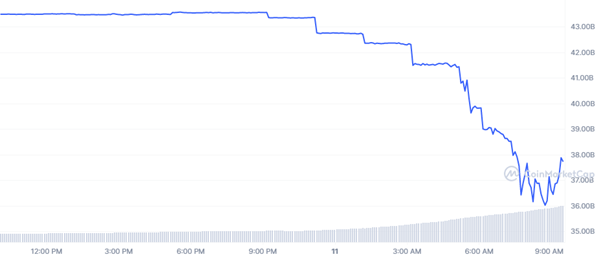
The insolvency of the bank has heavily hit Circle, the company behind the 2nd biggest stablecoin, USDC. USDC, which is fully backed by US Dollar, had 3.3 billion USD worth of collateral on the accounts of the bank. Even though 3.3 billion USD is shy of 8% of the total market capitalization of USDC, the price of the stablecoin, which is supposed to be as the name indicate – stable at 1 USD, started dropping overnight. The insolvency and liquidation of Silvergate earlier this week, a bank heavily involved in crypto markets, who was also a partner of Circle, is adding fuel to the fire.


Figure 1. USDC Market cap (1D Chart) source: coinmarketcap.com

The potential amounts lost on Silvergate are currently unknown. This led to the beginning of a bank run on USDC, with lots of crypto market participants swapping into other stablecoins, large cap crypto currencies or Fiat USD. Naturally, this caused the USDC depeg which at this time is larger than the estimated (potential) gap of collateral caused by the Silicon Valley Bank insolvency.

Another stablecoin project, DAI, has also disconnected in the wake of the scandal. Even though DAI had no exposure to the bank directly, 50% of DAI reserves are backed by USDC as collateral.

Systemic TradFi risks in crypto markets

The irony of this case lies in the fact that theoretically flaws of the traditional finance economy rarely affect crypto projects, as one of their inherent ideological pillar is to create a better, fairer and more resistant system. This case is unique though. The cause of the drop is a systematic counter-party risk. There is no inherent crypto market flaw or fraud at play. One can not blame Circle, as Circle is the most transparent and audited-on-point stable-currency provider. Even Silicon Valley Bank itself can at this point and with the information available so far not been held fully responsible either. Bank runs can happen. In this cause triggered through supposedly poor communication and unlucky timing. Even though their reserves were as conservative as possible, they still tumbled into insolvency due to fractional reserve policy installed by the FED.

Regulatory repercussions

One likely outcome is an even tighter and stronger accelerated approach to the regulation of stablecoins by financial market authorities and central banks – with the ultimate peak of this process being the eventual issuance of CBDCs. Although not very likely, we might even see the FED stepping in in some way in the next days, potentially even taking control of Circle. The meltdown of Luna and UST, and most recently the collapse and alleged fraudulent nature of FTX already previously enforced this step from a regulator’s point of view. Many crypto market participants see this very sceptical due to ideological resons. But increased regulatory security with fully regulated and safe stablecoins creating the ultimate smooth Fiat on- and offramp and DeFi backbone could be one of the necessary triggers for broad adoption of the technology.

Tigris Web3 analysis

Situations like the one with Silicon Valley Bank and Circle enforce our view for the need for decentralized and fully transparent solutions which mitigate counterparty risk. That is one of the main pillars in the investment thesis behind Tigris Web3, a Web3 focused fund managed by Venionaire Investment. Overall we see very low systemic risk at this point for both the portfolio assets and broader thesis of the fund. Circle hast very strong institutional backing. There is too much at stake (both financially and in trustworthiness) compared to what the actual financial damage through the insolvency of Silicon Valley Bank might be. Tigris Web3 is neither invested in USDC, DAI or any other stable coin. Also, we have no funds or accounts with Silicon Valley Bank or Silvergate. If you want to learn more about Tigris Web3, our portfolio assets and projects and investment thesis reach out to david@venionaire.com

Disclaimer

As this situation is currently unfolding, the parties involved are releasing new data and insights on an ongoing basis. This article only reflects the interpretation and knowledge based on information available until 11th March 2023, 10:30am CET. This is no financial advice. Investing in crypto assets is of the highest risk and can lead to a total loss of funds invested.


Authors: David Teufel & Ivo Pernar

Samurai of Tech

A brief historical digression

A Japanese samurai was once a loyal servant and protector, an imperial guard, a warrior with a strict code of honor. They lived according to the “Hagakure”, which contains about 1,300 lessons and dealt with both daily life and the relationship between lord and follower. The traditional warrior nobility of the samurai experienced its heyday in the 11th and 12th centuries A.D. The samurai, originally in the service of the emperor and nobility, became the ruling class of society with the rise of the shogunate and the establishment of a military aristocracy. The demise of the samurai 150 years ago also represents the rise of modern Japan. However, the myth and fascination with these warriors still exists today far beyond the borders of their homeland.

Between past and future

Japan is a country of (supposed) contrasts, performing a daily balancing act between tradition and modernity. While moving between centuries-old shrines and the most modern high-rise architecture, between traditional teahouses and eccentric maid cafés, and yet, despite the apparent contradictions, you can easily find a way between the centuries.

Let’s draw mental parallels and dare this balancing act for our business. Today, our “servants” are our digital or high-tech companions. From artificial intelligence, robots and drones to countless apps, that now make every facet of our daily lives easier. In Japan, you will find a large number of world leading corporations. They almost naturally have large powerful corporate venture vehicles. The few investment banks, some of which manage over 100 corporate venture funds, could be described as shoguns (rulers) in the ecosystem. Perfection is a social and cultural requirement, and this is achieved by specialists. Accordingly, these funds are often managed externally by specialists.

Behind the scenes

Japan’s technology giants are global players, but in Japan itself they like to keep to themselves. To this day, there are hardly any non-Japanese top managers, and the global subsidiaries’ leadership always contain Japanese managers. English as a foreign language is a matter of course for the educated Japanese, but they prefer to do business  in their mother tongue. It is therefore advisable for Western business people to be able to speak at least a few bars.

If we stick to our mental balancing act, these technology giants are the modern samurai of their industries. The innovative leadership of these “Samurai of Tech” goes far beyond Asia. They invest, develop spin-offs together with research institutes and have a strong presence in the international “super hubs” of the startup scene – for example in Israel, Silicon Valley or India. For the corporations, close ties with global startup hubs seem not only practicable, but actually extremely important in terms of their claim to long-term honourable cooperation with innovators. A good reputation ensures access to the best talent and thus the samurai’s superiority in the innovation race.

How to deal with crisis

Right now Europe is just learning to deal with the next and arguably most severe crisis in recent history. Japan has meanwhile perfected living in the crisis. Interest rates are still negative, inflation is not a major issue, the domestic market is strong and the country’s international position is excellent. Japanese are strategists, so it’s not surprising that the appetite for risk to increase activity in Europe – especially venture capital and Web3 – is growing strongly.

In Europe, however, Japanese corporations and corporate venture vehicles are currently hardly present. The European market is considered attractive, but unfortunately also very complex. Various hubs, regional cultural differences, many languages and different laws (depending on the region) in Europe are understandably deterrent. Those who want to be successful therefore ally themselves with strong partners – although this requires some patience. Strong partnerships are based on trust and building this trust does not work overnight.

Building Bridges between Japan and Austria

Venionaire Capital has very good experiences in working with Japanese co-investors and business partners. Attending the City Tech Tokyo Conference and speaking at an official Deloitte side event has greatly strengthened our bi-directional relationship. We are looking forward to a strong delegation from Japan attending the World Venture Forum in Kitzbühel.

You have questions regarding the Japanese market, or would like to find a strong partner for corporate venture funds (full service), or as a scale-up to enter the European market? Please contact our Advisory Team, led by our Managing Partner, Berthold Baurek-Karlic.

WHERE TO FIND US

VIENNA, OFFICE (HQ)

Babenbergerstraße 9/12,
A-1010 Vienna, Austria (EU)
office@venionaire.com

SAN FRANCISCO, USA

1355 Market St. #488
San Francisco CA 94103
sfo@venionaire.com

NEW YORK CITY, USA

122 East 37th Street
First Floor
New York, NY 10016
nyc@venionaire.com

LONDON, UK

Gable House, 239 Regents Park Road
London N3 3LF
office@venionaire.com

Luxembourg, LUX

28, Boulevard F.W. Raiffeisen
2411 Luxembourg
office@venionaire.com

LOOKING FOR FUNDING?

FOR STARTUPS

Venionaire Capital exclusively invests through the European Super Angels Club, for more information and application please go to the website. We do not accept direct investment proposals via this website.