Exit Windows in 2026: Episodic, Not Smooth – and What “Exit-Ready” Really Means

This article offers a focused insight into one of the core mechanisms shaping markets in 2026. The full Market Outlook 2026 provides the broader, integrated context across macro, public markets, private capital and digital assets.

The 2026 backdrop makes one thing clear: listed markets reset the cost of capital – and that flows into episodic IPO and M&A windows, higher dispersion, and a shift from beta to selective leadership.

In private markets, the binding constraint is not simply “sentiment”. It is realisation pathways. Exits improve versus the trough, but liquidity remains uneven, especially for mid tier and earlier stage companies – which raises the importance of secondaries, structured equity, and venture debt.

That tension also shows up in sentiment measures. EVSI signals improving confidence, while flagging practical pressure points for early 2026 such as higher requirements on traction and execution, a still tight exit market, and tougher Series A conditions.

This is why the exit discussion needs a reset. The likely pattern is not a smooth reopening, but episodic windows.

Public markets set the bar for private outcomes

Public equity markets reset the cost of capital in 2026.

Exit windows open in bursts – public markets set the bar

Even for PE and VC, listed markets matter because they determine three things:

  • the discount rate that anchors valuations
  • the multiples that reset private marks
  • the state of the exit window – IPO and M&A confidence

This is the transmission mechanism. When the listed market’s pricing regime shifts, private outcomes reprice with it.

A regional cross check makes the point concrete. In North America, the outlook expects the improved exit environment to support higher levels of realisation in 2026 – with the IPO window reopening and M&A activity remaining strong – while also warning that liquidity will remain uneven, particularly for mid tier and earlier stage companies.

Why exits open in bursts

Episodic windows follow a recognisable pattern: periods where quality issuance clears and acquisition confidence returns, followed by pauses when rates or politics reprice uncertainty.

That is consistent with the broader constraint described elsewhere: exits can improve while liquidity stays uneven. In that environment, the market clears the very best first – and the rest waits for the next window.

So the strategic error in 2026 is not “missing the perfect week”. The bigger error is building a portfolio plan around timing a window that can close as fast as it opens.

Don’t time it Be exit-ready

Exit readiness beats exit timing

The practical goal is to be exit ready at all times, not to “time the window”.

Exit readiness is not a slogan. It is a set of actions that raises optionality under imperfect conditions.

This is not a year where “market beta” does the work. In private markets, performance will be driven by manager actions.

What “exit ready” looks like in practice

The outlook frames levers that define readiness in 2026:

  • Portfolio triage, not portfolio hope. Concentrate follow on capital behind assets that can credibly reach cash flow breakeven or strategic defensibility within realistic timeframes. De risk the rest early through governance, cost actions, and strategic alternatives – rather than waiting for an external recovery to do the job.
  • Liquidity as a value creation lever. Secondaries, structured equity, and selective venture debt help protect ownership, extend runway without destructive dilution, and match company timelines to imperfect exit conditions. The outlook also expects these tools to play a growing role where liquidity remains uneven.
  • Operating discipline beats narrative. In a higher hurdle rate regime, improvements in gross margin, retention, payback, and working capital compound into higher exit optionality, because buyers and public markets underwrite durability, not only growth.
  • Execution speed is part of readiness. The outlook highlights term and cap table hygiene as practical work that raises the probability of capturing windows when they open.

A simple readiness checklist for 2026

If exit windows come in bursts, readiness becomes a continuous process. A practical checklist is to ask:

  • Can this asset defend its valuation under the discount rate and multiples regime set by listed markets?
  • If a window opens briefly, can governance and reporting move fast enough to convert interest into a process?
  • If a window closes, do we have liquidity tools – secondaries, structured equity, venture debt – to protect ownership and extend runway without destructive dilution?

Bottom line

In 2026, the exit environment does not reward perfect timing. It rewards readiness – because windows can open, clear quality, and then pause when uncertainty reprices.

If you want the integrated view – how the rates regime, public market pricing, and private market liquidity filters connect to exit outcomes – the full Market Outlook 2026 provides the broader frame.

Why the Middle East Economy Is More Resilient Than Headlines Suggest

Global markets periodically experience moments that test the strength of economic ecosystems. The recent geopolitical tensions affecting the Gulf region — including temporary disruptions to airspace and aviation operations — have sparked renewed debate about Middle East economic resilience and the long-term stability of global hubs such as Dubai and the United Arab Emirates.

While headlines often focus on immediate shocks, long-term investors know that the real question is different: how robust are the underlying systems that power global economic centers?

The Reality of Middle East Hub Risk

Major international hubs — whether Singapore, London, Dubai, or New York — are built on interconnected systems: aviation, trade, finance, tourism, and global mobility.

Recent disruptions in Middle Eastern airspace briefly interrupted flights and tourism flows, reminding markets that no region is completely insulated from geopolitical dynamics. Visible events such as airport closures or missile interceptions inevitably influence global perception and risk assessment.

In the immediate aftermath, several short-term effects typically emerge:

  • Temporary declines in tourism demand

  • Operational challenges for aviation networks

  • Increased media attention on regional stability

  • Heightened risk sensitivity among travelers and investors

However, such disruptions do not automatically translate into structural economic decline. In fact, Middle East economic resilience often becomes most visible precisely during these moments of stress.

Structural Strength Matters More Than Headlines

Dubai’s economic model offers a compelling case study in diversification and institutional capacity.

Tourism, while highly visible, represents only one pillar of a broader ecosystem that includes:

  • global logistics and aviation networks

  • international finance and capital markets

  • energy and trade infrastructure

  • technology and innovation initiatives

This diversification is critical. When one sector temporarily slows, others often compensate.

Equally important is the institutional capability to manage crises. Rapid operational responses, coordinated government actions, and strong public-private cooperation frequently determine whether disruptions remain short-lived or evolve into structural challenges.

In the Gulf, these capabilities have developed significantly over the past two decades.

The Power of Rapid Recovery

History shows that tourism and mobility sectors are remarkably resilient.

After global shocks — whether financial crises, pandemics, or regional conflicts — travel demand often rebounds faster than expected once stability returns.

Early indicators suggest a similar pattern may unfold across the Gulf region. Aviation operations typically normalize quickly after temporary disruptions, and international travel demand remains structurally strong as global mobility continues to expand.

For investors, the key takeaway is simple:

Temporary volatility does not necessarily alter long-term demand fundamentals.

Global connectivity remains one of the most powerful drivers of economic growth.

The Strategic Pivot: From “Perfect Safety” to “Professional Resilience”

One subtle but important shift may emerge from current events.

For decades, certain global hubs marketed themselves as completely insulated from regional volatility. In today’s interconnected world, that narrative is increasingly unrealistic.

Instead, the competitive advantage is shifting toward something more credible: the ability to manage complexity effectively.

Investors, businesses, and travelers increasingly value environments that demonstrate:

  • strong governance and crisis management

  • resilient infrastructure systems

  • transparent communication during uncertainty

  • long-term strategic planning

Cities and countries that prove capable in these areas often strengthen their reputation over time.

In other words, the narrative evolves from “nothing ever happens here” to “this system works even when things do happen.”

Scenario Thinking: A Core Skill for Investors

Periods of geopolitical uncertainty highlight the importance of structured scenario analysis — a discipline that venture investors, private equity firms, and sovereign funds have long relied upon.

Rather than predicting a single outcome, sophisticated investors evaluate multiple possible trajectories:

  • Short-term disruption followed by recovery

  • Periodic volatility requiring strategic adaptation

  • Long-term structural shifts in global networks

The probability distribution across these scenarios determines investment strategy, capital allocation, and risk management.

Most importantly, scenario thinking prevents emotional reactions to headlines and instead encourages data-driven decision-making.

The Bigger Picture: A Multipolar Global Economy

The deeper story is that global economic power is becoming increasingly multipolar.

New hubs continue to emerge across the Middle East, Southeast Asia, and parts of Africa. These regions are investing heavily in infrastructure, logistics, digital economies, and capital markets.

Dubai and the UAE have been among the pioneers of this transformation, positioning themselves as bridges between continents — a testament to the depth of Middle East economic resilience in the face of a rapidly shifting global order.

While geopolitical tensions can create temporary friction, the long-term trend toward greater global connectivity and regional economic diversification remains intact.

Lessons for Global Investors

For investors observing current developments, several strategic lessons stand out:

  1. Resilience is the new competitive advantage: Markets increasingly reward systems that can absorb shocks and recover quickly.

  2. Diversification matters — at both portfolio and national levels: Economies built on multiple sectors tend to weather volatility more effectively.

  3. Perception evolves, but fundamentals endure: Temporary media narratives rarely define the long-term trajectory of global economic hubs.

  4. Scenario planning beats prediction: Investors who model multiple outcomes are better prepared for uncertainty.

Looking Ahead

The world is entering an era where geopolitical complexity and economic globalization coexist.

For international investors, this does not mean retreating from dynamic regions. Instead, it means approaching them with greater analytical depth, strategic flexibility, and long-term perspective.

History repeatedly shows that the most innovative and connected cities — the true global crossroads — possess a remarkable ability to adapt.

The same resilience that built them often proves strongest when the world becomes more uncertain.

Valuation Asymmetry: Why Europe Can Compete Without Winning the AI Race

This article offers a focused insight into one of the core mechanisms shaping markets in 2026. The full Market Outlook 2026 provides the broader, integrated context across macro, public markets, private capital and digital assets.

Europe does not need to lead the AI headline to be investable in 2026. Instead, a more practical setup is valuation asymmetry – a wide multiples gap paired with a narrowing growth gap, inside a region where index composition naturally creates dispersion.

The mechanism: a multiples gap with a tightening growth gap

Late 2025 multiples show a clear valuation asymmetry: European equities traded at approximately ~15x forward earnings compared to ~22–23x for the S&P 500, implying a ~30–35% valuation discount.

A discount can persist. However, the setup changes when fundamentals move.

Consensus forecasts point to around ~12% earnings growth for European equities in 2026, and they explicitly link this to a narrowing growth gap versus the U.S. and a stronger case for valuation convergence.

15x vs 22–23x – and Europe’s 2026 growth gap tightens (~12%).

The implication is straightforward: if earnings growth stops being the core objection while valuation remains the core support, rotation becomes easier to justify on price and fundamentals rather than narrative.

Europe is not one trade – index composition drives dispersion

A single regional label hides meaningful differences. Crucially, country level dispersion is re-emerging across European equities, and index composition shapes return paths.

Europe isn’t one bet – index mix drives dispersion, so selectivity pays.

Major indices reflect distinct sector mixes:

  • Germany’s DAX tilts toward cyclicals such as industrials (~25%) and financials (~21%), with an IT component.
  • France’s CAC 40 concentrates in large industrials and global consumer and luxury leaders, with examples listed among top weights.
  • The UK’s FTSE 100 carries a high financials weight (~26%) and exposure to global resource linked sectors.

Therefore, the broader 2026 setup frames a more selective and higher dispersion regime – where selection quality tends to matter more than broad beta.

Valuation support already showed up in 2025 returns

The valuation support is not theoretical. It links to observed index performance: European equities matched and slightly beat the S&P 500 over 2025, despite differing sector compositions.

This does not guarantee 2026 outcomes. Rather, it clarifies the mechanism: comparable index level returns can come from different engines when relative pricing and sector mix are supportive.

Where the opportunity shows up: specific subsegments, not a blanket bet

The opportunity set shows up most clearly in subsegments such as B2B SaaS, cybersecurity, and industrial DeepTech tied to digital and energy infrastructure.

In addition, the same section highlights strategic investment into European data centre capacity and adjacent industrial suppliers – an additional channel outside the U.S. tech core.

The constraint that forces selectivity

The European equity lens sits against a macro backdrop of weak private capital formation across several economies, with the public sector increasingly compensating through infrastructure, energy, and digital spending. An Austria example illustrates the point: private net investment falls sharply while public investment rises.

In that environment, the premium rises on listed companies with global revenue exposure, strong balance sheets, and defensible competitive positions, while domestic investment conditions remain uneven.

Valuation asymmetry improves the odds. It does not replace underwriting quality.

Bottom line

The 2026 European case is not an anti U.S. call and not a bet on Europe winning the AI race. It is a valuation asymmetry setup: a wide multiples gap, earnings growth convergence, and index driven dispersion that rewards selective positioning.

If you want the integrated view – how this European valuation setup connects to the rates regime, U.S. concentration, and private market liquidity filters – the full Market Outlook 2026 provides the broader frame.

AI capex Reality Check: When Scale Meets Capital Discipline

This article offers a focused insight into one of the core mechanisms shaping markets in 2026. The full Market Outlook 2026 provides the broader, integrated context across macro, public markets, private capital and digital assets.

The 2026 equity narrative is not simply “AI wins” or “AI fades”.

It is a more specific tension: the same companies that dominate AI leadership are also absorbing an exceptional share of the system’s capital. In a higher term-premium world, that makes the cost of leadership a first-order valuation variable.

AI leadership is now a cost-of-capital story.

Concentration is not a footnote – it is the starting point

AI-centric mega-cap technology leaders remain the centre of gravity for index weight and earnings delivery, supported by exceptional levels of AI infrastructure spending.

The concentration is quantified: the “Magnificent Seven” accounted for 34 to 35% of the S&P 500 market cap in 2025, up materially from 2024.

That is the backdrop for 2026 selection. When leadership is narrow, mistakes are amplified – and “being right on the theme” is not the same as “being right on the price”.

CAPEX is the new filter – because the scale is historically exceptional

Estimates put hyperscaler spending at around $400bn in 2025 (roughly +70% YoY), and forecasts show it exceeding $500bn in 2026 as data centre and compute buildouts accelerate.

Major Big Tech issuers increasingly use debt to finance part of this cycle. In 2025, they raised >$120bn in new debt to support AI and cloud infrastructure. That signals how capital-intensive the buildout has become.

The risk is not that investment is “too big” in absolute terms. The risk is the mismatch between the pace of capital deployment and the pace of near-term earnings delivery, particularly if revenue realisation is back-loaded.

The phase shift: scale is no longer sufficient

A clear regime statement sits at the top level of the outlook: the AI investment cycle is entering its next phase. Markets increasingly demand capital discipline, monetisation evidence, and capex efficiency – not just scale.

Scale is no longer sufficient.

That shift matters because the outlook frames 2026 as a year with less room for error. Markets punish valuation stretch and narrative excess faster; dispersion rises; leadership becomes more selective.

What “capital discipline” means in a capex-heavy cycle

In this setup, the difference between “structural winner” and “overpriced infrastructure builder” becomes decisive. Heavy investment can create extraordinary capability – and still produce mixed returns for the companies funding the buildout, especially when capex growth outpaces near-term earnings delivery.

A disciplined lens is therefore practical, not philosophical. It turns into questions such as:

  • Does the capex trajectory match visible earnings delivery, or does revenue realisation become increasingly back-loaded?
  • Does the buildout rely more on debt financing – and does that change the market’s tolerance for valuation?
  • Are expectations already demanding, or is valuation support still present?

Where the “capex reality” creates relative opportunity

In a higher term-premium world, valuation asymmetry matters more. With U.S. market concentration near historic highs and valuations stretched, relative opportunities broaden toward lower-valuation markets and sectors where expectations are less demanding.

This is where the selective case for Europe enters: European-listed tech equities can benefit from a valuation rotation as investors seek alternatives to stretched U.S. mega-caps.

As of late 2025, European equities traded at approximately ~15x forward earnings compared to ~22–23x for the S&P 500, implying a ~30–35% valuation discount, well above long-term historical norms.

The point is not “Europe replaces the U.S.” The point is that valuation support and dispersion create room for selective rotation – particularly toward quality earnings, balance-sheet strength, and sectors where expectations are less demanding.

Bottom line

AI remains the leadership engine – but leadership now comes with a measurable capital bill. In 2026, the question is not whether the buildout continues; it is whether the market pays for the buildout at the same multiple once it assesses capex intensity, financing mix, and earnings delivery under a higher hurdle rate.

If you want the integrated view – how AI concentration and capex reality connect to the discount-rate regime, cross-asset dispersion, and regional valuation rotation – the full Market Outlook 2026 connects those dots.

From Cuts to Supply: How Duration Became the New Volatility

This article offers a focused insight into one of the core mechanisms shaping markets in 2026. The full Market Outlook 2026 provides the broader, integrated context across macro, public markets, private capital and digital assets.

For most of the past decade, fixed income lived inside one dominant story: central banks would eventually cut, yields would fall, and duration would behave. That framing no longer explains the world described in the Market Outlook 2026.

The key shift is stated plainly: “The defining fixed-income theme of 2026 is not where policy rates go next, but how markets price duration risk.”

In other words, the question is moving from direction to absorption – who holds duration, at what price, and with how much tolerance for volatility.

Not about cuts – about duration pricing.

Duration is back – and it is the volatility driver

Fixed income volatility is increasingly shaped by a different mix of forces than the simple “next central bank decision”. The drivers are bond supply, inflation compensation, and investor tolerance for duration.

This matters because those forces do not fade just because policy rates stop rising. When supply is heavy and inflation persistence remains a constraint, the long end can reprice even in an environment where growth still holds up.

From policy dominance to the supply channel

A central constraint on sentiment is inflation persistence. Inflation appears to have bottomed in 2025 at levels still meaningfully above pre-pandemic norms, with services and wages singled out as the areas to watch.

With inflation persistence as the backdrop, the market impact flows through a repricing of term premia, which lifts long-end yields and tightens financial conditions even without overt policy tightening.

That takes the market into a regime where the long end behaves less like a passive reflection of “future cuts” and more like a live referendum on credibility, inflation risk, and duration supply.

Curve pressure and the hurdle rate reset

The investment implication is explicit:

  • curve steepening pressure persists
  • long-duration complacency is penalised
  • higher risk-free yields raise the hurdle rate across assets

These are not abstract statements. They are a redefinition of what “risk” means in portfolios.

When the risk-free anchor is higher and less stable at the long end, the discount rate becomes a gatekeeper across markets – not only in rates, but in how equities, private assets, and growth narratives are priced.

Higher hurdle rates – more dispersion and selectivity across assets.

Why duration repricing spills into equities and private markets

The broader cross-asset setup is continued expansion with rate-driven pricing and rising selectivity.

In public equities, it describes a bifurcation – leadership concentrated in AI-centric mega-cap technology, with selective rotation elsewhere. The point here is not the equity story itself, but the rate story underneath it: when duration risk reprices, dispersion rises and the market becomes less forgiving of valuation stretch.

In private markets, the same constraint shows up through the cost of capital and the exit environment. The state of public markets feeds into private outcomes via discount rates, multiples, and the exit window.

The one question for 2026: who warehouses duration?

If you want one question that captures the shift, it is this:

Who is willing to hold long-duration exposure – and at what price – when supply, inflation compensation, and term premia are the active variables?

That question sits behind the macro framing of narrower margins for error and more structural volatility.

Signals to watch in 2026 – signals, not predictions

Mechanisms matter more than headlines:

  • Inflation persistence and its pathway into term premia and the long end.
  • The market’s capacity to absorb bond supply without higher inflation compensation.
  • Whether duration tolerance holds up when volatility resurfaces.
  • Whether curve dynamics remain a source of cross-asset repricing pressure.

Bottom line

In this framework, 2026 is not defined by a single “cut cycle” narrative. It is defined by how duration risk is priced in a world where supply and inflation compensation matter – and where that pricing sets the hurdle rate for everything else.

If you want the integrated view – how this supply-driven duration regime connects to global equities, private-market liquidity filters, regional capital cycles, and digital assets – the full Market Outlook 2026 is built to connect those dots.

Venionaire DealMatrix Multiples: Valuation Multiples Built for Private Markets

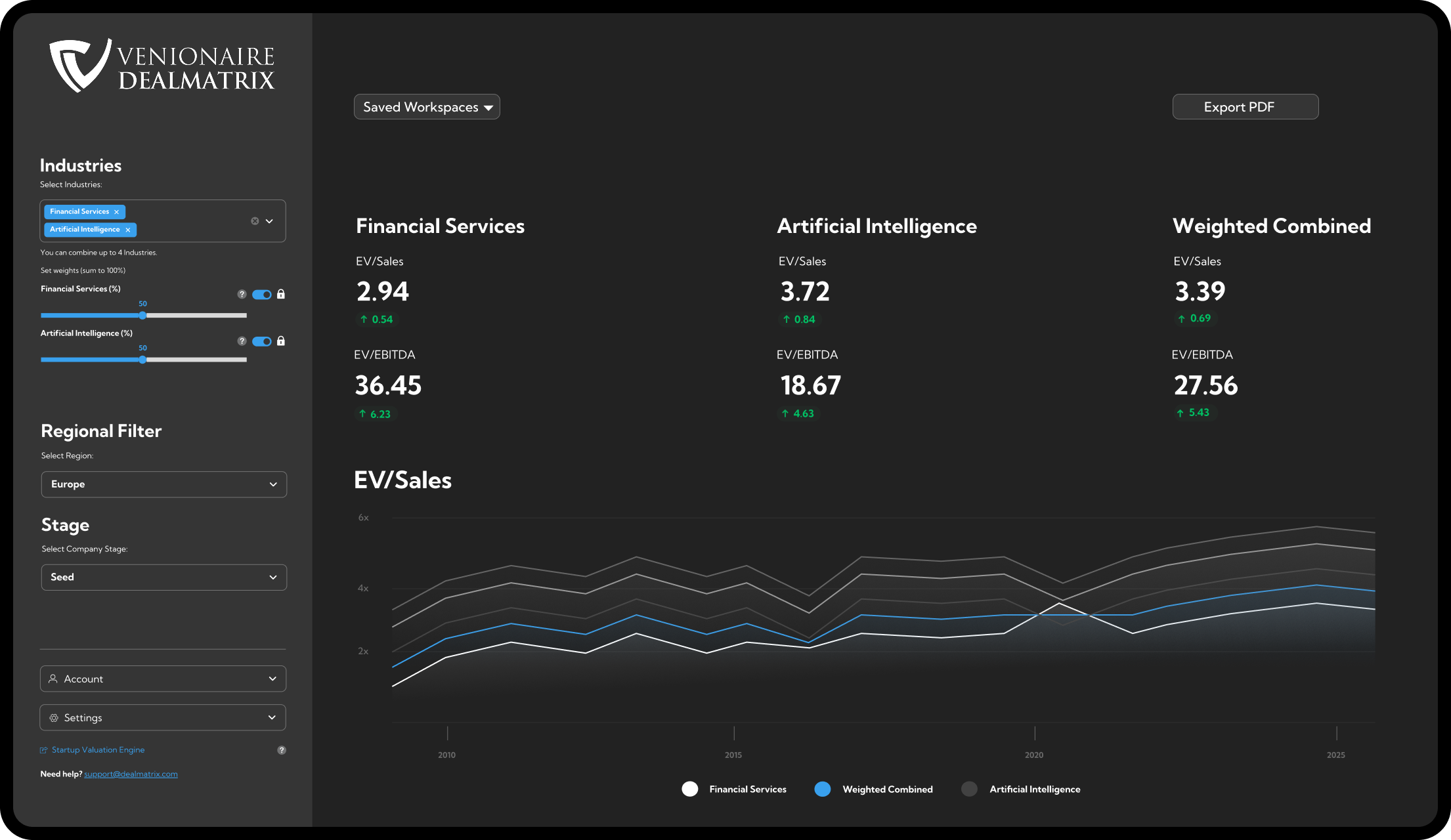
Venionaire DealMatrix, subsidiary of Venionaire Capital, has launched Venionaire DealMatrix Multiples, providing private-market EV/Sales and EV/EBITDA valuation multiples that can be explored by sector, stage, and region.

Venionaire-DealMatrix-Multiples-Mockup-2

Figure 1: Venionaire DealMatrix Multiples

The launch builds on Venionaire Capital’s long-standing activity across Venture Capital, Private Equity, and M&A, where valuation decisions are routinely made in environments characterized by limited transparency and high contextual dependency.


The challenge: valuation without a private-market framework

Across private markets, pricing decisions are still largely anchored in experience, precedent transactions, and public-market multiples. Not because these tools are ideal, but because there has been no widely available alternative designed specifically for private companies.

Private transactions are rarely disclosed, deal terms are negotiated bilaterally, and pricing varies significantly by sector, company stage, and geographic context. As a result, comparability is limited and valuation discussions often rely on narrative rather than a shared analytical foundation.


Why public-market multiples fall short

Public-market multiples became the default reference due to their availability and structure. However, they reflect a fundamentally different environment—one shaped by liquidity, scale, standardized reporting, and immediate exitability.

These characteristics rarely apply to private companies. Applying public multiples to private transactions therefore requires subjective adjustment, which introduces inconsistency when used systematically across deals.


Building a private-market methodology

Venionaire DealMatrix Multiples were developed to address this structural gap.

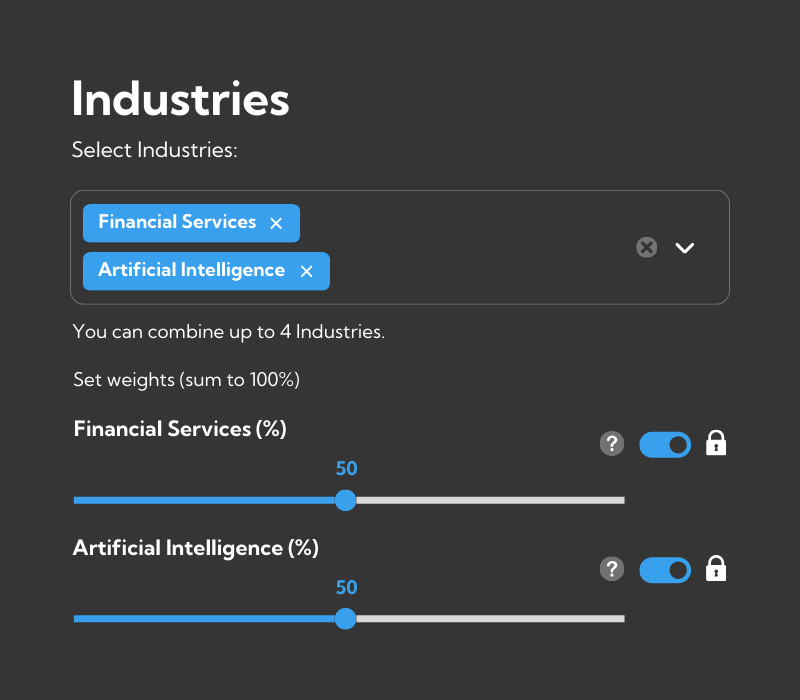
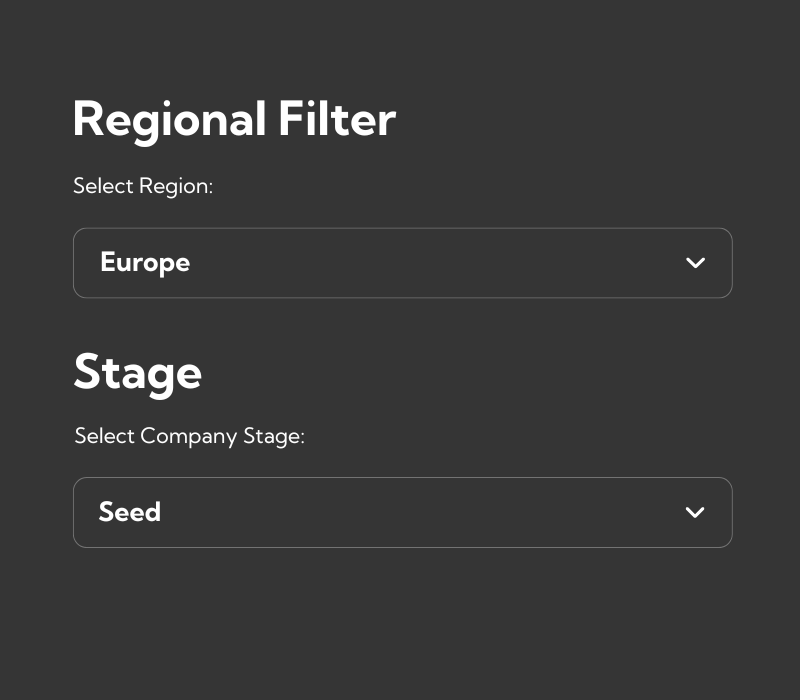
Instead of adapting public-market benchmarks, the methodology was built from the ground up around private-market characteristics. The result is a framework for calculating EV/Sales and EV/EBITDA multiples for private companies, structured by:

  • sector

  • company stage

  • geographic region

DealMatrix_Multiples_Industries

Figure 2: Industries Filter


DealMatrix_Multiples_Region_Stage

Figure 3: Regional & Stage Filter


Public-market data serves as a starting point for peer-group identification, but is systematically contextualized using macroeconomic indicators and proprietary private-market datasets accumulated through Venionaire’s work in Venture Capital, Private Equity, and M&A.


Launching Venionaire DealMatrix Multiples

Venionaire DealMatrix Multiples are now live. They are designed to support valuation discussions, deal screening, and comparative analysis by providing structure where private markets have traditionally relied on fragmented benchmarks and individual experience.

To introduce the product, the DealMatrix team has prepared a short video demonstrating how the platform works and how private-market multiples can be explored in practice.

The Discount-Rate Constraint: Why the Term Premium Became 2026’s Gatekeeper

This article offers a focused insight into one of the core mechanisms shaping markets in 2026. The full Market Outlook 2026 provides the broader, integrated context across macro, public markets, private capital and digital assets.

The Discount-Rate Constraint: Why the Term Premium Became 2026’s Gatekeeper

In 2026, markets can keep moving – and still become far more selective. The base case is continued expansion, but pricing is rate-driven; leadership broadens and selectivity rises across public and private markets.

One line captures the hinge point of the year: this is primarily a discount-rate problem, not an earnings problem.

2026 is a discount-rate year, not an earnings year

What “discount-rate problem” means in practice

Earnings do not “stop mattering.” What changes is the price investors are willing to pay for them when the cost of capital resets. With sticky inflation lifting term premia, the discount rate becomes the binding constraint.

Inflation persistence ? higher term premia ? higher long-end yields

A central constraint on sentiment is inflation persistence; inflation appears to have bottomed in 2025 at levels still meaningfully above pre-pandemic norms.

As growth firms into 2026, the balance of risks shifts from disinflation surprises to renewed upside pressure, particularly in services and wages. The knock-on effect is direct: inflation persistence feeds into higher term premia, which lift long-end yields and tighten financial conditions even without overt policy tightening.

This is not framed as a growth-scare dynamic. It is a discount-rate constraint – especially for duration-heavy, consensus-long segments (explicitly: AI, BioTech, CleanTech) that have little buffer against higher real yields.

From “cuts” to “supply”: why duration becomes the new volatility

The key rates-regime shift is stated plainly: “The defining fixed-income theme of 2026 is not where policy rates go next, but how markets price duration risk.”

As easing cycles stall and growth remains resilient, the baton passes from central banks to fiscal authorities. Volatility moves from “the next decision” to bond supply, inflation compensation, and investor tolerance for duration.

At the headline level, fixed income volatility increasingly reflects those forces rather than “simply the next central-bank decision.”

The implication is equally clear: curve steepening pressure persists, long-duration complacency is penalised, and higher risk-free yields raise the hurdle rate across assets.

The “buffer test”: why markets become less forgiving

The year becomes a buffer test: markets are increasingly less forgiving of narrative excess, valuation stretch, or policy missteps. Risk assets can grind higher, but leadership becomes more selective and volatility more structural rather than episodic.

At the top level, the setup is summarised as higher dispersion and a shift from broad beta exposure to selective leadership.

Concentration meets capex reality: the discipline phase of the AI cycle

Public equities are described as bifurcated between AI-centric mega-cap technology leaders and a selective rotation into European and industrial tech franchises.

The concentration and capex scale are quantified:

  • The Magnificent Seven accounted for 34–35% of the S&P 500 market cap in 2025.
  • Hyperscaler AI infrastructure spending is estimated around $400bn in 2025 (roughly +70% YoY) and forecast to exceed $500bn in 2026.
  • Part of the buildout is increasingly debt-financed, with major Big Tech issuers raising >$120bn in new debt in 2025 to support AI and cloud infrastructure.

Alongside those numbers sits the “phase shift”: the AI investment cycle is entering its next stage, where markets increasingly demand capital discipline, monetisation evidence, and capex efficiency – not just scale.

Selectivity is structural across public and private markets

Why this constraint cascades into private-market outcomes

The same gatekeeper shows up in private outcomes via three anchors: (i) the discount rate that anchors valuations, (ii) the multiples that reset private marks, and (iii) the state of the exit window (IPO and M&A confidence).

On exits, the pattern is explicit: not a smooth reopening, but episodic windows.

This connects directly to the private-market setup described as “recovery with a liquidity filter”: sentiment remains constructive but selective; improving sentiment pairs with targeted capital allocation rather than broad risk-taking; the key constraint is realisation pathways; and liquidity remains uneven – especially for mid-tier and earlier-stage companies – raising the importance of secondaries, structured equity, and venture debt as bridging tools.

Signals to watch in 2026 (signals, not predictions)

Watch mechanisms (not slogans):

  • Inflation persistence feeding into higher term premia and long-end yields.
  • Duration risk being priced through supply, inflation compensation, and duration tolerance.
  • Ongoing curve-steepening pressure and punishment of long-duration complacency.
  • Higher dispersion and a shift from beta to selective leadership.
  • A private-market recovery that stays constrained by liquidity and realisation pathways.
  • Exit windows that open in episodic bursts rather than staying continuously “open.”

A practical checklist for 2026 decision-making

The macro constraint translates into an operating playbook, including:

  • Underwrite duration honestly (assume exits can happen, but not “on schedule”).
  • Build exit readiness as an operating system (clean reporting, credible unit economics, cap-table/terms hygiene).
  • Use structure to create asymmetric outcomes, where downside protection can be more valuable than paying for upside multiple expansion.
  • Treat liquidity as a value-creation lever (secondaries, structured equity, selective venture debt as tools in 2026).

Bottom line

The base case is continued expansion – paired with a tighter pricing regime. In that world, the discount rate becomes the gatekeeper: it shapes valuations, filters leadership, and determines how forgiving the exit environment can be.

If you want the integrated view – how the discount-rate constraint connects to rates, equities, private-market liquidity, and regional dynamics – the full Market Outlook 2026 is built to connect those dots.

Venionaire Capital Market Outlook 2026: The Year of Selective Opportunity

With the Venionaire Capital Market Outlook 2026, Venionaire Capital provides a concise, cross-asset assessment of public markets, private markets, and digital assets. The report explains how macroeconomic forces shape risks and opportunities as fiscal policy extends the cycle and the margin for error narrows.

The global investment environment entering 2026 is not defined by recession, but by constraint. Growth continues, yet inflation remains persistent, interest rates stay structurally higher, and volatility becomes a permanent feature of markets.

Our central message is clear: the cycle continues, but the rules have changed.

The Five Structural Forces Shaping 2026

Against this backdrop, Venionaire Capital identifies five structural forces that will shape investment outcomes in 2026:

  1. The Macro Regime: From Policy Rates to the Term Premium

The main macro challenge in 2026 is not weak growth, but inflation that remains higher for longer. As growth continues, inflation pressure, especially in wages and services, can return.

Even without new rate hikes, higher real yields affect asset prices. Bond markets are now driven more by government issuance and inflation expectations than by central bank decisions.

Long-term assets are more sensitive to yields, and valuation discipline matters across all asset classes.

  1. Public Markets: Concentration Risk Meets Capex Reality

Stock markets are still dominated by a small number of AI-driven mega-cap companies. However, investors are shifting focus from growth and scale to capital efficiency, monetisation, and balance sheet strength.

High concentration and stretched valuations, especially in the U.S., increase the importance of relative value and diversification.

What matters more in this phase is not sheer market exposure, but the quality of earnings and underlying valuation levels.

  1. Private Markets: Recovery with a Liquidity Filter

Private equity and venture sentiment has improved, but capital remains selective. While the European Venture Sentiment Index stayed positive through 2025, rising confidence is translating into targeted investments rather than broad risk-taking. For 2026, the main constraint is realisation pathways.

Although exits are improving, liquidity remains uneven, especially for earlier-stage and mid-tier companies, increasing the relevance of secondaries, structured equity, and venture debt.

Successful private-market strategies focus on exit readiness, capital efficiency, realistic timelines, and active liquidity management rather than relying on a single IPO window.

  1. Regional VC Outlook: Leadership Broadens Beyond One Geography

Venture capital leadership is broadening beyond a single geography. North America remains the global center, but the focus shifts from funding growth to proving profitability and defensible business models.

Europe shows a cautious recovery with strong thematic depth, yet faces the challenge of scaling global champions. Latin America continues to stabilise, led by Brazil, while the Middle East expands through sovereign-backed ecosystems. In Asia, capital concentrates where regulation, execution, and infrastructure align.

Venture capital is becoming more regional and differentiated, making local market dynamics and exit pathways increasingly important.

  1. Crypto: From Narrative to Infrastructure

Crypto in 2026 is shifting from speculation toward real financial infrastructure. Stablecoins, tokenised real-world assets, institutional DeFi, AI-driven on-chain settlement, and broader access via ETFs and indices are driving adoption. As utility increases, opportunities expand, but regulatory execution and credibility remain the key risks. 
 
The opportunity set expands as crypto adoption shifts from speculation toward infrastructure, while regulatory execution and credibility risks remain the central challenges.

Venionaire Capital Market Outlook 2026: Bottom Line

The opportunity is real, but the game has changed.

2026 is not about chasing every opportunity, but about choosing carefully, understanding risks, and focusing on quality, realism, and structure.

Risk assets can grind higher, yet leadership is narrower, valuations matter more, and the discount rate is no longer a sideshow.

Investors who adapt to higher structural volatility and regime-driven rotations will be best positioned to navigate the year ahead.


Disclaimer 

This publication is issued by Venionaire Capital AG. All rights to the content of this document—including text, data, charts, tables, images, and design—are reserved. Any copying, redistribution, extraction, or other use (in whole or in part) is not permitted without the prior written approval of Venionaire Capital AG, unless explicitly allowed by mandatory law. The material isprovided for general information only. It is not prepared with regard to any individual’s investment objectives, financial situation, or particular needs, and it does not constitute investment research within the meaning of applicable regulations. While Venionaire Capital AG has prepared this publication with reasonable care and may refer to sources considered reliable, norepresentation or warranty is made as to the accuracy, completeness, or continued validity of the information. Views, estimates, and forward-looking statements reflect the situation at the time of writing and may change without notice. 

Nothing in this publication constitutes financial, investment, legal, tax, or accounting advice, nor should it be understood as an offer or solicitation to buy or sell any asset or instrument. This includes, without limitation, digital assets/crypto-assets, tokens, derivatives, or securities. Markets for digital assets may be volatile and involve significant risk, including the risk ofpartial or total loss. Past performance is not indicative of future results. Readers should make their own assessment and seek independent professional advice where appropriate. 

Venionaire Capital AG shall not be responsible for any loss or damage arising from the use of this publication or from reliance on any information contained herein, to the fullest extent permitted by law. 

© 2026 Venionaire Capital AG. All rights reserved. 

Why Discipline Outperforms Discretion: The Case for Rule-Based Investing in Digital Assets

In financial markets, emotion is the invisible tax on performance. Even the most seasoned active managers can fall victim to optimism, fear, or short-term incentives, behaviors that collectively explain why, over long horizons, the vast majority of funds fail to beat their benchmarks.


An index, by contrast, doesn’t get emotional. It follows its rules.


That distinction lies at the heart of VIDA – Venionaire Index for Digital Assets and „VLONE“ (Venionaire Layer-1 Select Index), a rules-based benchmark engineered by Compass Financial Technologies and developed by our Web3 team at Venionaire Capital. VLONE captures the performance of leading Layer-1 blockchains – Bitcoin, Ethereum, Solana, and many others, using transparent criteria such as liquidity, adoption metrics, network governance, and technological innovation.


Where an active crypto fund manager might chase narratives or overreact to market volatility, VLONE maintains structural discipline. Its quantitative methodology determines weights objectively and rebalances according to measurable fundamentals.


The result speaks for itself: VLONE has delivered strong cumulative returns through consistent methodology and zero human bias, as the time series of a few years of back testing shows.


For investors, investing in an index is more than efficiency, it’s psychological protection. By design, VLONE resists the emotional rollercoaster that undermines active decision-making in digital asset markets.


The recently lunched VLONE-based Decentralised Token Folio (DTF) by Reserve, a company trusted by top tier tech investors such as Peter Thiel and Sam Altman, extends this principle to an investable, on-chain structure, enabling exposure to the same disciplined framework through decentralised infrastructure.


In a market where sentiment swings faster than fundamentals, staying systematic isn’t just smart. It’s survival.

Venionaire Capital at the Clinton Global Initiative 2025 Annual Meeting 

A Global Platform for Collaboration 

Venionaire Capital was honored to take part in the Clinton Global Initiative (CGI) Annual Meeting 2025, held on September 24–25 in New York City, and serving as an advisor for the Economy Working Group. The event once again gathered leaders from business, government, philanthropy, and civil society to address urgent global challenges and explore solutions through collaboration. 

For more than two decades, the CGI community has launched groundbreaking partnerships, bold investments, and influential social impact initiatives. This year, the stakes were higher than ever, with a renewed focus on moving bold ideas into real-world solutions. 

The Introduction of CGI Working Groups 

A key innovation at CGI 2025 was the launch of Working Groups. These curated, hands-on sessions were designed for strategic collaboration and real-time problem-solving. Unlike traditional panels or presentations, Working Groups provided immersive and structured conversations, focused on short- and long-term action. 

Each Working Group convened for a total of three hours over two sessions. Guided by the Chatham House Rule, participants could freely exchange ideas without attribution, fostering a safe environment for open and constructive dialogue. 

The format prioritized engagement and inclusivity. Rather than pitches or self-promotion, discussions emphasized shared values, scalable solutions, and opportunities for practical collaboration. This approach aligned closely with Venionaire Capital’s mission to drive sustainable impact by bridging capital markets with innovative entrepreneurship. 

Venionaire Capital leading the Economy Working Group 

CEO of Venionaire Capital, Berthold Baurek-Karlic, led the Economy Working Group as the Working Group Advisor. This group brought together investors, entrepreneurs, and thought leaders. The central question was how to reignite inclusive and resilient economic growth by strengthening international cooperation and leveraging the transformative power of technology. 

Through active participation, we engaged in dialogue on global economic resilience, the role of innovation, and the importance of cross-border collaboration. These discussions highlighted the complexity of today’s challenges but also the immense potential of collective action. 

Breakout Session: Building Global Relations 

In addition to the Working Group, Venionaire Capital participated in a special breakout session co-hosted by the World Venture Forum Foundation and Encubay:
“Building Global Relations: Strategy & Social Networking for Entrepreneurs and Investors.” 

The session explored strategies for building stronger international ties and creating opportunities at the intersection of innovation and investment. It offered practical insights for entrepreneurs and investors seeking to strengthen global networks and foster meaningful collaborations. 

Looking Ahead: From Dialogue to Action 

Participating in CGI 2025 was both an honor and an important step in our ongoing commitment to impact. The experience reaffirmed our belief that the world’s most urgent problems cannot be solved in isolation. Instead, they require cooperation across sectors, borders, and disciplines. 

By engaging in this global dialogue, we continue to build on its mission to connect ideas, people, and capital. Together, with our partners in the CGI community, we are determined to fuel inclusive growth, empower communities, and shape a more resilient and sustainable future. 

WHERE TO FIND US

VIENNA, OFFICE (HQ)

Babenbergerstraße 9/12,
A-1010 Vienna, Austria (EU)
office@venionaire.com

SAN FRANCISCO, USA

1355 Market St. #488
San Francisco CA 94103
sfo@venionaire.com

NEW YORK CITY, USA

122 East 37th Street
First Floor
New York, NY 10016
nyc@venionaire.com

LONDON, UK

Gable House, 239 Regents Park Road
London N3 3LF
office@venionaire.com

Luxembourg, LUX

28, Boulevard F.W. Raiffeisen
2411 Luxembourg
office@venionaire.com

LOOKING FOR FUNDING?

FOR STARTUPS

Venionaire Capital exclusively invests through the European Super Angels Club, for more information and application please go to the website. We do not accept direct investment proposals via this website.