
“Better be on time!” – How timing owns startup success

Despite the vast amount of venture capital funding that startup companies receive every year (US$48 billion in 2014), many of them fail to succeed over the long term. Apparently, access to financial means is not the only important factor for success. Other essentials can easily be identified when trying to assess the success or failure of startups. Beginning with the underlying business idea, via the team, through to the business model and last but not least, what experts, entrepreneurs and managers tend to underestimate on regular basis: the timing!

Almost all multi-billion dollar tech-companies that have emerged in the last decade had one thing in common. Apart from incredibly well-working teams, enough funding and sometimes perfectly working business models, timing was even more crucial for their success.

But what does the term “timing” refer to? Lets have a glance at the past.


YouTube and the release of Adobe Flash

Until 2003 it was very difficult to view digital content online when using web browsers. Only two years later this problem was solved by Adobe Flash. Additionally, the internet speed had increased in recent years, so the timing was just perfect for YouTube. YouTube was not the first video portal, yet it is arguably the most successful one. Companies like shareyourworld.com tried the same thing earlier in 1997, but went belly up in 2001 due to inefficient cost structure (and probably due to bad timing?). One can see that the perfectly timed moment is even more important than a great idea.

Sometimes startups don’t necessarily have to cover all of the factors mentioned in the section above. In the case of YouTube, there did not even exist a working business model at first but was added later when the platform gained enough traction to implement a business model.


Airbnb and the economic recession

Airbnb, a website for private rent lodging, emerged during the economic recession when people were in need of extra money. Prior to Airbnb´s launch, experts predicted that individuals and households would never rent their private space to strangers. That was probably true under ordinary circumstances, but in times of economic downturn, their need for additional income prevailed over the inconvenience of renting out space to people they don’t know.


Uber and the rise of mobile devices

Uber´s success tells a similar story. While traditional taxi-companies struggled with increasing organizational and legal requirements and their inflexible structure, Uber came up with an organizational model which can quickly adapt supply to demand by providing individuals with the possibility to join their driver pool. Relying on the latest technological improvements in the field of smartphone usability in a time of enormous increase in smartphone sales and increasing acceptance of online services and payment solutions, Uber executed (and they did it against all odds) their idea at an optimal moment. Alongside great execution and an incredible business model, timing was their strongest asset to reach the status they now feed on.


Facebook and the fast spread of the internet

Both Facebook´s idea and execution were great but the main factor contributing to Facebook´s billion dollar business was – again –its timing. A fast spread of internet access and an exponentially increasing number of internet users created a suitable environment for social media platforms. While other companies like MySpace.com (launched in 2003) or SixDegrees.com (first social network ever to combine todays functions of a social network; 1997) did the groundwork for a general change of attitude concerning sharing of information and privacy online, Facebook was able to harvest the fruits of success.

At this years Ted Talks in Vancouver, Bill Gross, founder of Idealab, showed that Timing is by far the most important success factor coming in first before „idea“ and „team/execution“. Timing accounts for 42% of success of startup companies.
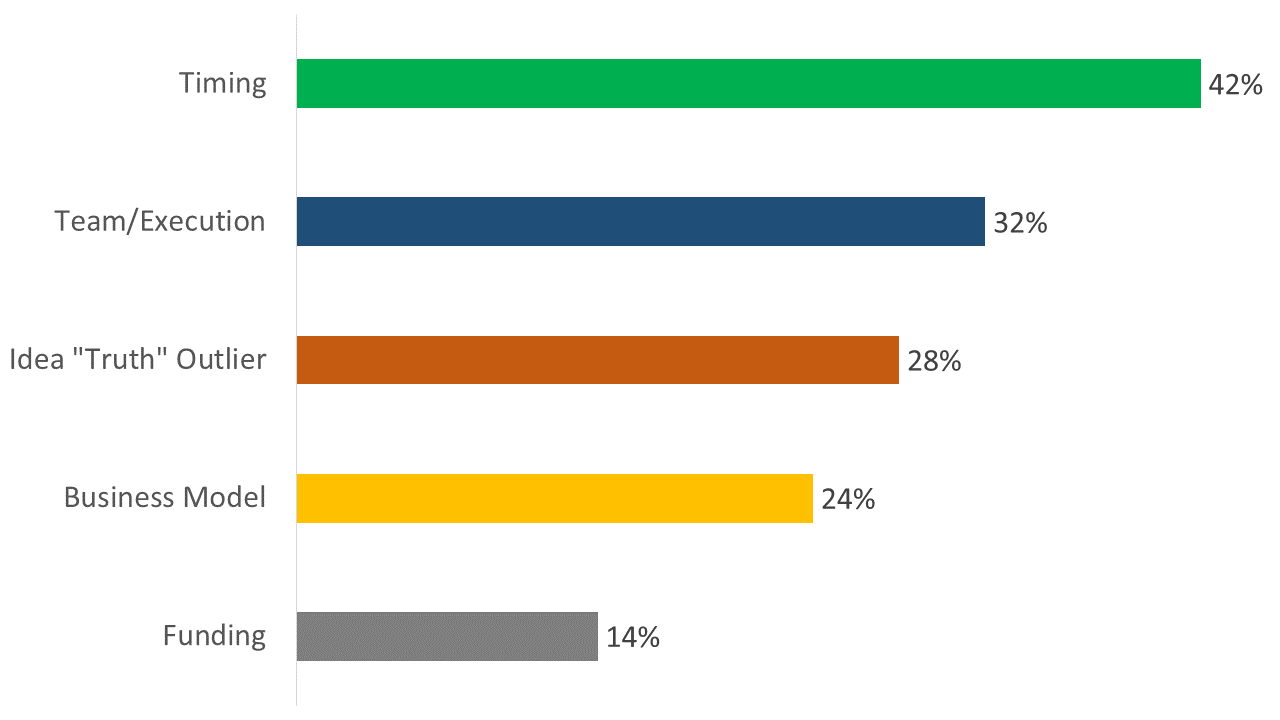
Timing Graph

Thus given, one ends up wondering how to estimate the right timing for a startup. Especially nowadays where industries and business models get disrupted on a higher frequency than ever before.

Failure permitted! – A call for more courage and endurance!

If Howard Schultz had given up after having been turned down more than two hundred times by banks, there would be no Starbucks today. If J.K. Rowling had given up her writing ambitions after several publishers told her they did not like her ideas for a fantasy novel, we would never have heard about Harry Potter. If the young Thomas Alva Edison had stopped after one of his failed attempts to create a working light bulb model, I wonder what our world would look like today. Instead of giving up, he just gave it another try and after his final success, he turned to the numerous sceptics and said: “I have not failed. I’ve just found 10,000 ways that won’t work.”


Making mistakes is our generation’s privilege

Working in a fast, globalized and disruptive business environment, while at the same time in a secure social society, is the best thing our generation can ask for! Today, hundreds of people are leaving their “safe” career paths as employees, creating their own businesses and following their ambitious goals of success and wealth. Therefore, it would be foolish to believe that your business idea is the only thing you need on your way to fame and fortune. Because of the many well-educated and trained competitors, it takes hard daily work, endurance and consistency more than ever. You need trustworthy suppliers, partners and employees as well as business angels, experts in venture capital and financial advisors. What it takes is an open mind towards new forms of business organization like co-working and co-creation and many more personal and professional skills. Most notably though, it takes courage to get up again after your business has crashed down. If you don’t get up and attempt to get your business, your team and yourself back on track, you will neither find success nor personal fulfilment.


Failures are permitted, Quitting is not

One lesson I have learned from my own company’s history is that there are a lot of institutions, NGOs, investors and experienced individuals who are willing to help you with your business idea. Professional experts along with the right mindset and skills can give every entrepreneur a powerful head start. This is the reason why I try to offer young business owners my helping hand, before and after their successful take-off, calling on them for more courage and endurance in their business careers.

“Failure permitted” (or ‘Scheitern erlaubt’ in German), is the overarching theme of this years ‘Jungunternehmertag’ (Austria’s biggest fair for business creation, young entrepreneurship and start-ups) which is taking place on October 13th at Messe Wien. It is the perfect opportunity for young business owners, start-ups, students and people who are considering starting their own company to learn more about successful business creations and the opportunities of failure from our special guest speakers who will be talking about their own respective defeats. We are looking forward to getting to know you, and learning about your business ideas!

One thing’s for sure: If you give up too soon or if you don’t get up again after a setback, you will never know what you will be missing. Keep going and don’t ever quit! Go to www.jungunternehmertag.com.


Juergen_Tarbauer_JWW_c_Junge_Wirtschaft_Wien


Jürgen Tarbauer is Founder and CEO of the marketing and advertising agency OMNES and Chairman of the Junior Chamber Vienna (Junge Wirtschaft Wien, JWW), an association of young entrepreneurs and leaders between the age of 18 to 40 years. JWW provides several business services and lobbying for better regulations for enterprises as well as national and international networking opportunities for its 3.500 members.

Picture: © Junge Wirtschaft Wien.


Startup Funding – five tips to improve your chances

Raising capital for your startup can be critical, considering a startups runway – mistakes could kill your project for good! External funding (Venture Capital) will enable you to grow your company much faster, more professionally and globally competitive. All of the startups which made it to the unicorn club in the first quarter of 2015, have been backed by several Venture Capital Funds and Business Angels, as stated in the CB Insights Blog Article.

Money alone never made a Unicorn out of a startup- it most definitely needs much more! Still if your business is in need of risk-taking investors, you should make sure to attract the right ones, at the right time, with a reasonable amount of money to gain enough traction, improve your product and eventually make it to the next stage. So, what are the best tips to get funding for your startup? Here’s five of them to remember.


#1 Plan your financing round in advance

One of the most common mistakes is that too many startups start looking to raise money once they have spent all of their cash. This is too late: once you are desperately looking for money, you end up in a very weak negotiation position, and therefore are tempted to accept any investment offer, under any circumstances or conditions.

A good timeline would be to start searching for investment at least 6 to 9 months in advance, even if you do not currently need cash at this moment. Per example, if you have just closed a seed investment round of 50K EUR, which represents a 9 months runway for your company, start planning the next round right away by setting objectives. If you announce tangible KPIs for the next three months in terms of traction, you will have solid numbers which will show investors your progress, achievement (even over achievements) and overall management capabilities. Don’t forget: working with investors requires relationship building, which takes time and trust.


#2 It is all about Smart Money

Many founders believe that raising money is just about filling your bank account and having a great burn-rate running “happily ever after”. This is obviously not true! Money alone keeps your project alive for another couple of months, but smart money gives you wings to fly! You could also think about it in this way: Money is just like petrol for a car – without a vehicle it will still burn, but at the end of the day will not take you anywhere.

Smart money also means that a startup doesn’t only apply to an investor: An investor also applies to be part of a startup’s growth because he or she can bring special added value to the startup. In fact I have realized that the best investors are willing to fight for a shot at the best startups. With the right investor you will feel like in a rocket launch – forget about cars and petrol, if you have the chance to reach for the stars!


#3 Profile your potential Investors

Venture Capitalists and Business Angels screen hundreds of startups per year, and quickly develop a set of criteria which help them judge if a startup is interesting to invest in or not. Getting to know-how an investor ticks is crucial, as you can nail your pitch right at this point.

According to the Angel Resource Institute, most investors base themselves on the following factors as being Best Practices in Dealscreening

  1. Region: Most Investors have a strong preference to Ventures which lay less than two hours flight from their offices.
  2. Technological/Industrial Focus: Investors tend to finance startups in industries where they have strong knowledge and expertise. Don’t pitch your Biotech startup to VC with focus on e-commerce.
  3. Growth potential: Investors rate market growth potential as top factor when considering a company. This means for some that the startup is already generating revenue and for others that the startup has a viable competitive edge which will lead to fast market capture.
  4. Management Team: Here, basic criteria often include trustworthy and commitment. Furthermore, the team has to be balanced, which means a founding team which includes technical, managerial and sales knowledge.


#4 A rocking pitch deck

The fundament for raising capital is a killer pitch deck, or in other words a document presenting your company in a simple and understandable way. Remember: the aim here is to hook the potential investor from the very first look. The pitch deck needs therefor to be extremely clear and concise, one which can be understood by everyone, especially if this person is not familiar with the companies sector. Ten slides are usually more than enough to give the overall picture. Realize that professional Investors and Analysts do not have more than 10 Minutes to decide, if your project is worth to dig deeper, or not – as they see a huge amount of deal-flow every day! I really think Guy Kawasaki’s nailed it in his article the only ten slides you need for a pitch.


#5 Take the most out of NO’s

Let’s face it: you will most probably get several rejections during your finding process. Fundraising is just like a sales process, so you will get to be familiar soon with the 10-3 -1 ratio: it will take you on average 10 meetings to get to three leads, and of these you may eventually get one investment. According to the Harvard Business Review, Venture Capital is even tougher. Only a tiny fraction of the total amount of startups applying for Venture capital money got investments, lower than 1%! You will probably fall several times in the 98 or 99% of startups rejected. And there is a lot to learn out of it. Does the investor see a problem in the team, market or strategy? Or is it just a misfit regarding the fund focus?

A good way to approach this is to get as much investor feedback as possible and aggregate them. You will probably very soon notice a clear pattern, which will teach you a lot about how your startup is perceived by externals.


Overall, it is crucial not to underestimate the fundraising process, which requires a lot of effort, time, network and specific expertise. From our experience, three to six months of intense fundraising has an opportunity cost which is always higher compared to hiring a professional advisory team to work on it. We are proud to have advised successfully more than 50 Startups and closed transactions with an overall volume of about 350 Million Euros over the last two and a half years.

To find out more how Venionaire can help your startup in fundraising, get in touch.

6 reasons for European Startups to go to New York

Big news struck the US financial sector this month: The New York based startup Etsy, an online marketplace for handmade unique items, made its initial pulic offering (IPO) at a valuation of $1.8 billion. Even more thrilling, it saw its shares and market capitalization almost double on Nasdaq the first day of trading.


Yuliya Chernova from Wall Street Journal describes this IPO conveniently as „Milestone for New York’s Startup Scene”. One reason is that big exits bring in cash, which will allow venture capital investors to spend that money on new venture while staying in the region. Her analyses completes particularly well our previous article in VentureBeat “Why New York City is the best choice for European Startups”. To sum up, we see New York as the place to be for any European startup identifying itself as a “born global” and the aim to scale globally. The City has some huge advantages:


  1. It has one of the strongest financial ecosystem worldwide. New York alone places more than half of Europe’s venture capital capacity and has a powerful banking sector.
  2. The average investment size is much bigger in NYC than it is in Europe, making the city the hotspot for later stage investments.
  3. New York has a strong Corporate Venture scene.
  4. With “Start-up NY” the city government is offering “tax-free zones” for qualified business within the first years of the company. Simply unimaginable in any of Europe’s high tax countries!
  5. 52 of 500 Fortune companies are in New York.
  6. Last but not least, New York is on the East Coast and is much closer to Europe than the Silicon Valley on the West Coast. Time difference matters if you work daily or weekly with off-shore teams in Europe.

The combination of these six arguments is the reason why we opened an Office in New York City. Alongside of other European investors, we are already seeking to create a landing platform in New York. Read more about this topic on VentureBeat.

WHERE TO FIND US

VIENNA, OFFICE (HQ)

Babenbergerstraße 9/12,
A-1010 Vienna, Austria (EU)
office@venionaire.com

SAN FRANCISCO, USA

1355 Market St. #488
San Francisco CA 94103
sfo@venionaire.com

NEW YORK CITY, USA

122 East 37th Street
First Floor
New York, NY 10016
nyc@venionaire.com

LONDON, UK

Gable House, 239 Regents Park Road
London N3 3LF
office@venionaire.com

MUNSBACH, LUX

3 rue Gabriel Lippmann
5365 Munsbach
office@venionaire.com

LOOKING FOR FUNDING?

FOR STARTUPS

Venionaire Capital exclusively invests through the European Super Angels Club, for more information and application please go to the website. We do not accept direct investment proposals via this website.