The Corporate Startup Engagement of Austrian Companies

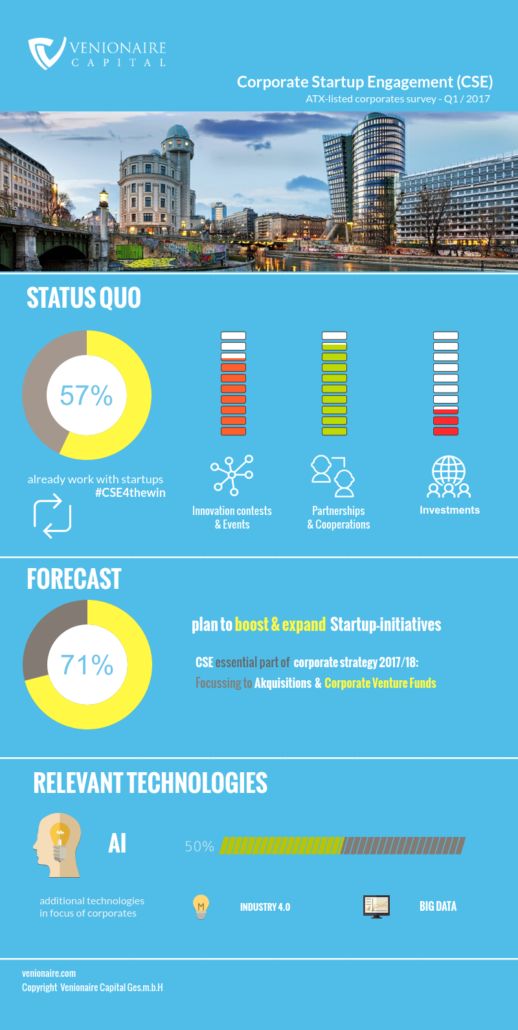
Venionaire Capital asked in the Austrian Trade Index (ATX) listed companies about their corporate startup engagement with surprising results: Every second company already works with startups and about two-thirds of the companies regularly participate in innovation and startup challenges in order to find new business ideas. Corporates identified Artificial Intelligence (AI) as particularly important.


Collaboration between corporates and startups in Austria is in the forefront, as a recent survey of the consulting and investment company Venionaire Capital among the largest Austrian companies revealed. More than half of all surveyed companies have already worked together with startups. Especially innovation competitions, such as the annual “Innovation to Company” startup challenges developed in cooperation with the Vienna Chamber of Commerce, are particularly popular. With this great interest in startups, Austria follows an international trend.


Note:
Agreeing on a valuation is one of the most critical point for a good corporate startup relation. We developed a startup valuation tool to help with that.

[hubspot type=cta portal=5314519 id=bc2a7bcd-bcee-4a08-960b-b43a6cea4bfe]


As a study by the business school INSEAD and “500 startups” from the year 2016 shows, more than two-thirds of the international top 100 companies deal with this topic. Global players, however, are not only looking to work but also invest in startups. Austrian companies were still hesitant in the past regarding early stage investments, but changes are emerging.


Enterprises want to intensify startup activities

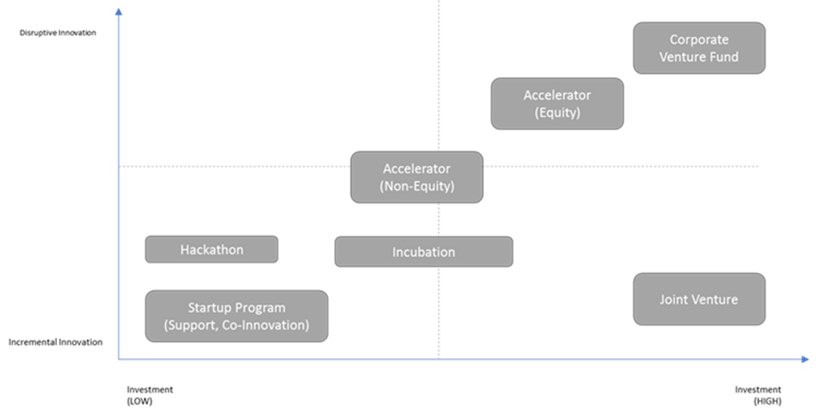
A good proportion of the surveyed companies would like to invest in startups in selected cases, which is, for example, possible through a partnership with the European Super Angels Club. Companies are also thinking about their own accelerators and corporate venture funds: “Corporates do not shy away with their accelerator and innovation hub programs from working with partners from complementary industries, as it is the case with Talent Garden in Vienna. Regarding corporate venture funds, openness depends very much on the extent of the strategic orientation of the corporate”, explains Berthold Baurek-Karlic, founder and CEO of Venionaire Capital. Our survey shows, that all companies, which have already worked with startups, want to intensify their startup activities. Companies with no startup engagement yet, see it as a potential part of their 2017 digitization campaign.


Reduce costs, increase innovation

The motivation for working with startups coincides with the global study from INSEAD and 500 start-ups: Established companies expect from a corporate startup engagement (1) more innovative ideas, (2) fewer innovation costs, (3) the possibility to test new products, and (4) mitigate the threats of new digital business models. Austrian corporates show a high interest in Artificial Intelligence as well as in big data and Industry 4.0 ( digitization of machines, infrastructure and buildings).


Positive reinforcement

The Austrian startup ecosystem is like a snowball – once moved, it now gains quickly more substance and speed, says Baurek-Karlic: “The on-going professionalization of the startup teams brings a new interest of investors and corporates, whose interest encourages new founders, who in turn attract new players on the market. Especially in our advisory activities for the “Innovation to Company” startup challenge and other projects with companies such as A1, AccorHotels, Microsoft Austria, New Frontier Group, Austrian Post, Raiffeisen, Uniqa or Verbund, show us, that startups getting more and more attention. These potentials should be leveraged at a pan-European level, which is why we were involved from the very beginning with Talent Garden in Vienna and the founding of the European Super Angels Club.”


KPMGs Pulse of FinTech – setting the pace

Last year European investment volumes were on decline not least due to political reasons: the turbulent political year of 2016 gave us Brexit, elections and referendums all across Europe (Italy, Austria, France), directly influencing the stability of financial systems and caution of investors. Similarly in the US: the elections, as the period of political uncertainty has influenced the investors on the other side of the Atlantic, too. However, when looking east, political stability in the Asian – Pacific region brought about the complete opposite: a lack of significant political events and turbulences gave the impression of economic stability. This fact directly reflected on the upward trends in Asian FinTech ecosystem investing activities.

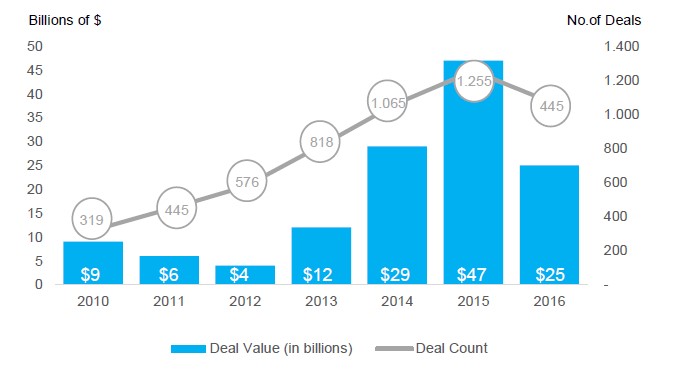
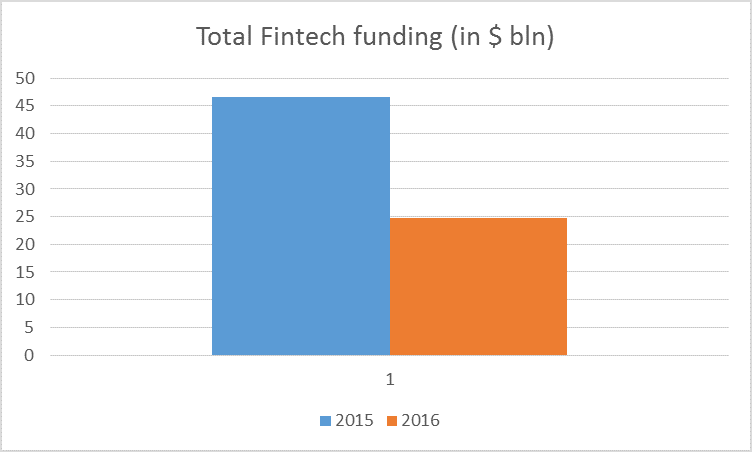
So how did we get to where we are now? 2015 has brought us plenty in terms of innovation and investing activity within the area of financial technology, the developments in the year behind us did not pick up such a fast pace. In 2015, we witnessed the strong emergence of innovative financial services delivered through a blend of various channels, combining various platforms and technological tools: the terms such as blockchain, API or POS became closer to the customer and in a way part of a daily conversation. These innovations have been fuelled by huge investment injection of $46.7 billion in value on global level. However, according to KPMG’s analysis of 2016, the FinTech market shows signs of slowing down. The decrease of almost 50% brought the investment value on a total of $24.7 billion.


Investment by FinTech Segments

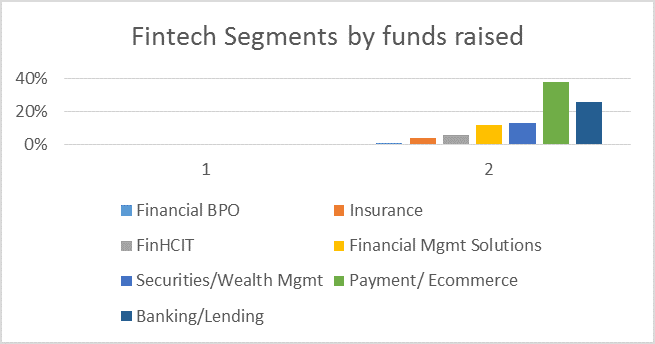
Banking/Lending has been the dominant segment when it comes to the number of companies raising funds (29% of companies that raised funds belonged to this segment).

However, the segment of Payments/Loyalty/E-Commerce is the one where the total funds raised value is highest. Companies categorized in this market segment have raised 39% of total funds raised by the entire Fintech industry in 2016.


M&A, PE, IPOs and VC deals

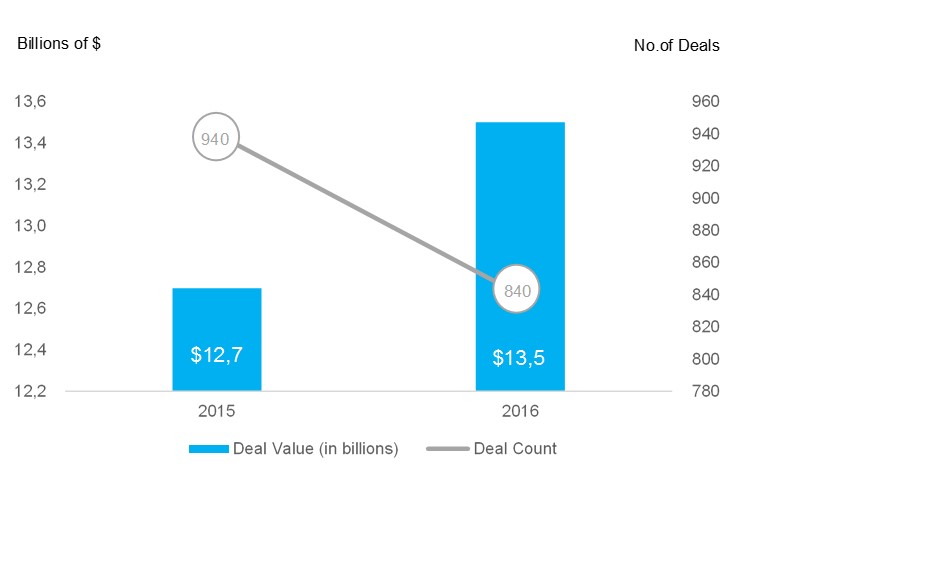
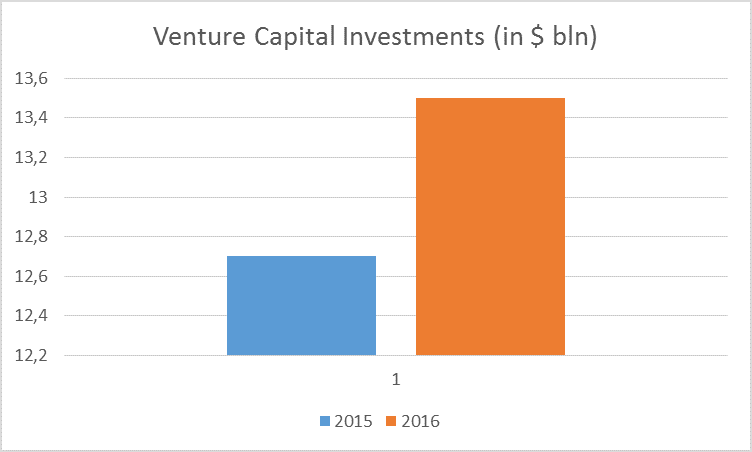
When analysing the structure of financing deals, the increase in venture capital activity is noticeable in comparison to 2015. According to KPMG, M&A and PE FinTech deals dropped considerably in 2016, while the venture capital investments reached $13,5 billion, even more than $12,7 billion in 2015.

The reasons for such a boost are mostly three gigantic financing rounds in China. The funding round to Ant Financial that occurred in second quarter last year was $4,5 billion heavy. Besides Ant, two more historic financing rounds, each over $1bn, significantly increased investment numbers in China.
Luf ax.com – $1,2 billion and JD finance – $1 billion.
After these three giant investment shots, China outpaced the US for the first time with $7,7 billion in total value of deals (28 in total), with an 84% increase in comparison to 2015 ($4,2 billion).
Except Markit’s $5,5 billion merger with HIS, there were no significant IPOs in 2016, either. The expectations are that the trend will pick up in 2017, as we have more mature companies in the market. The most active FinTech investor was fund and accelerator 500 Startups with 39 investments. In June, they announced raising a $25million separate Fintech fund for investing in early stage companies globally.


Key Q4’16 indicators

KPMGs report found that the last quarter of the year showed some revival of the investing activity. The VC funding increased from $1,9 billion to $2,1 billion between third and fourth quarter of the year, though still not near the previous year’s numbers.
On the American continent, VC investment revolved around $1,1 billion in Q4 ’16, not deviating too much from the previous year’s results for the same period.
In Asia, VC funding jumped to $680 million after a year’s low of $200 million in third quarter. The rebound was mostly driven by a $ 384 million deal in the last quarter.
Europe has stayed relatively stable, sitting on $319 million of investments in the industry. This result still remains lower in comparison to the same period in 2015 (around $350 million).


FinTech Future?

The appetite for investing has certainly not vanished, neither is the appetite for innovating. 2017 is the year that can bring revival in terms of more overall activity in the market and possibly some significant shifts that would include big investment deals and the appearance of some new innovative solutions. There are three major drivers to this possible scenario:

• As soon as we experience some political stability, the expectations are that the trends of investing will pick up the pace
• Regulation that should take force in 2017 (PSD2) will stimulate innovation in the field of FinTech, leading to even more aggressive investing activity
• The strong upward trends of technology adoption in emerging markets could fire up the payment segment (mobile to mobile just might be the key feature in 2017)

Whilst we only know what the future holds once it becomes our present, we can do our best in predicting it by shaping it.


Sources:

  • KPMG – the Pulse of Fintech Q4 – data highlights
  • The 2016 VC FinTech Investment Landscape by Innovate Finance
  • CB Insights, Fintech Trends Report, 2016
  • Pitchbook, 2016

Fintechs meet up in Berlin

The Pioneers Festival attracts over 2500 attendees, selected startups and investors to Vienna’s Hofburg every year. Now, Pioneers has started a series of smaller events around Europe with a focus on selected topics. Venionaire recently attended the Fintech.Pioneers event in Berlin 16-17th February 2017. Fintech.Pioneers started in a relaxing ambience on Thursday in a former brewery and soon to open as bar location in Berlin. It was great to meet the event’s participants in such a relaxed manner. On Friday the Fintech.Pioneers Bootcamp Day started with full speed in the following format: 3 fintech expert speakers would present briefly on their topic, followed by 4 startup pitches with Q&A aided by Piobot, whom the audience could send their questions to.

The audience was lead through the most important Fintech topics in a very organized manner: the kick-off was given by an introductory session on the disrupting nature of Fintech, with co-founders of Wikifolio Can Ertugrul, Bitcoin.com co-founder Adam Stradling and Augur’s Perry Despeignes. All three speakers stressed how their innovations gave users the power for more transparency, central to the rise of Fintechs.

Then 4 startups pitched on stage: Italian Euklid presented its AI-powered decision making trading algorithm; Bitbond, one of the three finalists, explained how it enabled worldwide small business loans via Bitcoin transfers; Crediwire provides banks with a tool for credit ratings for small businesses and FinTecSystems provides banks with its client’s real-time data for financial transactions. After the first session participants were given a two-hour time slot for meetings, which could be neatly organized through the event’s platform.

In the next session, Adizah Tejani from Token.io explained how the new PSD2 directive (Payment Services Directive to come into effect 2018) – which obligates banks to provide third-party providers access to their customers’ accounts through open APIs – will enable third-parties to build financial services on top of banks’ data and infrastructure. He argued, that through Token.io this could also be an opportunity for banks as they could be effectively led to comply with the new regulation. Alexander Graubner-Müller and Erki Kert from Big Data Scoring both presented their solutions for small business loans. In the second session of the startup pitches, Enterprise Bot presented its white label solution for banks to chat with their customers; Hufsy is a simple accounting system for startups; finalist Telleroo enthusiastically shared how through its payment solution platforms could pay large numbers of vendors and zuper shared how it wants to become a personalized financial advisor to users through comparing different providers and providing users a neat oversight over one’s finances via app. The session ended with a panel discussion on how the retail bank of the future would look like – Maximilian Tayenthal from N26 spoke of a “democratization of financial services”, where customers would receive better services at better prices.

After a short break, fintech investor Marc Bernegger explained how there are several fintech hubs across the continents yet that the European market is an opportunity for Fintechs. In the following session speakers went into how banks and startups could collaborate using the blockchain technology. Digital strategist Axel Apfelbacher, Bruce Pon from Bigchain DB and Joshua Scigala from Vaultoro went on to share their view on how blockchain allowed for entirely new solutions – such as Vaultoro’s bitcoin/gold trading solution – which not only were unthinkable before, but added immense value and transparency for users. In the last startup pitching session we heard about Quantoz’ blockchain based solutions for banks; Blockchain Helix’ blockchain based KYC solution; Plutus’ payment gateweay for bitcoin holders and last but certainly not least as the startup won the best of prize: Bitwala’s solution as the fastest global bank transfers paying with bitcoins and cashing out to debit cards or bank accounts.


Overview of all participating fintechs

  • Italian Euklid presented its AI powered decision making trading algorithm
    Founded: 2014, HQ: Milan, investors: Leve39, Club Digitale, Club Italia Investimenti.


  • Bitbond, one of the three finalists, explained how it enabled worldwide small business loans via Bitcoin transfers;
    Founded: 2013, HQ: Berlin, investors: Angel investors, website: www.bitbond.com


  • CrediWire provides banks with a tool for credit ratings for small businesses
    Founded: 2015, HQ: Copenhagen, investors: TechFounders, website: crediwire.com


  • Enterprise Bot presented its white label solution for banks to chat with their customers
    Founded: 2016, HQ: London, investors: Startupbootcamp, website: www.enterprisebot.org


  •  Hufsy is a simple accounting system for startups;
    Founded: 2015, HQ: Copenhagen, investors: North-East Venture, website: www.hufsy.com


  • Telleroo enthusiastically shared how through its payment solution platforms could pay large numbers of vendors
    Founded: 2016, HQ: London, investors: Seedcamp, Pioneers Ventures , website: www.telleroo.com


  • Quantoz’ blockchain based solutions for banks;
    Founded: 2013, HQ: Netherlands, investors: TechFounders, Agile Accelerator, website: quantoz.com


  • Blockchain Helix’ blockchain based KYC solution;
    Founded: 2016, HQ: Frankfurt, investors: angel backed, website:  blockchain-helix.com


  • Plutus’ payment gateweay for bitcoin holders;
    Founded: 2015, HQ: London, investors: North-East Venture, website: plutus.it


  • Bitwala’s solution as the fastest global bank transfers paying with bitcoins and cashing out to debit cards or bank accounts.
    Founded: 2015, HQ: Netherlands, investors: Evonik Venture Capital, Digital Currency Group

0100 Conferences: International VCs and Angels in Vienna

picture from left: Jürgen Lederer (KPMG), Berthold Baurek-Karlic (Venionaire), Michael Petritz (KPMG), Christoph Drescher (Dealmatrix), Fabian Greiler (Venionaire)

Last Thursday, the 0100 Conferences took place at the Hilton Hotel in Vienna. The goal of the Conference is to bring Western and Eastern Investors together. The event originally launched last year under the name of Up Venture Conference“. 0100Ventures – the organizers of the event – are well-connected in Europe, which has been reflected in the international speaker lineup.

Michael Petritz, Partner at KPMG Austria, started the conference with an opening panel about “Venture Capital in Europe”.


Michael Petritz Partner at KPMG Austria (Board Member of European Super Angel Club) now opens the first panel of the…

Gepostet von Venionaire Capital am Donnerstag, 16. Februar 2017


Together with Uli Grabenwarter (Deputy Director – Equity Investments at EIF), Olivier Schuepbach (GP at Partech Ventures), Joe Schorge (Managing Partner at Isomer Capital), Ralph Guenther (Partner at Pantheon), and Fabian Heilemann (Partner at Earlybird) he discussed the status quo and future of the VC industry in Europe. The topics included the role of incubators, accelerators, and co-investment schemes in Europe for VCs. They also mentioned the European Super Angels Club, powered by KPMG and Venionaire, as one example for new investment opportunities in Europe. The Club provides a platform for (U)HNWI, family offices, foundations and corporate investors to follow Europe’s leading venture capital funds as co-investors.

We were involved in two panels. Dan Choon, the Managing Partner of Venionaire Investment, moderated the panel about the Automative Industry with Sophie Paturle (Managing Partner at Demeter Partners), Paul McNabb (Partner at Episode 1), Juraj Vaculik (CEO at AeroMobil) and Michael-Viktor Fischer (CEO at Smatrics).


Our Dan Choon moderates now the panel on automotive with Sophie Paturle from Demeter Partners, Paul McNabb from Episode 1, Juraj Vaculik from AeroMobil and Michael-Viktor Fischer from SMATRICS.

Gepostet von Venionaire Capital am Donnerstag, 16. Februar 2017


At the same time, Berthold Baurek-Karlic participated in the second panel as a speaker about “Angel Investment in CE”. He mentioned that Austria has seen a rapid development during the last years. In 2013, the total Business Angel Investments in Austria amounted to only € 2,9 Mio. In 2015 we had total angel investments of € 16,3 Mio.  – more than in Poland with € 12,4 Mio. (see EBAN European Early Stage Market Statistics 2015) However, the whole CEE region is gaining speed with a 130% increase in angel investments between 2013-2015. (see investeurope.eu)


“Angel Investment in Central Europe” with Lukas Püspök, Peter Oszkó, Karol Gogolak and @Berthold_KARLIC.

Gepostet von Venionaire Capital am Donnerstag, 16. Februar 2017


The Conference had a high-quality of speakers and guests. The organizers, 0100Ventures, are based in Bratislava, with the aim to create and support new ventures, foster local talents and contribute to the development of the European startup ecosystem. Besides 0100Conferences, they operate a 600 m2 co-working space in Bratislava and are offering rapid development and value chain optimization for established companies. We are looking forward to hearing more of their initiatives! By the way: Join their next event in Dublin on May 10.

© Featured Image: © Mako Hindy / Masahi Films

Talent Garten opens in Vienna

The Talent Garden A1 Telekom Austria campus will be a physical platform for digital, tech and creative professionals to work, learn and connect. A reference point for the Austrian innovation ecosystem promoted by Talent Garden, Europe’s largest coworking network, with the strong support of the most important players of the industry and local institutions: A1 Telekom Austria, Raiffeisen Zentralbank and the Vienna Chamber of Commerce and Industry. Venionaire is a proud founding partner of the Talent Garden Campus in Vienna.

A1 Telekom Austria provides the ideal location for the campus: 5.000 square meters’ venue that will host TAG café, event spaces, and coworking, which will open 24/7 and host more than 500 professionals.  Start-ups, existing companies, freelancers, investors, and agencies will work together to create innovations. The advantage is the exchange between the enterprises working there, in conjunction with TAG Innovation School, a unique in-house academy in the digital field, events, a community gastronomy and an internal networking platform. The coworkers can work based on their membership in all other Talent Garden locations across Europe.

Talent Garden successfully operates 18 such campus locations in six countries as a leading European company. Talent Garden has just closed an EUR 12 million investment round that will fund its further expansion into Europe, reaching 70.000 square meters across the network and 8.000 members.


Davide Dattoli, CEO Talent Garden: “We have been planning to expand into a German-speaking city for the first time since the middle of 2016. Vienna has convinced us for three reasons: Firstly, an ever-growing startup and digital ecosystem. Secondly, an incredibly positive feedback from our founding partner A1 Telekom Austria and all the industry-leading corporate partners and the public sector the Vienna Chamber of Commerce and Industry, the City of Vienna and the Business-Agency Vienna Wien helped who us in a cooperative and bureaucratic way. From this point of view, Vienna is an ideal base for our community work in the region. Last but not least, a committed group of our local co-founders is crucial for the acceptance in the creative scene of a city. We have been working with our co-founders Martin Giesswein, Max Lammer, and Berthold Baurek-Karlic for months and together with our colleagues from Italy, they are now preparing the opening. From April on, Bernhard Kainrath as local managing director will join the team.”


Alejandro Plater, CEO Telekom Austria Group: “By hosting Talent Garden A1 Telekom Austria campus, we prove our long-term commitment to Austria’s Start Up ecosystem and outline, that we are working very hard on the development of new industries in order to strengthen Austria’s economy. We as Telekom Austria Group are the digital backbone of Austria as a business location and provide our core competences to the Start Up community to encourage innovation. Because: Innovation is in the DNA of Start Ups, which is the reason they have been disrupting entire industry sectors and will do so in the future. And exactly this kind of “will to innovate” is very much needed in a digital world”.


Margarete Schramböck, CEO A1: “As one of the major enablers of Austria’s digital future, A1 has already been supporting the Austrian Start Up scene for more than 5 years. We have helped almost 10 Start Ups develop and scale their business. Start Ups are a vital part of Austria’s economy and are responsible for more than a third of new jobs annually. With the Talent Garden A1 Telekom Austria campus we will support the Austrian Start Up ecosystem growing and innovating.”


Michael Höllerer, Member of the Management Board of Raiffeisen Zentralbank Österreich AG: “The concept of Talent Garden is absolutely convincing. It was clear for us, that we will support the idea of having such an innovation hub in Vienna. As international banking group, we focus on sustainable digitization and innovation topics. Cooperating with FinTechs and Start-ups is an important part of our strategy. Still during the first half-year 2017 we will start our accelerator program. For this Talent Garden provides the ideal basis and therefore we will have our own startup space within the campus. Michael Höllerer is coordinating the topics of digitization and the cooperation with Talent Garden for the whole RZB-Group.


Walter Ruck, President of the Vienna Chamber of Commerce and Industry: “Industry 4.0, automation, broadband offensive, digital & mobile revolution – the economy of tomorrow has begun already. If we want to be a strong player in an international and competitive environment, we have to make the city of Vienna a hotspot for the young, wild and creative start-ups. This is also the reason why we support Talent Garden. In Vienna an international competence centre and home for the start-up industry comes into being. These are very good news for the location for business and the entrepreneurial future in this city“.


Martin Giesswein: “Parallel to the adaptation of the building, we are going to invite Viennese start-ups, freelancers and digital-oriented companies together with other well renowned corporate partners in the coming weeks to move into the campus with us when it opens middle of year 2017. We will ask well known stakeholders from the innovation scene of Vienna as ambassadors to work on building a vibrant and open campus community.”


The new Talent Garden A1 Telekom Austria campus will be presented to the Start Up community and the media at a community event at 28th of march. If you are interested in Talent Garden Vienna, please send us a “hello(Replace this parenthesis with the @ sign)venionaire.com”.

Picture: © Talent Garden, Instagram.

Technology Stack for Investors I: Research

How to make it on the Road to Dakar? Winning the race with a strong investors’ brand. In this blog series, we explore what it takes to get your investment tools in order by looking at the following four major areas: research, deal flow, portfolio management and network management.


There is some truth to the saying that “investing in early-stage tech is more of an art, than science”. However, just as the Paris-Dakar rally is not won purely based on enthusiasm and gut feeling, but rather the adequate handling of the right machine and equipment, early stage investors also need to be adequately equipped to perform. Funnily enough, we found out that although a majority of investors deal with innovation and technologies every day, they stick to excel spreadsheets, word documents, as well as paper and pencil for their own work. “The blacksmith’s horse has no horseshoes” is resounding in our day and age as well. To be fair, technology for this industry has only evolved a couple years ago and the adoption rate is rising. The need for a technology stack is not only directly correlated to the rising complexity of the business, it is particularly necessary to track one’s investments effectively as well as providing resource efficiency. Investors have to balance their fix costs as they have a direct negative impact on the IRR. Whether you are mostly looking for a deal flow at the very beginning, or just started to improve your inner processes, or find yourself in the need of a better way to track a large number of investments: you will have to choose if you stick to the old way or implement a digital technology stack for your early stage investment business. Ultimately, you want to choose the best machine if you want to get to Dakar.

First quest: what does my machine need to be able to do

To guide you through the windy and sandy maze on your route to Dakar, we have divided the technology stack into four major areas:

  1. research,
  2. deal flow,
  3. portfolio management,
  4. and network management (including business intelligence, monitoring and internal communication).


 Technology stack for Research

VCs provide research: a) to gather the important expertise b) to be known as an expert in the field and c) gathering inbound deal flow. Thus to make it onto the race track, the rally driver needs to prove his skill and practice.


Gathering Expertise

Just as the race driver needs to first train to become one, investors need to do their homework – this is a time investment which needs to be made. There are many useful tools providing valuable data and information to facilitate your research such as

  • Product Hunt,
  • AngelList,
  • Crunchbase,
  • EVCA

or paid services such as

  • Pitchbook,
  • CB Insights,
  • Bureau van Dijk

which should be systemically followed in order to understand market dynamics, technology trends and current developments of valuations – as prices (multiples) will change in hype-cycles just like publicly traded companies. Apart from increasing the likelihood of successful investment strategy, venture investors need a deep understanding of markets, investor landscapes in a certain field and eventually deciding upon certain investment niches over others. The distribution of supply and demand of innovation across industries is critical to analyze in advance of a deal (as far as possible), as you will need to exit an investment down the road.

The pricing usually varies, depending on the functionalities and features a user prefers. Below is the table showing the comparison of free and pay services for some of the useful research platforms. See our table of software features.

Free databases like Crunchbase (in its basic version at least) and Product Hunt represent useful tools for general information, data mining and getting a quick overview of markets and competition. However, if your ambition is to dig deeper and generate high-quality information and real insights – including news and analysis, we recommend CB Insights, BvD and Pitchbook (make sure to verify if company data is 100% correct through a commercial registry, though). For the access to structured, official commercial register data on the global level we recommend Kompany.com.

As a company with a focal point oriented more towards European markets, our machine of choice is Pitchbook. The platform contains a better database of funding histories, valuation, series terms, information about the investors and startups and much, much more. The integration is well executed, as it enables exporting possibilities and integrates directly with other platforms, such as Salesforce and Microsoft Office Suite.


Be known as expert and gather inbound deal flow

A simple but effective way to strengthen your presence in the ecosystem is simply by publishing valuable insights through platforms like Medium for blogging, Quora for Q&A interaction and Slideshare for presentations. Your public presence will not only boost your reputation as a market professional, it will also help to gather inbound deal flow. The better your market reputation, the stronger you are as an investor, the higher the quality of deal flow and eventually your negotiation position will be when it comes to terms and valuation. If a large number of startups are addressing you as an investor, you will statistically have a better chance to select superior deals, but you need to know what you are looking for.

The platforms used for presentation of content (Medium and Slideshare) come in very practical packages, as the free versions offer a broad range of possibilities for raising awareness of your brand. For the purpose of sharing content, we consider Slideshares basic service more than enough. Depending on the preferences and subjective orientation, its Silver, Gold and Platinum subscription models offer upload benefits, monthly tracking of leads and geo-targeting, depending on the chosen model.


Conclusion

Research comes as a starting point, the first lap of your long and intensive race. It is also the point where you start assembling your powerful motorbike that should get you to the finish line before the other contestants. Be careful, power is not everything. The machine has to be balanced out according to your needs and adjusted to the conditions of the race. In the next lap, we will pay attention to the deal flow, the next critical piece of assembly you will need for your powerful drivetrain.


Some of the best practices from investors like Andreessen Horowitz or Sequoia that are using various platforms for their public presence could also be of use to you:

Blogs:

YouTube:

  • Sequoia Capital’s Doug Leone on Luck & Taking Risks by Sequoia


Clever Clover – Kick-Off NEO II

Last Friday, the beautiful Dylan Hotel in Amsterdam was the venue of choice for Clever Clover’s annual New Years event. The founders and managing partners of Clever Clover invited current portfolio und prospective startups, experts, and investors to share some news about the current portfolio of the firm (NEO I), thoughts on the last year, important learnings that have been made and how they kickstarted NEO II, with some little modifications compared to NEO I. Venionaire started to work with Clever Clover a little bit less than a year ago and it has been a trustful start of a strong collaboration between our two firms.

Amsterdam is a very interesting startup hub, you can literally feel innovation every second you walk around, as the city is a benchmark for electric mobility, many cabs are Tesla cars and there is this beautiful mix of modern, creative, courageous architecture shaping the character of the city. Of course, the Netherlands have a long tradition in international trade and do have numerous international corporates as well as some of the wealthiest pension funds, but we learned that there is even more, speaking to one of the rising startup accelerators NEXT Amsterdam. Esther and Timan are not only building their own business, they are also very enthusiastic about developing the ecosystem in Amsterdam and connecting it to European Hubs – let us see what we can do together.


NEO II

It sounds a little awkward, that NEO II is a Venture Capital Fund fully dedicated to the old economy – where most people would expect a strategy of digital or tech products, when they hear “Venture Capital”. Clever Clover is different. NEO II, the second fund of this VC focuses in particular on Fast Moving Consumer Goods (FMCGs) and it is a very well needed field to cover. The best proof for this is the strong demand of startups approaching the experienced network of Clever Clover.

We do believe there is a lot of fantasy in retail products and trust in the deep knowledge of Clever Clovers team. It is very hard to build a brand and place products in shelves all over the world, it is very expensive to develop hardware products and bring them into mass production, but if you succeed, you have most likely build a sustainable “old-economy” company. Venionaire brings in additional network and resources to back the management team in special situations. It’s valuable expertise in the field of digital services, performance marketing and fundraising helps Clever Clover in the development of their portfolio companies.

Clever Clover focuses on five sectors in relation to FMCG: Media, Sports, Distribution, Food and Retail in general. A unique selling proposition make NEO II a very special fund: NEO II aims at an exit through a founders buy-back of shares – at a clear multiple set at the time of investing. In order to achieve this goal, Clever Clover selects specific products and matches them with a strong mentoring and market access network in order to build solid, profitable companies.

The regional focus of the fund is mainly Austria and Netherlands, as it is obvious considering the core operations out of Vienna and Amsterdam. With its first portfolio, NEO I invested and accelerated a number of well-known startups like Flying Tent, Scoot and Ride, FlyFit or Adoptiq – with regard to performance, Clever Clover confirmed that its portfolio is exactly on track to achieve its target return.

NEO II was established as a legal cooperative (B.V.) based in Amsterdam and registered as an AIFM, by Marloes Voermans (Netherlands) and Heinrich Prokop (Austria) in 2016 and started to sign investors (members – to be technically correct, speaking of a cooperative). Marloes is very creative and hands-on. Connecting start-ups with the right people is an art to her and this is truly some magic hard to copy. Heinrich really needs no introduction in Austria, as he has been on three seasons of the famous Puls 4 TV Show “2 Minuten 2 Million”. He is a very successful entrepreneur in the field of FMCG himself – having run and build Gutschermühle to what it is today. (Note: Gutschermühle was acquired by swiss HACO AG in 2015)

AWS Risikokapitalprämie: “Kick-Back” for Early Stage Investors

[UPDATE 05.02.2019. The AWS Risikokapitalprämie ended with 31.12.2017]

2017 starts with very good news for national and international Start-up Investors. As of January 1st the Austrian Wirtschaftsservice (AWS – Austria’s federal promotion bank) provides a new risk capital initiative (Risikokapitalprämie) or „kick-back“ for investors, who invest in Austrian Startups.

Investors may receive up to 20% “kick-back” (immediate cash) from their investment of up to a maximum of EUR 250.000 per year, thus receiving a maximum “kick-back” of EUR 50.000 per year. This incentive is open for private investors, their private holding companies or family offices, but not for funds (which might be difficult to discern in some cases) as long as they are not publically listed. In terms of income and capital gains tax, this kick-back will most likely be considered tax neutral, similarly to other grant schemes – however, we do advise you to consult your tax advisor for specifics and validation for your specific case.


A lean 3 steps application process for AWS Risikokapitalprämie

First step: Investors will need to apply for the investment grant on the AWS web page directly – at the so-called AWS Fördermanager – before an investor is about to finalize an investment. You may have been signing a term sheet, but have not signed the final shareholder agreement nor closed the deal before this application.

Second step: Unless the startup has already been certified and possesses an identification number, a startup will have to undertake a so-called “Selbsttest”, a specific quick check on the AWS Fördermanager immediately, after an investor’s application. The startup should thus be prepared to hand in certain documents. This could be

  • a business plan with proof of the market innovation (ie. providing pending patent applications),
  • gained traction such as received risk capital in the past, a growing number of employees or a significant revenue growth projected,
  • in addition/alternatively, a startup may refer to other grants of AWS or FFG received before this application.


Third step: After the positive evaluation by the AWS, certified startups receive an identification number. The investor submits this ID together with a signed participation agreement and a transfer voucher of the amount invested. We have as of yet, how AWS will deal with investments other than cash (e.g. work for equity, media for equity, provided materials or any other kind of resources). We assume, that those will be treated similarly to other AWS programs – such as “double equity”, which have been considering those non-cash (at least a few types) investments in the past.

Several investors, within specific financing round, may apply for this “AWS Risikokapitalprämie” program. Trustors or other types of syndication vehicles should be also eligible for the grant if the participation chain is disclosed to the AWS. We would advise in this special case to consult AWS directly for clarification.

Good news for Austrian as a startup hub

Looking at comparable programs in neighbouring countries, we expect this new initiative (AWS Risikokapitalprämie) to attract more international investors to invest in Austrian Start-ups. We are looking forward to promoting a higher number of syndicated pan-European investments through the European Super Angels Club, where Business Angels, Family Offices, and (U)HNWIs will profit from this initiative in Austria.

Alternative Finance: Crowdinvesting on the Rise in Europe

Crowdinvesting as we know it today, began to gain traction in the wake of the 2008 global financial crisis, as raising capital through traditional institutions was becoming evermore difficult. Crowdinvesting was originally seen as a much-needed solution to the long-standing funding gap but this model soon proved itself as a legitimate source of investment. Although crowdfunding and crowdinvesting have experienced significant growth in recent years.


We want to give you an insight about Alternative Finance and especially about the European crowdinvesting market. As terms of Alternative Finance are often used wrongly, we want to give you first an overview of the three most common types:

What is crowdinvesting?

  • Equity-based: purchase of company shares, usually from early-stage firms to investors.
  • Mezzanine-based: debt capital that gives the lender the right to convert to an equity interest if the loan is not paid back on time and in full.
  • Debt-based: lenders receive a non-collateralized debt obligation, typically paid back over an extended period of time. Similar in structure to purchasing a bond, but with different rights and obligations.
  • Others: ghost shares, profit-sharing, exit-participation etc.

What is crowdfunding?

  • Donation-based: no legally binding financial obligation incurred by the recipient to the donor and no financial or material returns are expected by the donor.
  • Reward-based: backers have an expectation that recipients will provide a tangible (but non-financial) reward or product in exchange for their contribution.

What is peer-to-peer lending?

  • Business lending: debt-based transactions between individual or institutional investors and existing businesses (usually SMEs).
  • Consumer lending: debt-based transactions between individuals, most commonly unsecured personal loans.


Alternative Finance in Europe

In 2014, the cumulative European market size for alternative finance added up to €2,955.3m. Overall the whole sector grew by a 3-year average growth rate of 146%, which was made up by an increase of 149% from 2012 to 2013 and 144% from 2013 to 2014.

A closer look at the transaction volumes of different alternative finance models reveals that the market’s sustainable growth stems from its various sub-markets. From 2012 to 2014 most of these doubled in size, whereas individual ones even tripled (peer-to-peer business lending, invoice trading, and crowdinvesting). Thus, the European alternative finance market certainly has achieved strong and diversified growth.

Source: Source: University of Cambridge (2015). Moving Mainstream: The European Alternative Finance Benchmarking Report. London: Wardour.


Market Potential for Crowdinvesting

In years past, crowdfunding as a means of financing a business was more of a novelty. Today, announcing a crowdfunding campaign is just as common as any other traditional financing possibility, if not more so. With a market size of 173.6m, in 2014 it is difficult to overlook its macroeconomic importance. However, crowdinvesting has already overtaken crowdfunding in terms of volume. Following the previously introduced taxonomy, the market potential for crowinvesting has increased steadily over the past few years. With an average annual growth rate of 195% over the last three years, the European market for crowdinvesting has developed rapidly, from €24.9m in 2012 to €90.2m in 2013 and €205.2m in 2014. This is particularly remarkable compared to an average growth rate of 129% on the market for crowdfunding. An end of this growing phase is not in sight, as the crowdinvesting market profits from the also fast growing startup ecosystem in Europe.

If you are interested in learning more about Crowdinvesting in Austria, Switzerland and Germany, the legal framework behind it, and further trends in the market, we highly recommend you to download our 100% free report on Alternative Finance.


Unicorns and Black Swans

In his bestseller, The Black Swan, Nassim Nicholas Taleb lays out a theory about how people perceive probability. The book focuses mainly on events named “Black Swans” which distinguish themselves by holding three main characteristics:

  1. They have a possibility of occurring, no matter how unlikely this possibility may be,
  2. if they do occur, they cause a disproportionately high impact,
  3. and they are almost impossible to predict.

Sounds familiar? It certainly does for anybody involved in the Venture Capital industry. The desired aim of all startup investors is to identify and invest in companies which will make it bigger than 1 Billion USD, commonly named Unicorns. Unfortunately, a Unicorn shares the same characteristics as the Black Swan described by Taleb, making them by definition almost impossible to predict. Therefore, investors need to be involved in the startup scene  – travel, socialize and chat as much as possible. Besides that, investing is always a game of numbers. The only way to achieve a high IRR is to invest intelligently in many companies, making the law of large numbers work on your behalf. Several studies and mathematical simulations have shown that it takes investing the same amount of money consistently in at least 20 to 25 companies before your returns begin to approach the typical return of over 20 percent for professional, active angel investors. This means, the greater the number of companies into which an angel invests, the greater the likelihood of an overall positive return.

Venture Capital is all about making the right hit while investing. Giving the fact that any particular company has roughly similar odds of succeeding or failing, the lopsided nature of the returns means that, on balance, the more companies in which you invest, the more likely your whole portfolio is to generate higher returns. Finally, investors have to be prepared to accept failure. Finding a Unicorn often means experience some of the biggest disappointment and disasters you can imagine. At the end of the day, it’s all about having your winnings being bigger than the losses, which ever number of Unicorns turning out to be ordinary poneys.

WHERE TO FIND US

VIENNA, OFFICE (HQ)

Babenbergerstraße 9/12,
A-1010 Vienna, Austria (EU)
office@venionaire.com

SAN FRANCISCO, USA

1355 Market St. #488
San Francisco CA 94103
sfo@venionaire.com

NEW YORK CITY, USA

122 East 37th Street
First Floor
New York, NY 10016
nyc@venionaire.com

LONDON, UK

Gable House, 239 Regents Park Road
London N3 3LF
office@venionaire.com

MUNSBACH, LUX

3 rue Gabriel Lippmann
5365 Munsbach
office@venionaire.com

LOOKING FOR FUNDING?

FOR STARTUPS

Venionaire Capital exclusively invests through the European Super Angels Club, for more information and application please go to the website. We do not accept direct investment proposals via this website.