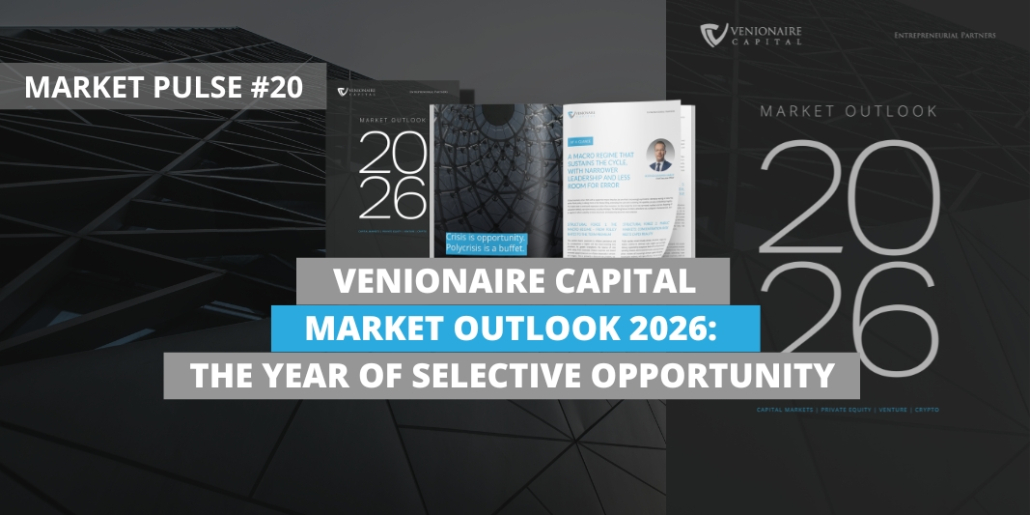
Venionaire Capital Market Outlook 2026: The Year of Selective Opportunity
With the Venionaire Capital Market Outlook 2026, Venionaire Capital provides a concise, cross-asset assessment of public markets, private markets, and digital assets. The report explains how macroeconomic forces shape risks and opportunities as fiscal policy extends the cycle and the margin for error narrows.
The global investment environment entering 2026 is not defined by recession, but by constraint. Growth continues, yet inflation remains persistent, interest rates stay structurally higher, and volatility becomes a permanent feature of markets.
Our central message is clear: the cycle continues, but the rules have changed.
The Five Structural Forces Shaping 2026
Against this backdrop, Venionaire Capital identifies five structural forces that will shape investment outcomes in 2026:
-
The Macro Regime: From Policy Rates to the Term Premium
The main macro challenge in 2026 is not weak growth, but inflation that remains higher for longer. As growth continues, inflation pressure, especially in wages and services, can return.
Even without new rate hikes, higher real yields affect asset prices. Bond markets are now driven more by government issuance and inflation expectations than by central bank decisions.
Long-term assets are more sensitive to yields, and valuation discipline matters across all asset classes.
-
Public Markets: Concentration Risk Meets Capex Reality
Stock markets are still dominated by a small number of AI-driven mega-cap companies. However, investors are shifting focus from growth and scale to capital efficiency, monetisation, and balance sheet strength.
High concentration and stretched valuations, especially in the U.S., increase the importance of relative value and diversification.
What matters more in this phase is not sheer market exposure, but the quality of earnings and underlying valuation levels.
-
Private Markets: Recovery with a Liquidity Filter
Private equity and venture sentiment has improved, but capital remains selective. While the European Venture Sentiment Index stayed positive through 2025, rising confidence is translating into targeted investments rather than broad risk-taking. For 2026, the main constraint is realisation pathways.
Although exits are improving, liquidity remains uneven, especially for earlier-stage and mid-tier companies, increasing the relevance of secondaries, structured equity, and venture debt.
Successful private-market strategies focus on exit readiness, capital efficiency, realistic timelines, and active liquidity management rather than relying on a single IPO window.
-
Regional VC Outlook: Leadership Broadens Beyond One Geography
Venture capital leadership is broadening beyond a single geography. North America remains the global center, but the focus shifts from funding growth to proving profitability and defensible business models.
Europe shows a cautious recovery with strong thematic depth, yet faces the challenge of scaling global champions. Latin America continues to stabilise, led by Brazil, while the Middle East expands through sovereign-backed ecosystems. In Asia, capital concentrates where regulation, execution, and infrastructure align.
Venture capital is becoming more regional and differentiated, making local market dynamics and exit pathways increasingly important.
-
Crypto: From Narrative to Infrastructure
Crypto in 2026 is shifting from speculation toward real financial infrastructure. Stablecoins, tokenised real-world assets, institutional DeFi, AI-driven on-chain settlement, and broader access via ETFs and indices are driving adoption. As utility increases, opportunities expand, but regulatory execution and credibility remain the key risks.
The opportunity set expands as crypto adoption shifts from speculation toward infrastructure, while regulatory execution and credibility risks remain the central challenges.
Venionaire Capital Market Outlook 2026: Bottom Line
The opportunity is real, but the game has changed.
2026 is not about chasing every opportunity, but about choosing carefully, understanding risks, and focusing on quality, realism, and structure.
Risk assets can grind higher, yet leadership is narrower, valuations matter more, and the discount rate is no longer a sideshow.
Investors who adapt to higher structural volatility and regime-driven rotations will be best positioned to navigate the year ahead.