
Posts

Small Modular Generators: A New Layer of Energy Infrastructure

Small Modular Generators (SMGs) are emerging as a new category of energy technology that sits between traditional nuclear, renewables, and industrial-scale infrastructure.

Global markets are entering a phase where energy systems, technological innovation, and capital allocation are increasingly intertwined. Stability, scalability, and cost-efficiency are no longer optional. They are prerequisites for any energy solution that aims to operate at scale.

In this context, SMGs represent a shift not just in technology, but in how energy systems are designed and financed.

From Reactors to Generators

For years, Small Modular Reactors (SMRs) have been positioned as the future of nuclear energy. However, SMGs introduce a fundamentally different approach.

Instead of relying on a continuous chain reaction, SMGs use accelerator-driven systems to trigger energy release. This removes several of the structural risks associated with nuclear energy and reframes the entire category.

As discussed in our latest Let’s Talk About Tech episode with Florian Wagner, CEO and Founder of Emerald Horizon, the concept is to retain the benefits of nuclear energy while eliminating its key drawbacks .

The result is a system that behaves less like a traditional power plant and more like a controllable energy device. Energy generation becomes something that can be switched on and off, rather than something that must be continuously managed at scale.

Modular by Design, Not by Label

One of the core differences lies in how SMGs approach modularity.

While many “modular” energy systems are still large-scale infrastructure projects, SMGs are designed from the ground up as container-sized units. Each unit delivers meaningful output on its own and can be combined depending on demand.

This changes the economics entirely. Instead of building one large asset, energy capacity can be deployed incrementally. It also reduces dependency on large grid expansions, as production can move closer to consumption.

From a capital markets perspective, this introduces a manufacturing logic into energy. Scaling is no longer tied to project size, but to production capacity.

Rethinking Energy Supply Chains

A central element of SMG technology is thorium.

Unlike uranium, thorium is widely available and geographically distributed. It already exists as a by-product of industrial processes, particularly in rare earth mining. This fundamentally changes the supply-side dynamics of energy.

Rather than relying on concentrated resource regions, energy systems can be built on more globally accessible inputs. This reduces geopolitical exposure and introduces a different level of resilience into the system.

At the same time, thorium-based systems avoid many of the regulatory and safety concerns that have historically slowed nuclear adoption .

Energy as a Scalable System

What makes SMGs particularly interesting is not just the technology, but the system logic behind it.

Traditional energy infrastructure is defined by scale, long timelines, and high upfront capital intensity. SMGs shift this toward a model that resembles industrial production.

Energy capacity can be added in units, deployed where needed, and scaled over time. This creates a more flexible system that aligns better with real-world demand patterns.

It also opens the door to new business models, where energy is not only produced centrally, but distributed in a modular and adaptive way.

The Investor Perspective

From an investment standpoint, SMGs sit at the intersection of deep tech, infrastructure, and energy transition.

They combine long-term structural relevance with a fundamentally different scaling dynamic. This makes them comparable to other emerging categories where technology redefines how infrastructure is built and monetized.

At the same time, the space remains early. Many comparable companies operate without revenues, and valuations are often driven by expectations rather than realized performance .

This creates a familiar pattern for investors: high potential, paired with execution and regulatory risk.

Europe’s Strategic Position

For Europe, SMGs could offer a unique pathway forward.

Energy policy across the region remains fragmented, particularly when it comes to nuclear. SMGs introduce a middle ground by offering a technology that captures the benefits of nuclear energy without its most controversial elements.

This creates the potential for a broader consensus on energy strategy, especially in a context where resilience and independence are becoming increasingly important .

Watch the Full Discussion

To explore these ideas in more detail, listen to our latest Let’s Talk About Tech episode featuring Florian Wagner, CEO & Founder of Emerald Horizon.

Conclusion

SMGs are not just another iteration of existing energy technologies. They represent a shift in how energy systems are conceptualized.

If successful, they could move energy from large, centralized infrastructure toward modular, scalable systems that behave more like technology platforms than traditional utilities.

For investors, this is where the real relevance lies. Not only in the technology itself, but in the structural change it introduces to one of the most fundamental industries in the global economy.

Disclaimer

This publication is provided for informational purposes only and does not constitute investment, legal, or tax advice. The content reflects general market perspectives and does not represent an offer, solicitation, or recommendation to buy or sell any securities or investment products. Past performance and market observations are not indicative of future results. Readers should seek independent professional advice before making investment decisions.
Asia VC: Capital Rotation, Hard-Tech Sovereignty, and the New Cross-Border Playbook

This article offers a focused insight into one of the core mechanisms shaping markets in 2026. The full Market Outlook 2026 provides the broader, integrated context across macro, public markets, private capital and digital assets.

Asia’s VC rebound is not a return to globalised beta. Instead, it reflects a rotation toward ecosystems that can host long-term capital under tighter cross-border conditions.

The rebound is selective, not cyclical

You can see Asia’s venture recovery in the headline figures. However, the composition is more decision-useful. Total Asian VC funding reached USD 73.6bn across 4,308 transactions. Moreover, late-stage and technology-growth rounds carry meaningful weight.

Implication: capital is likely to keep favouring maturity signals. That means later-stage scale-up capacity and fewer, higher-impact bets. It also means less broad-based early-stage risk appetite.

Capital has returned – but only where scale, structure, and exit pathways are already legible.

Geopolitics rewires the investment filter

The report frames 2026 as a period of shifting geopolitical realities. As a result, cross-border strategies recalibrate and investors become more selective.

Implication: underwriting in Asia increasingly shifts from “market size first” to friction management. Therefore, policy credibility and regulatory clarity matter more. Likewise, investors prefer repeatable pathways for capital and exits.

Hard-tech sovereignty replaces platform scaling

The report describes a 2025 reset for China’s VC scene. It also notes a more active government role. In that context, capital flows into strategic “hard tech”. Examples include semiconductors, aerospace, quantum, and advanced AI.

Implication: for China-linked exposure, the question changes. Investors move from “can it scale fast?” to “can it compound inside a sovereignty-first priority set?”. Consequently, timelines can extend and execution matters more.

Japan and Singapore as institutionalisation plays

The report positions Japan as a beneficiary of reform and DeepTech strength. It also points to momentum in automation and robotics.

Implication: Japan can screen as an “institutionalisation” market. Governance, reform, and DeepTech depth can support deployment conditions. Still, the return profile may look less momentum-driven.

The report describes Singapore as a scale-up gateway. It highlights a globally competitive business climate and “regional expansion readiness”.

Implication: Singapore strengthens as a platform for scaling and funding across Asia. In particular, this holds when investors prioritise regulatory clarity and repeatable cross-border setups.

Dual domiciliation becomes a core structuring choice

The report notes a growing number of startups exploring relocation or dual domiciliation. It highlights this dynamic especially for China-linked companies. The stated aim is access to neutral capital markets, hedging political risk, and unlocking international expansion routes.

Implication: domicile becomes part of the investment thesis. Therefore, terms, governance, and exit planning move up the checklist. Investors will also test whether cross-jurisdiction operation adds avoidable financing friction.

In Asia, institutional readiness – not innovation alone – determines where global capital can stay invested.

“Institutional readiness” as the practical filter

The report makes its framing explicit for 2026. It highlights ecosystems that combine regulatory clarity, executional talent, and scalable infrastructure. It also calls out those that “match innovation with institutional readiness”.

Implication: the investable edge shifts from the most innovative companies to the most financeable ecosystems. In other words, capital prefers places where it can deploy, scale, and repatriate with fewer surprises.

The report describes India’s upside as tied to improved regulatory throughput. It also emphasises a specific unlock: simplifying visa, tax, and capital repatriation frameworks. The goal is converting international interest into sustained investment flows.

Implication: India’s opportunity set may expand if friction falls. However, allocations remain sensitive to whether throughput improvements materialise in practice.

What this means for investors in 2026

Asia is less a single VC bucket and more a portfolio of regimes. Accordingly, the report points to rotation toward jurisdictions and hubs that combine policy and regulatory clarity with scale-up infrastructure.

Implication: the winning playbook looks less like rebound chasing and more like structuring for durability. Therefore, investors map geopolitical exposure explicitly. They also build jurisdiction-aware governance. Finally, they plan financing for episodic exit windows rather than smooth reopening.

To explore the full regional frameworks, capital flows, and structural filters shaping Asia and global venture markets in 2026, download the complete Market Outlook 2026 report.

Middle East & Africa in 2026: The Two-Speed VC Model

This article offers a focused insight into one of the core mechanisms shaping markets in 2026. The full Market Outlook 2026 provides the broader, integrated context across macro, public markets, private capital and digital assets.

In 2026, the Middle East & Africa venture ecosystem no longer reads as a single growth story. Instead, it operates as a two-speed capital-formation model with three clearly defined roles: Israel acts as the innovation engine, the UAE serves as the late-stage capital hub, and Saudi Arabia builds the early-stage system. As a result, capital moves deliberately across stages rather than evenly across geographies.

Two-speed VC, one region

Capital formation, not just deal flow

At the core of the region’s dynamics lies how capital is organised, not simply how much is deployed. Therefore, the Market Outlook 2026 frames the Middle East less as a commodity-linked macro narrative and more as a capital-allocation system, where execution, funding structure, and sequencing drive outcomes.

Moreover, this distinction matters in a global environment shaped by selective liquidity and episodic exits. Regions that clearly separate innovation generation, scale financing, and ecosystem construction gain an advantage. In the Middle East & Africa, these functions increasingly operate as distinct but connected layers.

Israel: the innovation anchor

Israel remains the region’s innovation anchor. Venture activity concentrates on early- and late-stage rounds rather than technology-growth mega-financings. Consequently, the ecosystem prioritises pipeline renewal and disciplined scale-up instead of volume-driven expansion.

From a capital-formation perspective, Israel supplies validated technology and repeat founders into the wider regional system. Rather than absorbing the largest pools of capital, it generates assets that investors can finance, internationalise, or partner elsewhere in the region.

UAE: the late-stage capital hub

By contrast, the UAE occupies a structurally different position. Venture activity shows a clear tilt toward late-stage and technology growth rounds, supported by sovereign participation and cross-border inflows. As a result, the UAE functions as the region’s scale capital hub, not as a pure startup factory.

In practical terms, the UAE absorbs companies that have already cleared early execution risk and now require larger cheques, institutional governance, and global connectivity. This role grows in importance in a higher-rate environment, where late-stage capital becomes scarcer and more selective worldwide.

Saudi Arabia: early-stage build-out under Vision 2030

Saudi Arabia forms the third pillar of the model through early-stage ecosystem construction at scale. Venture activity focuses on seed and early-stage rounds. At the same time, this focus aligns with Vision 2030’s emphasis on founder capacity, domestic innovation hubs, and long-term infrastructure rather than immediate scale.

Importantly, this is not a late-stage catch-up story. Instead, it reflects a sequencing strategy: first build depth, then enable scale. In capital-formation terms, Saudi Arabia invests in optionality by expanding the base of investable companies so that later-stage capital can deploy domestically over time rather than arrive structurally from abroad.

Sovereign capital as the connective tissue

Sovereign capital binds this two-speed model together. Rather than smoothing cycles indiscriminately, sovereign participation allows the region to pursue long-dated investment agendas even as global financial conditions tighten.

Sovereign capital is the glue

At the same time, sovereign capital differentiates roles across the system. It supports early-stage system building in Saudi Arabia, enables late-stage scale in the UAE, and anchors confidence around innovation output across the region.

Why the model matters in 2026

In a year when private markets face liquidity filters and selective exits, the Middle East & Africa stands out for structural clarity. Capital does not attempt to do everything everywhere. Instead, the region operates as a multi-node system, where innovation, scaling, and ecosystem depth rely on different channels and move at different speeds.

Ultimately, the key question for investors is not whether activity will continue. Rather, it is how effectively capital can move between these nodes as conditions change. That question — centred on sequencing, funding tolerance, and execution — sits at the heart of the Market Outlook 2026.

This article highlights one mechanism shaping venture markets in 2026. The full Market Outlook 2026 places it within the broader context of global liquidity, private-market selectivity, and regional capital rotation.

Latin America in 2026 – A Post-Boom Market That Has Learned Discipline

This article offers a focused insight into one of the core mechanisms shaping markets in 2026. The full Market Outlook 2026 provides the broader, integrated context across macro, public markets, private capital and digital assets.

Latin American venture capital is no longer trading on momentum. The region has moved into a post-boom phase defined by stabilisation rather than acceleration. Capital is flowing again, but it is doing so with far clearer constraints. The result is a disciplined cycle: broad entrepreneurial activity at the early end of the market, paired with a narrow funnel for scale-up capital.

Stabilisation is back – boom logic is not.

This matters because it changes how risk is priced. In earlier cycles, growth capital was abundant and forgiving. In 2026, capital is available, but only where operating resilience and scale-readiness are already visible.

Broad Pipeline, Narrow Capital Gate

One of the defining features of the current Latin American VC setup is the contrast between deal count and capital concentration.

Company formation remains active. Seed and early-stage rounds account for a large share of transactions, signalling a wide pipeline and ongoing entrepreneurial energy across the region. At the same time, a disproportionate share of deployed capital is concentrated in a small number of technology growth and late-stage deals.

Broad pipeline – selective scale-up capital.

This is not a contradiction. It reflects a market that is rebuilding from the bottom up while reserving growth capital for companies that have already demonstrated durability through volatility.

Mechanism:

  • Early-stage activity rebuilds optionality.
  • Growth capital acts as a filter, not a catalyst.
  • Scale is funded selectively, not assumed.

Brazil as Anchor, Not Exception

Within this structure, Brazil continues to function as the region’s anchor market. Its role is not simply a matter of size, but of balance.

Brazil combines:

  • A deep early-stage pipeline.
  • Repeated exposure to operating volatility.
  • A growing set of scale-ups that have survived multiple funding and macro cycles.

This combination makes Brazil structurally attractive in a disciplined environment. It is not immune to volatility, but it produces companies that are built for it. As a result, growth capital in Latin America increasingly concentrates around Brazilian platforms rather than being spread evenly across the region.

Macro Tailwinds Without a Boom Reset

The macro backdrop into 2026 is improving, but not in a way that reopens the door to indiscriminate risk-taking.

Following an extended period of tight financial conditions, lower local interest rates are easing pressure at the margin. This supports valuation visibility and operating planning, but it does not recreate boom dynamics. Instead, macro tailwinds act as an enabler for selective deal-making rather than a trigger for broad repricing.

In practice, this means:

  • Better conditions for refinancing and follow-ons in strong companies.
  • Limited tolerance for leverage or growth-at-all-costs strategies.
  • A renewed focus on capital efficiency as a prerequisite for scale.

Where Capital Still Shows Conviction

Within this disciplined cycle, sector preferences remain tightly linked to structural demand rather than narrative appeal.

Across the region, investor attention continues to cluster around:

  • FinTech, reflecting persistent gaps in financial access, payments, and SME financing.
  • AgroTech, aligned with productivity, food security, and climate resilience.
  • HealthTech, driven by demand for scalable, technology-enabled healthcare access.

What unites these themes is not rapid growth alone, but their ability to compound value within complex operating environments. In a market where volatility is the norm, resilience becomes a competitive advantage.

What to Watch Next

The key question for Latin American venture capital is not whether activity will recover, but how far up the stack confidence will travel.

Watchpoints for 2026 include:

  • Whether growth capital widens beyond a handful of scale-ups.
  • How consistently macro easing translates into realised exits rather than improved sentiment alone.
  • Whether early-stage breadth begins to convert into a deeper, more repeatable scale-up layer.

For now, the signal is clear: Latin America has exited the boom, but it has not exited the game. The market is functioning again – with discipline.

This article captures one mechanism shaping Latin American venture capital in 2026. The Market Outlook 2026 connects this regional dynamic with global capital flows, exit conditions, and cross-asset signals.

Download the full report to explore how selectivity, liquidity, and scale interact across regions in the year ahead.

Europe’s VC reset – recovery without a cycle reset

This article offers a focused insight into one of the core mechanisms shaping markets in 2026. The full Market Outlook 2026 provides the broader, integrated context across macro, public markets, private capital and digital assets.

Europe’s venture environment has moved into a recovery phase characterised by improving activity and clearer thematic focus – while remaining structurally selective rather than broadly risk-on.

This distinction matters. A rebound in funding and sentiment does not automatically translate into unconstrained growth. Outcomes remain tied to liquidity, exit capacity, and the ability to scale beyond early success.

Rebound, not risk-on – liquidity still rules.


Rebound numbers – activity returns, selectivity persists

European venture activity recovered in 2025, reaching USD 65.9 bn across 3,784 transactions. Capital deployment, however, remained uneven across stages:

  • Late-stage: USD 26.6 bn across 781 deals
  • Early-stage: USD 18.8 bn across 662 deals
  • Technology growth: USD 13.7 bn across 83 deals
  • Seed and angel: USD 6.7 bn across 2,258 deals

Sentiment indicators stayed above neutral throughout the year, pointing to renewed confidence without a return to indiscriminate allocation.

Mechanism: Recovery is taking place inside a constrained capital regime – where liquidity and realisation pathways determine which companies can convert momentum into durable outcomes.

Thematic specialisation – depth as Europe’s advantage

Europe’s recovery is underpinned by thematic concentration rather than broad-based exposure. Capital continues to cluster around areas with established regional depth:

  • Targeted AI specialisation, moving beyond general experimentation
  • Applied AI and infrastructure layers such as compute, data tooling, chips, and AI safety
  • ClimateTech and the wider energy transition

Into 2026, the shift is from horizontal technology narratives toward domain-specific applications and infrastructure that can justify selective capital deployment.

Mechanism: Specialisation supports recovery only when it creates defensible scaling paths – not when it simply accelerates early validation.

The scale gap – Europe’s unresolved champion problem

A persistent structural constraint remains Europe’s difficulty in building global champions.

Innovation is strong – scaling champions is the gap.

Venture-backed companies frequently achieve technical and commercial validation but are absorbed before reaching full scale, resulting in the export of intellectual property and long-term value creation.

The emergence of new unicorns in 2025 signals renewed formation capacity, but does not resolve the scaling bottleneck on its own. Without sufficient late-stage capital and liquidity mechanisms, exits risk becoming the default outcome rather than a strategic choice.

Late-stage growth capital and secondaries are therefore positioned as structurally important tools for extending holding periods and supporting scale.

Mechanism: Recovery strengthens the pipeline – but without deeper scaling infrastructure, it reinforces the same pattern it seeks to overcome.

What to watch in 2026

The binding variable is not sentiment, but realisation.

Key questions:

  • Do exit channels broaden beyond episodic windows?
  • Do secondaries normalise as a structural liquidity instrument?
  • Do barriers to scale meaningfully decline, enabling value to compound locally rather than being exported?

Why this matters

Europe’s VC reset is not a cyclical replay. It combines recovery with selectivity – while leaving the central challenge unresolved: scaling champions instead of exporting IP.

The broader framework that connects venture dynamics to liquidity, exits, and the cross-asset environment sits beyond this mechanism view.

The North America VC shape: broad seed, narrow scale

This article offers a focused insight into one of the core mechanisms shaping markets in 2026. The full Market Outlook 2026 provides the broader, integrated context across macro, public markets, private capital and digital assets.

North America’s venture market holds two truths at once: high deal activity at the earliest stages and heavy capital concentration at scale. In practice, seed and angel rounds create volume, while the market’s real “yes/no” decisions happen later, where fewer rounds absorb most of the dollars.

As a result, that barbell structure matters in 2026 because it changes what “momentum” looks like. At the same time, a busy pipeline can coexist with a narrow set of winners. Ultimately, the question is not whether companies can start, but whether they can graduate into the part of the market where outcomes are priced.

AI concentrates capital – broad seed activity continues, but late-stage conviction rounds dominate.

AI as the market’s gravity well – and a concentration amplifier

At the centre of the North American venture market sits AI. In particular, capital clusters around the parts of the stack that are harder to replicate – infrastructure, compute, chips, data tooling, and robotics – and, by contrast, becomes more selective elsewhere.

Consequently, in a gravity-well regime, “sector rotation” happens inside venture itself. Rather than following ideas alone, funding increasingly follows durability. Therefore, the closer a business model is to defensible infrastructure and real-world deployment, the easier it becomes to justify large cheques.

2026: from deployment to capital justification

Into 2026, the market shifts from capital deployment to capital justification. After a year defined by mega-rounds, investors now expect tangible outcomes – revenue growth, defensible moats, and credible paths to profitability.

In effect, this shift turns proof into a financing input. Accordingly, execution quality becomes a pricing factor – and “why this capital, at this valuation, right now?” emerges as a core underwriting question across stages.

Exit visibility improves – liquidity remains uneven

On the one hand, exit visibility improves: an IPO window reopens and M&A provides an additional route to realisation, thereby broadening the outcomes companies can actively position for.

On the other hand, liquidity remains uneven – particularly for mid-tier and earlier-stage companies. Therefore, this is where 2026 gets practical: companies and investors need a plan that assumes exits can happen, but not on command.

2026 demands proof – capital justification, exit readiness, and uneven liquidity decide outcomes.

Financing adapts as proof thresholds rise

In a proof-driven regime, the financing toolkit expands. Specifically, alternative structures move into focus – including venture debt, structured equity, and secondary transactions – as flexible ways to support portfolio companies without relying solely on traditional equity rounds.

Importantly, the point is not financial engineering for its own sake. Instead, it is about matching company timelines to imperfect liquidity and, in turn, protecting optionality when the market rewards evidence over narrative.

What to watch in 2026

For example, where does “capital justification” show up first – in pricing, terms, or follow-on selectivity? Additionally, does the AI gravity well widen the gap between scaled platforms and the mid-tier? Finally, do alternative structures improve runway and optionality – or simply delay the hard reset?

Why this matters for 2026 decision-making

Overall, North America remains the centre of gravity – but the bar is moving. Capital does not disappear; instead, it becomes more conditional. In 2026, proof, discipline, and exit readiness are what turn attention into outcomes.

If you want the full integrated context – including the broader regime logic that sits behind this shift across public markets, private capital, and digital assets – then download the complete Market Outlook 2026.

Recovery with a Liquidity Filter: Secondaries, Structure, and the New Private-Market Toolkit

This article offers a focused insight into one of the core mechanisms shaping markets in 2026. The full Market Outlook 2026 provides the broader, integrated context across macro, public markets, private capital and digital assets.

Why “better mood” is not the same as better outcomes

Exit activity is improving relative to the trough, yet liquidity remains uneven. That distinction defines the environment for 2026: conditions are no longer uniformly deteriorating, but recovery does not translate into broadly realised outcomes.

Improvement exists, but it is selective. The central issue is therefore not whether conditions have stabilised, but who is actually positioned to convert stabilisation into realised liquidity – and who remains structurally constrained.

Exits may improve – but liquidity stays uneven.

The liquidity filter – framed as a mechanism, not a claim

When liquidity remains uneven, a filtering process emerges by default. It does not need to be asserted; it is implied by how markets function under constrained exit capacity.

The relevant questions are therefore structural rather than emotional:

  • which companies can realistically access exit windows when they open
  • which portfolios can sustain value if those windows close again
  • which capital structures remain workable under delayed realisation

Recovery, in this framing, is conditional. Liquidity does not vanish, but it concentrates rather than disperses.

Secondaries, structure, and debt – why they enter the discussion

Secondaries, structured equity, and venture debt enter the picture not as signals of exuberance, but as responses to constrained realisation. They appear where timing risk dominates and traditional exits remain uncertain.

Secondaries and structure become the toolkit for selective liquidity.

Rather than indicating a universal shift, these instruments support a narrower reading:

  • when exits are possible but inconsistent, bridging mechanisms gain relevance
  • when timing risk outweighs pricing risk, structure matters more than headline valuation
  • when dilution becomes expensive, alternative capital forms enter consideration

They function as options under constraint, not as guarantees of outcome.

Exit readiness instead of exit timing

Preparedness takes precedence over prediction. The environment does not reward precise timing forecasts, but it increasingly differentiates between those who are structurally ready and those who are not.

This shifts attention:

  • away from identifying a single optimal exit moment
  • toward maintaining conditions under which multiple exit paths remain viable

Capital efficiency and durability matter in this context, not as solutions, but as prerequisites for optionality.

What remains uncertain – and therefore actionable

Several unresolved questions naturally follow:

  • If liquidity is uneven, how long can individual companies realistically bridge?
  • Under what conditions do secondaries or structured capital improve outcomes rather than defer decisions?
  • When does extending runway preserve optionality – and when does it quietly erode it?

These are not resolved mechanically. They are the decision points that define outcomes under selective liquidity.

Why this framing matters

Recovery can coexist with persistent liquidity constraints for a large share of assets. Making that tension explicit reframes secondaries, structure, and alternative financing as context-dependent tools, not universal solutions.

For readers seeking the full cross-asset logic – how this liquidity filter connects to macro conditions, public markets, and capital discipline – the complete Market Outlook 2026 provides the necessary depth and integration.

DefenseTech 2026: Where Investors Should Pay Attention

DefenseTech 2026 is emerging as one of the most important investment themes of the decade.

Global markets are entering a phase where technology, geopolitics, and capital markets intersect more closely than ever before. Defense is no longer limited to traditional military contractors. Instead, it increasingly includes startups, software companies, satellite providers, and cybersecurity platforms.

As a result, investors are beginning to treat defense technology as a strategic innovation sector rather than a purely governmental domain.

In short, DefenseTech has moved from the margins of venture capital to the center of geopolitical technology competition.

Why DefenseTech Is Becoming a Major Investment Theme

Several structural trends explain the growing importance of DefenseTech in 2026.

First, the global security environment has changed. Many governments now speak openly about hybrid threats, which combine cyber attacks, infrastructure disruption, economic pressure, and technological competition.

Unlike traditional warfare, hybrid threats target entire societies. Critical infrastructure such as energy systems, telecommunications networks, financial platforms, and supply chains are now considered strategic assets.

In our recent Let’s Talk About Tech podcast with Dr. Bernhard Müller, Industry Lead Aerospace & Defense at PwC, we discussed how cyber attacks, infrastructure disruptions, and digital warfare are already shaping modern security environments.

This shift has direct implications for investors. Governments and corporations are now allocating capital toward technologies that increase resilience, security, and strategic autonomy.

The Rise of Dual-Use Innovation

Another defining feature of DefenseTech 2026 is the rise of dual-use technologies.

Historically, many breakthrough technologies, like the internet, GPS or satellite communications, originated in defense research.

However, innovation dynamics have changed.

Today, the private sector often leads technological progress. Startups and commercial technology companies develop innovations that can later be adapted for defense applications.

Examples include:

  • artificial intelligence systems

  • drone and autonomous technologies

  • satellite networks

  • cybersecurity platforms

  • quantum technologies

Because private companies innovate faster than traditional military procurement cycles, governments increasingly rely on commercial technology ecosystems.

For investors, this creates a new category of companies operating at the intersection of venture capital, national security, and deep technology.

Critical Infrastructure Is the New Strategic Battlefield

One of the most important consequences of hybrid threats is the focus on national resilience.

Governments are now investing heavily in protecting critical infrastructure. This includes:

  • electricity grids

  • telecommunications systems

  • financial networks

  • water infrastructure

  • logistics and supply chains

Even short disruptions in these systems can cause significant economic damage.

For example, cyber attacks targeting infrastructure operators or financial institutions have already demonstrated how quickly modern economies can be affected.

As Müller explains, resilience has therefore become a new leadership principle for both governments and corporations.

Defense Spending Is Entering a Structural Growth Cycle

DefenseTech 2026 is also supported by a major macroeconomic trend: rising global defense spending.

Across Europe and NATO countries, governments are increasing military budgets and investing in technological modernization.

This shift reflects several structural drivers:

  • geopolitical fragmentation

  • supply chain security

  • technological competition between global powers

  • protection of critical infrastructure

Importantly, many of these investments focus on technology rather than traditional hardware.

As a result, private technology companies are becoming essential partners in the defense ecosystem.

For venture investors and private equity firms, this creates opportunities across the broader security and resilience technology stack.

Space Is Becoming a Strategic Technology Domain

Another emerging pillar of DefenseTech is space.

Satellite infrastructure has become a critical backbone for modern economies and security systems alike, enabling navigation, global communications, surveillance capabilities, and military coordination. At the same time, the rapid expansion of commercial satellite constellations is fundamentally changing the economics of space technology.

Private companies are now building large-scale satellite networks that serve both civilian markets and defense-related applications. As a result, governments are increasingly integrating commercial space providers into their national security architectures.

For investors, this development signals that space technology is evolving beyond a specialized government domain into a strategic layer of commercial infrastructure with growing geopolitical relevance.

DefenseTech 2026: The Investor Perspective

Taken together, these developments are reshaping the technology investment landscape.

DefenseTech now sits at the intersection of several major innovation domains:

  • artificial intelligence

  • cybersecurity

  • autonomous systems

  • satellite infrastructure

  • quantum technologies

  • advanced manufacturing

Importantly, many of these technologies serve both civilian and defense markets.

This dual-use dynamic makes DefenseTech particularly interesting for venture capital and private equity investors.

The companies building these technologies are not only contributing to national security. They are also shaping the next generation of global technology infrastructure.

Listen to the Full Discussion

To explore these topics in more depth, listen to our latest Let’s Talk About Tech podcast episode featuring Dr. Bernhard Müller, Industry Lead Aerospace & Defense at PwC.

In this episode we discuss:

  • hybrid warfare and cybersecurity

  • critical infrastructure resilience

  • the role of private sector innovation in defense

  • geopolitical developments shaping technology markets

Listen to the full episode:

Speak With Our Investment Team

Defense technology, infrastructure resilience, and dual-use innovation are becoming key areas of strategic investment.

At Venionaire Capital, we continuously analyze emerging technology sectors and their implications for investors, founders, and corporate partners.

If you are building a company in the DefenseTech, cybersecurity, or deep-technology ecosystem, or if you are an investor exploring opportunities in this space, we would be happy to connect.

Speak with our team to explore collaboration or investment opportunities.

Disclaimer

This publication is provided for informational purposes only and does not constitute investment, legal, or tax advice. The content reflects general market perspectives and does not represent an offer, solicitation, or recommendation to buy or sell any securities or investment products. Past performance and market observations are not indicative of future results. Readers should seek independent professional advice before making investment decisions.
From Cuts to Supply: How Duration Became the New Volatility

This article offers a focused insight into one of the core mechanisms shaping markets in 2026. The full Market Outlook 2026 provides the broader, integrated context across macro, public markets, private capital and digital assets.

For most of the past decade, fixed income lived inside one dominant story: central banks would eventually cut, yields would fall, and duration would behave. That framing no longer explains the world described in the Market Outlook 2026.

The key shift is stated plainly: “The defining fixed-income theme of 2026 is not where policy rates go next, but how markets price duration risk.”

In other words, the question is moving from direction to absorption – who holds duration, at what price, and with how much tolerance for volatility.

Not about cuts – about duration pricing.

Duration is back – and it is the volatility driver

Fixed income volatility is increasingly shaped by a different mix of forces than the simple “next central bank decision”. The drivers are bond supply, inflation compensation, and investor tolerance for duration.

This matters because those forces do not fade just because policy rates stop rising. When supply is heavy and inflation persistence remains a constraint, the long end can reprice even in an environment where growth still holds up.

From policy dominance to the supply channel

A central constraint on sentiment is inflation persistence. Inflation appears to have bottomed in 2025 at levels still meaningfully above pre-pandemic norms, with services and wages singled out as the areas to watch.

With inflation persistence as the backdrop, the market impact flows through a repricing of term premia, which lifts long-end yields and tightens financial conditions even without overt policy tightening.

That takes the market into a regime where the long end behaves less like a passive reflection of “future cuts” and more like a live referendum on credibility, inflation risk, and duration supply.

Curve pressure and the hurdle rate reset

The investment implication is explicit:

  • curve steepening pressure persists
  • long-duration complacency is penalised
  • higher risk-free yields raise the hurdle rate across assets

These are not abstract statements. They are a redefinition of what “risk” means in portfolios.

When the risk-free anchor is higher and less stable at the long end, the discount rate becomes a gatekeeper across markets – not only in rates, but in how equities, private assets, and growth narratives are priced.

Higher hurdle rates – more dispersion and selectivity across assets.

Why duration repricing spills into equities and private markets

The broader cross-asset setup is continued expansion with rate-driven pricing and rising selectivity.

In public equities, it describes a bifurcation – leadership concentrated in AI-centric mega-cap technology, with selective rotation elsewhere. The point here is not the equity story itself, but the rate story underneath it: when duration risk reprices, dispersion rises and the market becomes less forgiving of valuation stretch.

In private markets, the same constraint shows up through the cost of capital and the exit environment. The state of public markets feeds into private outcomes via discount rates, multiples, and the exit window.

The one question for 2026: who warehouses duration?

If you want one question that captures the shift, it is this:

Who is willing to hold long-duration exposure – and at what price – when supply, inflation compensation, and term premia are the active variables?

That question sits behind the macro framing of narrower margins for error and more structural volatility.

Signals to watch in 2026 – signals, not predictions

Mechanisms matter more than headlines:

  • Inflation persistence and its pathway into term premia and the long end.
  • The market’s capacity to absorb bond supply without higher inflation compensation.
  • Whether duration tolerance holds up when volatility resurfaces.
  • Whether curve dynamics remain a source of cross-asset repricing pressure.

Bottom line

In this framework, 2026 is not defined by a single “cut cycle” narrative. It is defined by how duration risk is priced in a world where supply and inflation compensation matter – and where that pricing sets the hurdle rate for everything else.

If you want the integrated view – how this supply-driven duration regime connects to global equities, private-market liquidity filters, regional capital cycles, and digital assets – the full Market Outlook 2026 is built to connect those dots.

Venionaire DealMatrix Multiples: Valuation Multiples Built for Private Markets

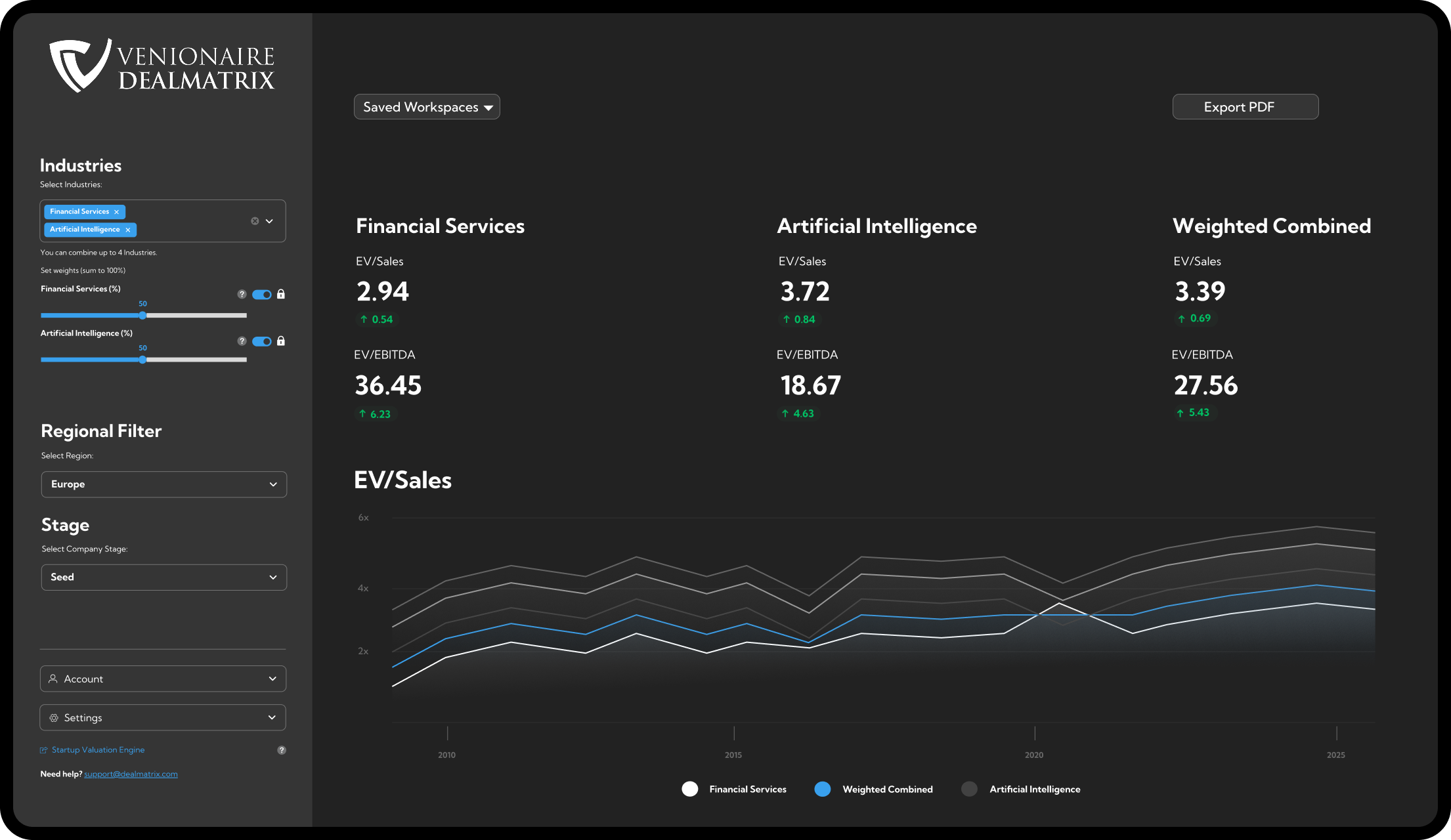
Venionaire DealMatrix, subsidiary of Venionaire Capital, has launched Venionaire DealMatrix Multiples, providing private-market EV/Sales and EV/EBITDA valuation multiples that can be explored by sector, stage, and region.

Venionaire-DealMatrix-Multiples-Mockup-2

Figure 1: Venionaire DealMatrix Multiples

The launch builds on Venionaire Capital’s long-standing activity across Venture Capital, Private Equity, and M&A, where valuation decisions are routinely made in environments characterized by limited transparency and high contextual dependency.


The challenge: valuation without a private-market framework

Across private markets, pricing decisions are still largely anchored in experience, precedent transactions, and public-market multiples. Not because these tools are ideal, but because there has been no widely available alternative designed specifically for private companies.

Private transactions are rarely disclosed, deal terms are negotiated bilaterally, and pricing varies significantly by sector, company stage, and geographic context. As a result, comparability is limited and valuation discussions often rely on narrative rather than a shared analytical foundation.


Why public-market multiples fall short

Public-market multiples became the default reference due to their availability and structure. However, they reflect a fundamentally different environment—one shaped by liquidity, scale, standardized reporting, and immediate exitability.

These characteristics rarely apply to private companies. Applying public multiples to private transactions therefore requires subjective adjustment, which introduces inconsistency when used systematically across deals.


Building a private-market methodology

Venionaire DealMatrix Multiples were developed to address this structural gap.

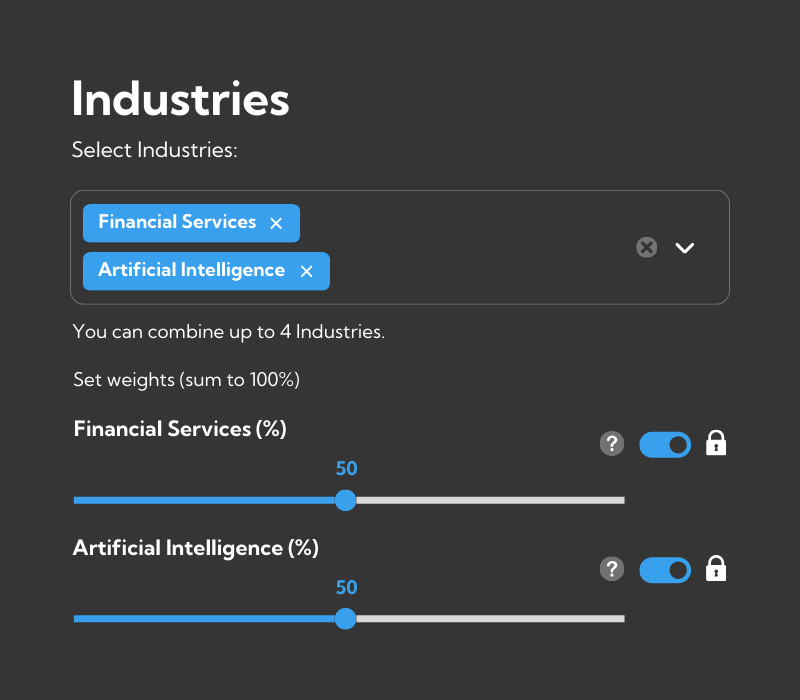
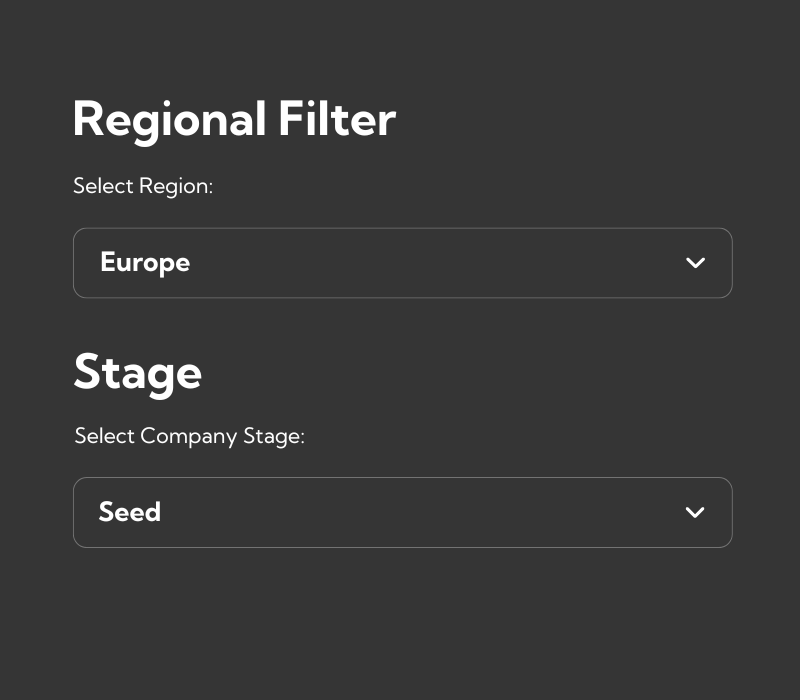
Instead of adapting public-market benchmarks, the methodology was built from the ground up around private-market characteristics. The result is a framework for calculating EV/Sales and EV/EBITDA multiples for private companies, structured by:

  • sector

  • company stage

  • geographic region

DealMatrix_Multiples_Industries

Figure 2: Industries Filter


DealMatrix_Multiples_Region_Stage

Figure 3: Regional & Stage Filter


Public-market data serves as a starting point for peer-group identification, but is systematically contextualized using macroeconomic indicators and proprietary private-market datasets accumulated through Venionaire’s work in Venture Capital, Private Equity, and M&A.


Launching Venionaire DealMatrix Multiples

Venionaire DealMatrix Multiples are now live. They are designed to support valuation discussions, deal screening, and comparative analysis by providing structure where private markets have traditionally relied on fragmented benchmarks and individual experience.

To introduce the product, the DealMatrix team has prepared a short video demonstrating how the platform works and how private-market multiples can be explored in practice.

WHERE TO FIND US

VIENNA, OFFICE (HQ)

Babenbergerstraße 9/12,
A-1010 Vienna, Austria (EU)
office@venionaire.com

SAN FRANCISCO, USA

1355 Market St. #488
San Francisco CA 94103
sfo@venionaire.com

NEW YORK CITY, USA

122 East 37th Street
First Floor
New York, NY 10016
nyc@venionaire.com

LONDON, UK

Gable House, 239 Regents Park Road
London N3 3LF
office@venionaire.com

Luxembourg, LUX

28, Boulevard F.W. Raiffeisen
2411 Luxembourg
office@venionaire.com

LOOKING FOR FUNDING?

FOR STARTUPS

Venionaire Capital exclusively invests through the European Super Angels Club, for more information and application please go to the website. We do not accept direct investment proposals via this website.