Article Part 3: The history of AI – From the “AI Winter” to the final breakthrough

In cooperation with Venionaire Capital, DerBrutkasten.com publishes a four-part article series on the subject of artificial intelligence. We are concentrating on the economic aspects of how AI works to the current research and the future of artificial intelligence.

In the first article we described “Artificial Intelligence (AI)” as the ability of a machine to learn and adapt from its own experience. The second article was about the basis concept of AI and in the third part, we will provide an overview of research, trends and leading companies in the field.

Artificial intelligence is often seen as a new world conquered just by brave pioneers from Silicon Valley. In reality, however, the subject had a lot of ups and downs. The breakthrough seemed only a matter of time, but the researchers underestimated the problem that words can have different meanings in different contexts. The US Government cancelled the financing and this this period was referred to as “AI Winter” in analogy to the concept of “nuclear winter”.

Historically, there have always been such drought periods. The result of financial incidences were fewer research activities. Over and over again there were deep and then high phases (“AI Sommer”).

After a difficult situation in the early 1990s, the AI industry was finally recovering in the 2000s. The upturn was supported not so much by governments but by tech companies such as Google, Facebook, Apple, Amazon, Microsoft or the Chinese company Baidu.  The basis for the rapidly growing commercial interest are the computer systems that now enable the broad use of AI technologies for the first time.

The search engine giant Google is one of the leading companies when it comes to the topic of artificial intelligence. The main focus of their research (see research.google.com) is Machine Learning, Natural Language Understanding, the entire health care system, the perceptive abilities of machines, robotics and, interestingly, the creation of music and art. Thereby “deep learning” plays a very important role, for example Google’s Alpha Go, which clearly defeated the professional Go player Fan Hui and later Lee Sedol.

The question that is important to investors is, of course, whether the high phase is only a hype or sustainable. In contrast to the past, AI is already being used in everyday life.


For the whole article click here.


What is a startup? – Understanding the difference between ‘search and execute’

What is a startup? Esther Gons from the Dutch Startup Studio NEXT.Amsterdam wondered how easily Austrians use the term “startup” for every kind of new business. In this guest article, she explains how NEXT.amsterdam defines a startup and why it is important to use this term precisely.


Startups are everywhere, they are disrupting, new, fast and moving quickly. Rapid technological development and digitalisation have changed the world we operate in. ‘The global reset’ I often call it. Tech startups have seized the opportunity due to lower barriers to entry and started to look for ways to help people in this new world. Changing the business models of long existing companies along with it. Both corporates and investors have taken an interest in this development and are looking for ways to profit from it.


What is a Startup?

As a seasoned startup mentor and investor, who is also helping corporates with innovation within their company, I have seen all sides of the coin. With the sudden interest in startups and innovation, the core importance of why the term startup is there in the first place is often overlooked. When I ask people: “Do you know what a startup is?” – the answers vary from ‘a young business’, ‘a business under 5 years old’ to ‘a business that does tech’ or is ‘doing something new’. Now, when Steve Blank first wrote about startups he described it as follows:

A startup is a temporary organisation designed to search for a repeatable and scalable business model.

Although both repeatable and scalable are important elements of this definition, the most important part here is the word search.


Business Model

Startups are actively searching for a business model that works. Everything they do is focused on that specific goal. This precisely is why they are different from a starting business, even if that business includes software. A starting business, say a new hair salon, has a proven business model. This means that you have to invest in execution on that proven model in order to grow profits. In the lean startup methodology, there is a clear distinction between the search phase and the scale phase. Only when a startup has found a business model that it has proven to work, the startup is ready to scale. The uncertainty in the searching phase is also the reason why the lean startup methodology came into being in the first place.


The first step

While startups are searching, and starting businesses are getting ready to execute on scaling, corporates are very effectively executing on their core business. They have taken scaling and optimized on this. All of their core mechanics and processes are optimized on executing towards growth. So much so that it is not always obvious anymore. For such a company it is much harder to do innovation from within. What do you do with a new product that has been invented outside if all you have to judge is success by its ROI? How do you keep track of a new innovation if you ask them to predict the next 5 years in a business plan? A startup cannot come up with these predictions since it doesn’t really know yet. How to accommodate searching with all of the existing execute governance? The first step towards being able to innovate is to understand this difference between searching and executing. Because the biggest risk of failure for startups in a corporate environment is premature scaling.


Difference

As an investor or a corporate innovator investing in new projects, it is important to realize that this difference in mechanics will also need a different approach and a different process of reviewing progress. Understanding the difference between a startup and a starting business is an important one. It will help both the portfolio and the way you can add value to a startup. Searching requires a rhythm of creating, testing and learning. It needs to invest in proving their value to their customers. Before the startup has proven that it is ready to scale, there is no point in investing in marketing and sales or push for ROI. Investing in a startup before the scale phase needs a different approach and involves a much higher risk than investing when a startup has moved from the search to the scale phase and is thus ready to execute on growth.


Esther Gons is the co-author of the book The Corporate Startup; how established companies can build successful innovation ecosystems and founder of the startup studio NEXT.amsterdam. NEXT.Amsterdam invests in and supports startups by providing dedicated mentor teams and a structured framework in their search for a working business model. Additionally, she is an innovation strategist, visual changemaker, international speaker, and has 20 years of experience as an entrepreneur and helped over 100 startups so far.

Decision Making in the Venture Industry

René Andres under the supervision of Prof. Jörn Block from the University of Trier conducted a comprehensive study on decision making of growth venture investors. They did a “conjoint-experiment” with 798 investors, in which each participant was asked to make a series of decisions between several growth ventures that were presented to her/him. Their survey brought up some interesting facts on what is important for investors.


Revenue growth has the highest relevance

It turned out, that revenue growth is the most important criteria for investors, followed by the value-added of the product or service for costumers. The third most important criteria is the relevant track record of the management.


Source: Andres, René; Block, Jörn (2017): Decision-making when screening growth ventures.


Investors also showed a clear preference for business models with a lock-in design which makes it difficult for customers to switch to another provider (e.g. marketplaces).


Later Stage Investors focus on Profitability

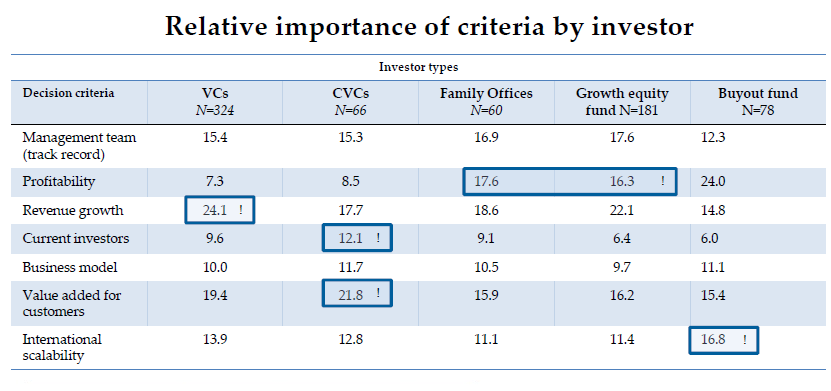
Mr. Andres and Mr. Block further analyzed the importance of the mentioned criteria by investor type. For Venture Capitals (VCs), the most important criteria is the revenue growth of the venture, whereas for Corporate Venture Capitals (CVCs) it is the value-added of the product or service for the customer. CVCs put the highest importance to the criteria of current investors. For VCs as well as CVCs the profitability was the least important criteria in contrary to buyout funds, growth equity funds, and family offices. Interestingly, growth equity investors seem to put more importance on the track record of the team than VCs.


Source: Andres, René; Block, Jörn (2017): Decision-making when screening growth ventures.


Majority of Funds have an IRR of 11-30%

The researchers also asked respondents about the average IRR of their fund, resulting in the graph below.

Source: Andres, René; Block, Jörn (2017): Decision-making when screening growth ventures.

One rather consistent pattern they found was that investors with entrepreneurial background were associated with higher financial performance. We were happy to support this study as a participant.

Venionaire supported this study as one of the 798 participants.

You can download a comprehensive research report here.

Fintech 2016: Investment Activity Overview

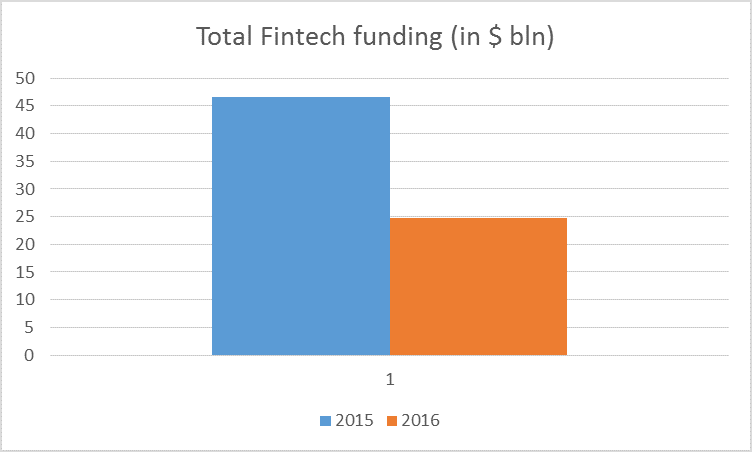
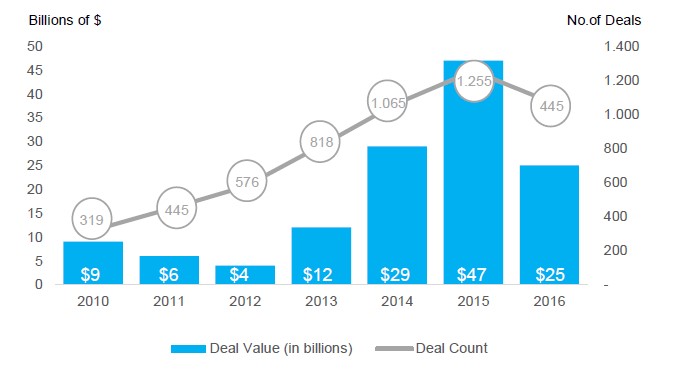
After 2015 has brought us plenty in terms of innovation and investing activity within the area of financial technology, the developments in the year behind us did not pick up such a fast pace. In 2015, we have witnessed the strong emergence of innovative financial services delivered through a blend of various channels, combining various platforms and technological tools. Besides, the terms such as blockchain, API or POS became closer to the customer and in a way part of a daily conversation. These innovations have been fuelled by huge investment injection of $46.7 billion in value on global level. However, according to KPMG’s analysis of 2016, the FinTech market shows signs of slowing down. The decrease of almost 50% brought the investment value for a total of $24.7 billion.


Total global investment in Fintech companies, 2010 – 2016 


*Source:Pulse of Fintech Q4 ’16, Global Analysis of Investment in Fintech, KPMG International (data provided by Pitchbook), February 2017.


 Investment by FinTech Segments

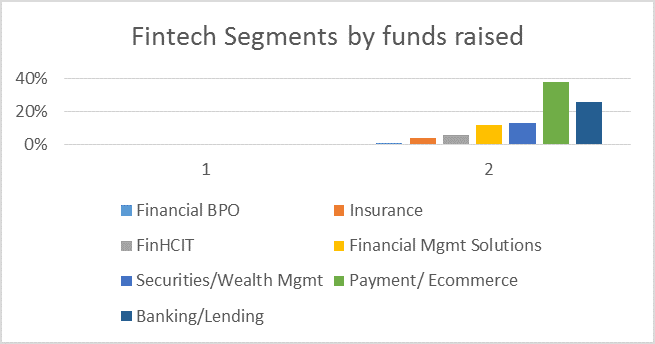
Banking/Lending has been the dominant segment when it comes to the number of companies raising funds (29% of companies that raised funds belonged to this segment).


Fintech Segments by funds raised 2016


*Source:LTP, Global Fintech Funding in 2016, January 2017.


However, the segment of Payments/Loyalty/E-Commerce is the one where the total funds raised value is highest. Companies categorized in this market segment have raised 39% of total funds raised by the entire Fintech industry in 2016. 


M&A, PE, IPOs and VC deals

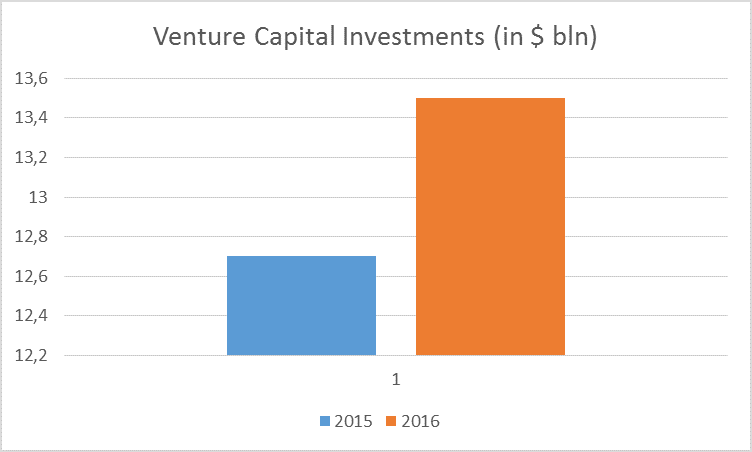
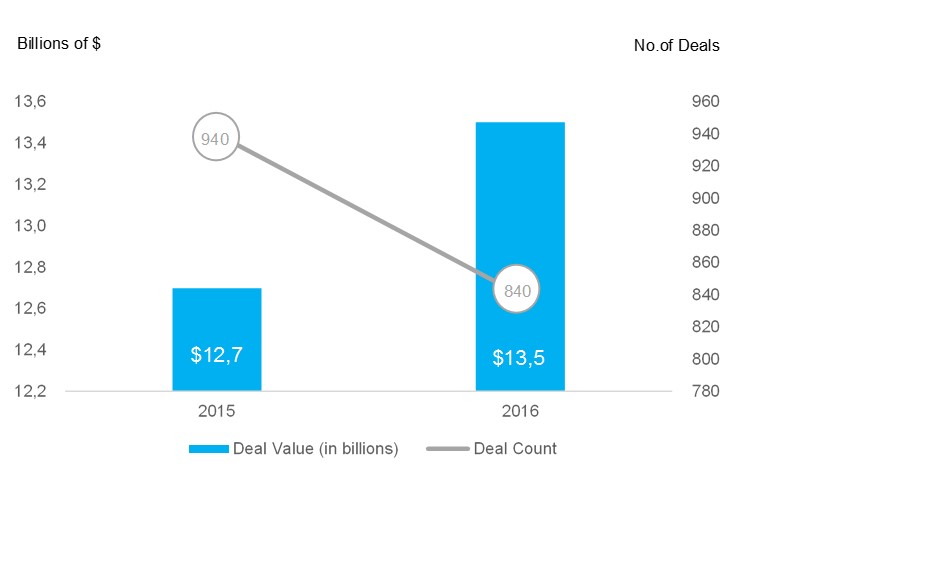
When analyzing the structure of financing deals, the increase in venture capital activity is noticeable in comparison to 2015. According to KPMG, M&A and PE FinTech deals dropped considerably in 2016, while the venture capital investments reached $13,5 billion, even more than $12,7 billion in 2015. The increase in VC investments occurred despite the decrease in number of deals.


VC investment activity 2016 
*Source:Pulse of Fintech Q4 ’16, Global Analysis of Investment in Fintech, KPMG International (data provided by Pitchbook), February 2017.


The reasons for such a boost are mostly three gigantic financing rounds in China. The funding round to Ant Financial that occurred in second quarter last year was $4,5 billion heavy. Besides Ant, two more historic financing rounds, each over $1bn, significantly increased investment numbers in China: Luf ax.com – $1,2 billion and JD finance – $1 billion.

After these three giant investment shots, China outpaced the US for the first time with $7,7 billion in total value of deals (28 in total), with an 84% increase in comparison to 2015 ($4,2 billion).

Except Markit’s $5,5 billion merger with HIS, there were no significant IPOs in 2016, either. The expectations are that the trend will pick up in 2017, as we have more mature companies in the market. The most active FinTech investor was fund and accelerator 500 Startups with 39 investments. In June, they announced raising a $25million separate Fintech fund for investing in early stage companies globally.


Key Q4’16 indicators

KPMG states that the last quarter of the year showed some revival of the investing activity. The VC funding increased from $1,9 billion to $2,1 billion between third and fourth quarter of the year, though still not near the previous year’s numbers. On American continent, VC investment revolved around $1,1 billion in Q4 ’16, not deviating too much from the previous year’s results for the same period. In Asia, VC funding jumped to $680 million after a year’s low of $200 million in third quarter. The rebound was mostly driven by a $ 384 million deal in the last quarter. Europe has stayed relatively stable, sitting on $319 million of investments in the industry. This result still remains lower in comparison to the same period in 2015 (around $350 million).


Conclusion

 European investment volumes were on decline, what was mostly driven by the political reasons. The turbulent political year gave us Brexit, elections and referendums all across Europe (Italy, Austria, France), directly influencing the stability of financial systems and caution of investors. Similar happened in the US. The elections, as the period of political uncertainty has influenced the investors on the other side of the Atlantic, too.

However, when looking east, political stability in Asian – Pacific region brought totally the opposite – the lack of significant political events and turbulences gave the impression of economic stability. This fact directly reflected on the upward trends in Asian FinTech ecosystem investing activities.

The appetite for investing has certainly not vanished, neither is the appetite for innovating. 2017 is the year that can bring revival in terms of more overall activity in the market and possibly some significant shifts that would include big investment deals and the appearance of some new innovative solutions. There are three major drivers to this possible scenario:

  • As soon as we experience some political stability, the expectations are that the trends of investing will pick up the pace
  • Regulation that should take force in 2017 (PSD2) will stimulate innovation in the field of FinTech, leading to even more aggressive investing activity
  • The strong upward trends of technology adoption in emerging markets could fire up the payment segment (mobile to mobile just might be the key feature in 2017)


*Sources:

  • KPMG – the Pulse of Fintech Q4 – data highlights
  • The 2016 VC FinTech Investment Landscape by Innovate Finance
  • CB Insights, Fintech Trends Report, 2016
  • Pitchbook, 2016
  • LTP, Global Fintech Funding, 2017

KPMGs Pulse of FinTech – setting the pace

Last year European investment volumes were on decline not least due to political reasons: the turbulent political year of 2016 gave us Brexit, elections and referendums all across Europe (Italy, Austria, France), directly influencing the stability of financial systems and caution of investors. Similarly in the US: the elections, as the period of political uncertainty has influenced the investors on the other side of the Atlantic, too. However, when looking east, political stability in the Asian – Pacific region brought about the complete opposite: a lack of significant political events and turbulences gave the impression of economic stability. This fact directly reflected on the upward trends in Asian FinTech ecosystem investing activities.

So how did we get to where we are now? 2015 has brought us plenty in terms of innovation and investing activity within the area of financial technology, the developments in the year behind us did not pick up such a fast pace. In 2015, we witnessed the strong emergence of innovative financial services delivered through a blend of various channels, combining various platforms and technological tools: the terms such as blockchain, API or POS became closer to the customer and in a way part of a daily conversation. These innovations have been fuelled by huge investment injection of $46.7 billion in value on global level. However, according to KPMG’s analysis of 2016, the FinTech market shows signs of slowing down. The decrease of almost 50% brought the investment value on a total of $24.7 billion.


Investment by FinTech Segments

Banking/Lending has been the dominant segment when it comes to the number of companies raising funds (29% of companies that raised funds belonged to this segment).

However, the segment of Payments/Loyalty/E-Commerce is the one where the total funds raised value is highest. Companies categorized in this market segment have raised 39% of total funds raised by the entire Fintech industry in 2016.


M&A, PE, IPOs and VC deals

When analysing the structure of financing deals, the increase in venture capital activity is noticeable in comparison to 2015. According to KPMG, M&A and PE FinTech deals dropped considerably in 2016, while the venture capital investments reached $13,5 billion, even more than $12,7 billion in 2015.

The reasons for such a boost are mostly three gigantic financing rounds in China. The funding round to Ant Financial that occurred in second quarter last year was $4,5 billion heavy. Besides Ant, two more historic financing rounds, each over $1bn, significantly increased investment numbers in China.
Luf ax.com – $1,2 billion and JD finance – $1 billion.
After these three giant investment shots, China outpaced the US for the first time with $7,7 billion in total value of deals (28 in total), with an 84% increase in comparison to 2015 ($4,2 billion).
Except Markit’s $5,5 billion merger with HIS, there were no significant IPOs in 2016, either. The expectations are that the trend will pick up in 2017, as we have more mature companies in the market. The most active FinTech investor was fund and accelerator 500 Startups with 39 investments. In June, they announced raising a $25million separate Fintech fund for investing in early stage companies globally.


Key Q4’16 indicators

KPMGs report found that the last quarter of the year showed some revival of the investing activity. The VC funding increased from $1,9 billion to $2,1 billion between third and fourth quarter of the year, though still not near the previous year’s numbers.
On the American continent, VC investment revolved around $1,1 billion in Q4 ’16, not deviating too much from the previous year’s results for the same period.
In Asia, VC funding jumped to $680 million after a year’s low of $200 million in third quarter. The rebound was mostly driven by a $ 384 million deal in the last quarter.
Europe has stayed relatively stable, sitting on $319 million of investments in the industry. This result still remains lower in comparison to the same period in 2015 (around $350 million).


FinTech Future?

The appetite for investing has certainly not vanished, neither is the appetite for innovating. 2017 is the year that can bring revival in terms of more overall activity in the market and possibly some significant shifts that would include big investment deals and the appearance of some new innovative solutions. There are three major drivers to this possible scenario:

• As soon as we experience some political stability, the expectations are that the trends of investing will pick up the pace
• Regulation that should take force in 2017 (PSD2) will stimulate innovation in the field of FinTech, leading to even more aggressive investing activity
• The strong upward trends of technology adoption in emerging markets could fire up the payment segment (mobile to mobile just might be the key feature in 2017)

Whilst we only know what the future holds once it becomes our present, we can do our best in predicting it by shaping it.


Sources:

  • KPMG – the Pulse of Fintech Q4 – data highlights
  • The 2016 VC FinTech Investment Landscape by Innovate Finance
  • CB Insights, Fintech Trends Report, 2016
  • Pitchbook, 2016

Grüzi from Zurich: connecting Europe

Switzerland definitely has more to show than cheese and the famous World Economic Forum in Davos – there are extremely successful world market leaders, some of the best universities and of course some pretty awesome start-ups. It was about time to come back and meet some old and some new friends in good old Zürich.

We met a lot of Family Offices, Venture Capital Funds, Business Angels and other key players from this amazing start-up hub and exchanged ideas to collaborate even stronger across borders and how to unite European Startup Hubs through intelligent platforms and partnerships. It is all about combining our strength in terms of co-investments, joint efforts to support the best tech entrepreneurs in Europe and to build the next European champions, no matter where they have been founded. We have been working on a solution for this complex issue quite a while ago and finally came up with a flexible and competitive solution – the European Super Angel Club (ESAC). If you want to learn more about this initiative please visit www.superangels.club.

This platform has the power to connect startups and investors across Europe and enable co-investments with some of the best lead investors in the market. We believe in a stronger interlinkage and connection of startup hubs and investor communities – this was also our main motivation to enable Talent Garden Vienna, which will soon become reality.

On Jan. 19th we attended the AWS pitching days, where 12 Austrian Health-Tech startups pitched in front of very seasoned life science experts and investors. We were truly impressed by the quality of pitches, the organization by the local Advantage Austria team and as well as the feedback startups received on average. After a successful series of pitching-days which has been established internationally – AWS (Austria’s federal promotion bank) landed another great event.

Big congrats to all participants and a big thank you from us for the highly positive feedback on our recent projects! We will definitely be back in Zürich very soon. Grüzi.

Technology Stack for Investors I: Research

How to make it on the Road to Dakar? Winning the race with a strong investors’ brand. In this blog series, we explore what it takes to get your investment tools in order by looking at the following four major areas: research, deal flow, portfolio management and network management.


There is some truth to the saying that “investing in early-stage tech is more of an art, than science”. However, just as the Paris-Dakar rally is not won purely based on enthusiasm and gut feeling, but rather the adequate handling of the right machine and equipment, early stage investors also need to be adequately equipped to perform. Funnily enough, we found out that although a majority of investors deal with innovation and technologies every day, they stick to excel spreadsheets, word documents, as well as paper and pencil for their own work. “The blacksmith’s horse has no horseshoes” is resounding in our day and age as well. To be fair, technology for this industry has only evolved a couple years ago and the adoption rate is rising. The need for a technology stack is not only directly correlated to the rising complexity of the business, it is particularly necessary to track one’s investments effectively as well as providing resource efficiency. Investors have to balance their fix costs as they have a direct negative impact on the IRR. Whether you are mostly looking for a deal flow at the very beginning, or just started to improve your inner processes, or find yourself in the need of a better way to track a large number of investments: you will have to choose if you stick to the old way or implement a digital technology stack for your early stage investment business. Ultimately, you want to choose the best machine if you want to get to Dakar.

First quest: what does my machine need to be able to do

To guide you through the windy and sandy maze on your route to Dakar, we have divided the technology stack into four major areas:

  1. research,
  2. deal flow,
  3. portfolio management,
  4. and network management (including business intelligence, monitoring and internal communication).


 Technology stack for Research

VCs provide research: a) to gather the important expertise b) to be known as an expert in the field and c) gathering inbound deal flow. Thus to make it onto the race track, the rally driver needs to prove his skill and practice.


Gathering Expertise

Just as the race driver needs to first train to become one, investors need to do their homework – this is a time investment which needs to be made. There are many useful tools providing valuable data and information to facilitate your research such as

  • Product Hunt,
  • AngelList,
  • Crunchbase,
  • EVCA

or paid services such as

  • Pitchbook,
  • CB Insights,
  • Bureau van Dijk

which should be systemically followed in order to understand market dynamics, technology trends and current developments of valuations – as prices (multiples) will change in hype-cycles just like publicly traded companies. Apart from increasing the likelihood of successful investment strategy, venture investors need a deep understanding of markets, investor landscapes in a certain field and eventually deciding upon certain investment niches over others. The distribution of supply and demand of innovation across industries is critical to analyze in advance of a deal (as far as possible), as you will need to exit an investment down the road.

The pricing usually varies, depending on the functionalities and features a user prefers. Below is the table showing the comparison of free and pay services for some of the useful research platforms. See our table of software features.

Free databases like Crunchbase (in its basic version at least) and Product Hunt represent useful tools for general information, data mining and getting a quick overview of markets and competition. However, if your ambition is to dig deeper and generate high-quality information and real insights – including news and analysis, we recommend CB Insights, BvD and Pitchbook (make sure to verify if company data is 100% correct through a commercial registry, though). For the access to structured, official commercial register data on the global level we recommend Kompany.com.

As a company with a focal point oriented more towards European markets, our machine of choice is Pitchbook. The platform contains a better database of funding histories, valuation, series terms, information about the investors and startups and much, much more. The integration is well executed, as it enables exporting possibilities and integrates directly with other platforms, such as Salesforce and Microsoft Office Suite.


Be known as expert and gather inbound deal flow

A simple but effective way to strengthen your presence in the ecosystem is simply by publishing valuable insights through platforms like Medium for blogging, Quora for Q&A interaction and Slideshare for presentations. Your public presence will not only boost your reputation as a market professional, it will also help to gather inbound deal flow. The better your market reputation, the stronger you are as an investor, the higher the quality of deal flow and eventually your negotiation position will be when it comes to terms and valuation. If a large number of startups are addressing you as an investor, you will statistically have a better chance to select superior deals, but you need to know what you are looking for.

The platforms used for presentation of content (Medium and Slideshare) come in very practical packages, as the free versions offer a broad range of possibilities for raising awareness of your brand. For the purpose of sharing content, we consider Slideshares basic service more than enough. Depending on the preferences and subjective orientation, its Silver, Gold and Platinum subscription models offer upload benefits, monthly tracking of leads and geo-targeting, depending on the chosen model.


Conclusion

Research comes as a starting point, the first lap of your long and intensive race. It is also the point where you start assembling your powerful motorbike that should get you to the finish line before the other contestants. Be careful, power is not everything. The machine has to be balanced out according to your needs and adjusted to the conditions of the race. In the next lap, we will pay attention to the deal flow, the next critical piece of assembly you will need for your powerful drivetrain.


Some of the best practices from investors like Andreessen Horowitz or Sequoia that are using various platforms for their public presence could also be of use to you:

Blogs:

YouTube:

  • Sequoia Capital’s Doug Leone on Luck & Taking Risks by Sequoia


Unicorns and Black Swans

In his bestseller, The Black Swan, Nassim Nicholas Taleb lays out a theory about how people perceive probability. The book focuses mainly on events named “Black Swans” which distinguish themselves by holding three main characteristics:

  1. They have a possibility of occurring, no matter how unlikely this possibility may be,
  2. if they do occur, they cause a disproportionately high impact,
  3. and they are almost impossible to predict.

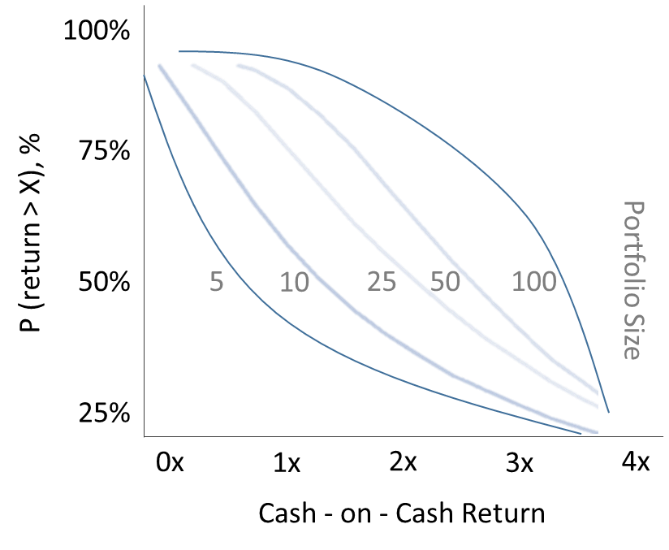
Sounds familiar? It certainly does for anybody involved in the Venture Capital industry. The desired aim of all startup investors is to identify and invest in companies which will make it bigger than 1 Billion USD, commonly named Unicorns. Unfortunately, a Unicorn shares the same characteristics as the Black Swan described by Taleb, making them by definition almost impossible to predict. Therefore, investors need to be involved in the startup scene  – travel, socialize and chat as much as possible. Besides that, investing is always a game of numbers. The only way to achieve a high IRR is to invest intelligently in many companies, making the law of large numbers work on your behalf. Several studies and mathematical simulations have shown that it takes investing the same amount of money consistently in at least 20 to 25 companies before your returns begin to approach the typical return of over 20 percent for professional, active angel investors. This means, the greater the number of companies into which an angel invests, the greater the likelihood of an overall positive return.

Venture Capital is all about making the right hit while investing. Giving the fact that any particular company has roughly similar odds of succeeding or failing, the lopsided nature of the returns means that, on balance, the more companies in which you invest, the more likely your whole portfolio is to generate higher returns. Finally, investors have to be prepared to accept failure. Finding a Unicorn often means experience some of the biggest disappointment and disasters you can imagine. At the end of the day, it’s all about having your winnings being bigger than the losses, which ever number of Unicorns turning out to be ordinary poneys.

New book about Crowdfunding and the Austrian Alternative Financing Law (AltFG)

The new book “Handbuch Crowdfunding und AltFG” (language: German) provides a comprehensive overview of the various systems of crowdfunding, the legal framework in Austria, especially taking into account the new act on alternative financing (Alternativfinanzierungsgesetz – AltFG).

The book is an ideal guide for entrepreneurs and legal advisors, as it explains when and what type of crowdfunding is promising and what minimum standards must be adhered to for the protection of investors. Furthermore the book provides information about the legal aspects of licensing, the operation of Internet platforms and mandatory contents of prospectuses. The authors: Bibiane Kaufmann works for the Austrian Financial Market Authority (Finanzmarktaufsicht – FMA), while Georg Seper and Christian Zenz are both deputy head of department in the Austrian Federal Ministry of Science, Research and Economy (BMWFW) and were instrumental in creation and elaboration of the AltFG.

Venionaire Managing Partner Berthold Baurek-Karlic contributed a chapter with practical examples of crowdfunding and investing. Combining alternative types of financing from equity to debt or equity mezzanine (venture debt) is an fairly underestimated art – structuring a deal right, may reduce funding costs and improve available capital for growth. If you want to learn more about this topic, please contact our experts.

Order your copy of the book now!

GSA Region outperforms rest of Europe in terms of average VC deal size

In 2015, the GSA region (Germany, Austria and Switzerland) was responsible for €3.6 billion of Venture Capital invested through 374 deals. This yields not only the largest average deal size, but also Europe’s second largest share in terms of total Venture Capital investment. Only UK & Ireland outperform the GSA region with a total VC funding of €4.47 billion in 2014.

Overall, Europe saw a decline of Venture Capital activity in many areas when compared to 2014. Broken down by stage, the total number of deals in the GSA region decreased from 2014 by 36.1% in the angel/seed stage, by 17% in early stage and by 14.3% in late stage investments, which amounts to an average decrease of 22.5%. In UK & Ireland, where 855 VC deals were closed in 2015, the number of deals decreased by 39.7% compared to 2014.

But in the same time, the capital invested in the GSA region increased by 13% and even by 125% compared to the year 2011. Consequently, the deal sizes in investment rounds raised. Overall, the invested capital in the GSA region had an average annual growth of 25% in the last 5 years, while the average growth in UK & Ireland was 23%, in the Nordic region 20% and in France & Benelux 19%.

In a global perspective, the GSA region is responsible for 3.1% of total Venture Capital invested and 3% of total global Venture Capital deals closed. We are confident that this figure will even grow further as the GSA region offers great investing opportunities. Therefore, Venionaire Investment is focusing on this market region. Learn more about our aim of a new Venture Capital fund here.

Get the detailed report on pitchbook.com.

WHERE TO FIND US

VIENNA, OFFICE (HQ)

Babenbergerstraße 9/12,
A-1010 Vienna, Austria (EU)
office@venionaire.com

SAN FRANCISCO, USA

1355 Market St. #488
San Francisco CA 94103
sfo@venionaire.com

NEW YORK CITY, USA

122 East 37th Street
First Floor
New York, NY 10016
nyc@venionaire.com

LONDON, UK

Gable House, 239 Regents Park Road
London N3 3LF
office@venionaire.com

Luxembourg, LUX

28, Boulevard F.W. Raiffeisen
2411 Luxembourg
office@venionaire.com

LOOKING FOR FUNDING?

FOR STARTUPS

Venionaire Capital exclusively invests through the European Super Angels Club, for more information and application please go to the website. We do not accept direct investment proposals via this website.