Booming Cybersecurity in Austria

With the digitalization of almost every industry, the need for Cybersecurity in Austria and worldwide is booming. Andreas Tomek, Managing Partner of SBA Research – the leading Austrian IT security research center and Advisor for Venionaire Investment, explains in a guest post for IT-magazine Computerwelt why cybersecurity offers great investment opportunities, in particular for Venture Capitalists in Europe.

The most important points of his comment are:

  • In the next years we will see the rise of European cybersecurity startups
  • The main reason for this is the growing integration of technology in our daily lifes (Collaboration Tools & Internet of Things)
  • European cybersecurity startups benefit from a powerful IT-infrastructure and accumulation of top-noch knowledge in many fields
  • On the other hand hackers are becoming more professional and therefore more dangerous
  • Last but not least: We have better data protection laws compared to other regions of the world

But how can we use these competitive advantages? Mr. Tomek urges us to build a bridge between science community and market. We need to promote initiatives which are matching products and venture capitalists! Read the whole comment here. (article in German)

Veninoaire Vienna

Why Vienna is the perfect startup hub

Vienna: A rising startup hub

The Viennese startup ecosystem is a hidden jewel. When I moved to Vienna last February, I was pleasantly surprised to find out that the city I now call home is one of the most vivid, diverse and fastly growing scenes in Europe. And as all good treasure hunt stories go – it was by pure coincidence that I discovered it. I grew up in the French speaking part of Switzerland with a cultural melting pot home: a Scottish father and a Lebanese mother. Before I joined Venionaire in April, I was working for a Swiss startup based in Lausanne and got selected to join the CISCO Accelerator Program in Vienna. Back then, I didn’t know much about the city and had barely heard anything about Viennese startups. It didn’t take long until I realized that the startup scene here is booming. Vienna is on the right track to become a major European startup hub for many reasons:


An ideal spot.

A lot of cities claim to be well situated, but little can compete with Vienna. I believe geographical location is one of the fundamental reasons for the Viennese startup scene’s growing success. Vienna is ideally connected to many European cities and capitals. Prague, Budapest, Bratislava are a short drive away and the main European startup hubs Berlin and London are easily accessible with affordable flights in less than two hours. Furthermore, Vienna has an unique mix of Western and Eastern European cultures, making the city the ideal spot to build a company which can easily expand to the whole European continent.


A strong startup ecosystem.

I consider a startup ecosystem to be strong when a city or region can provide startups easy access to the right support (financial, material and knowledge) in every step of building a company. I was astonished how much this definition applies to Austria. Vienna is an ideal city if you wish to learn how to found, grow or run a startup. Dozens of organizations, profit and nonprofit, such as Austrian Startups, AWS or the Technical University offer classes to get the right knowledge to start a company. There is almost not one single working day in Austria without an event or lecture organized for (future) founders. From pitch training to finance or even programming, there is always something useful to learn. And the best part? Most of the events are free, and even no need to register. More and more coworking spaces are also popping up across the town, where startups can work in teams for affordable prices.

Finally, Austria is becoming one of Europe’s hottest spots to get financing. The Dow Jones Venture Capital Report for 1Q 2015 states that Austria rose to fourth position when it comes to Equity Financings into Europe-based Venture capital backed Companies. Austria holds now a 7% share of the total European Equity financing, raising €173 million during 1Q 2015.


Young Startups – Future Hidden Champions.

Over the last couple of months, I was astonished to discover almost every week a “hidden champion” here in Austria – or in other words a company which is hardly known of, but is however leader in its field of expertise. The numbers speak for themselves: 19% of Austrian companies hold a global market share of more than 20% in the field of their core activities. Austria counts an impressive 15.6 hidden champions per 1 million inhabitants, which brings it to the second position in Europe. The reasons for such success are diverse, but according to the Austrian Federal Economic Chamber report, hidden champions share the same traits that can make startups highly successful: outstanding quality products which have proven to be hard to imitate, high vertical integration and strong research and development.


Startup Education starts at the university.

Viennese universities offer a huge pool of talented young people, and the right set of tools to make them develop their entrepreneurship skills. Not surprisingly, over 80% of Austrian startup founders in 2013 come from a University background. During the last couple of months, I have encountered several PHD and master students from the University of Vienna, WU and TU starting their own company next to their studies. Universities and schools here encourage students to start early on their start-up project, with a series of lectures at university inviting successful entrepreneurs to talk about their experience and inspire young graduates to take the jump. The interest and motivation for students to engage with the startup scene has also made many great events become reality, such as Entrepreneurship Avenue Conference, which brings together founders, investors and a wide mix of people from the startup ecosystem together with students.


Vienna, there’s no place I’d rather be.

Finally, a startup scene can only be successful on a long term if it is situated a city or a region where people would love to live and move to. And which better city than Austria’s capital? I personally can’t agree more with the Mercer’s survey results which evaluates the quality of living in 230 cities around the world, ranking Vienna number 1. The unique balance between excellent quality of living combined with affordable prices makes Vienna a city where one can enjoy working in the very best conditions.


There is one last aspect that cannot be measured by numbers or ranking: the people who make the Viennese startup scene feel like a big family. When I arrived in Vienna, I barely knew anyone. A couple of weeks later, it already felt like home. The culture and ambiance in the Austrian startup scene is amazing, one which is focused on support, trust, knowledge sharing, and also having fun. Trust me: once you become part of the Viennese startup scene family, you will not want to leave.

Honestly, there is no Tech Bubble

Nowadays, there are several discussions about a potential tech bubble in the US Venture industry. Valuations of companies like Uber make markets fear that the world is heading towards a crisis similar to the bursting of the dotcom bubble in the first decade of this millennium. But what is actually a “bubble”? There is a wide range of literature about economic crises, but this would dig a little too deep into scientific publications. I personally like the neat and easy definition of Paul Krugman from New York Times:

It is a situation in which asset prices appear to be based on implausible or inconsistent view about the future.


The market has changed

Now that we are settled with the definition of a bubble, we can focus on the question if there is actually one or not. Take a look back: 15 years ago, the internet was just at the beginning of its global commercialization. It was in its strongest growth phase, but was far away from a solid market, ready for trillion dollars of revenue. In 1997, only 2% of the world population had access to the internet compared to 55% or over 4 billion user in 2018. If there was a bubble today under the same metrics, the valuations would need to be 200 times higher than 15 years ago and this is certainly not the case.

These numbers are the key driver for changes in all industries. The landscape of internet based, tech revolution is currently spread over all fields and has in some industries just started to knock on the doors. Nowadays, we have increasingly inexpensive and capable mobile computing devices and internet connectivity, with huge bandwidth and much higher data-storage capabilities. After 15 years of post-dotcom successes and failures, the approaches of startups and investors changed dramatically. Both sides of the market are much more professional nowadays.


Consistent and plausible market

Bubbles behave very much like black swans – they are not predictable if you just look at events in the past. Nevertheless, there are several indicators to which people refer. Let´s see if some of the most commonly used indicators implicate implausibility or inconsistency as described in our definition of a bubble. If you read articles across the venture blogs where people argue for a bubble, you will always see these indicators mentioned:

  • Investors put more money in late-stage rounds
  • Private company valuations are rising
  • IPO Exit ratios are dropping

In fact is, the average amount raised has increased in the last two years. But on the other hand, the number of total deals stayed rather flat. So the money is therefore invested in a small selected group of companies and not strayed to everyone who claims to be next “unicorn” (and there are many of them). This implicates a raise of valuations: otherwise the founders and early stage investors would get diluted too strongly which is actually a good argument against a bubble. Ljungqvist & Willhelm pointed out in their publications that the fragmentation in stakeholder ownership was one of the main factors for the dotcom bubble.


The IPO exit ratios are falling and there simple explanation for that. The attitude of founders has changed dramatically. 15 years ago the main goal was to just build a business and make an IPO at whatever costs to get rich as fast as possible. Now, companies have solid revenue streams and significant amount of money on their bank accounts. They want to keep private, expand their business and exploit their opportunities on their own rather than just go public or get bought. They prefer bigger late stage rounds (nowadays also called “Private IPOs”) instead of IPOs.
The companies are in the same stage of development so they need similar amounts of money (low exit ratios) as in the past – they just follow a different strategy nowadays. The same phenomena is the reason for the increased activity in the “Venture Debt” market (i.e. Netflix with a 1bn$ bond emission last year).You also see this if you look at the average time from the first VC funding to IPO/M&A. It has more than doubled from less than 4 years (1997) to 8 years (2014).
Now what is the reason for an investor to put in so much money in these deals? Just consider a PE investor who is struggling to keep up his IRR because of the low interest rates. The average IRR in PE has fallen to 8%-12% p.a. It is plausible for a PE investor to enter a late stage Venture Market. There is a trillion dollar market with plenty proof of markets and an average IRR of 23% in case of an IPO. It just appears that after 15 years the border of late stage Venture and PE are converging, and this is not to be confused with a speculation bubble.
Nevertheless, it has already happened that the valuation of the D-round is higher than the followed IPO. Which would be a contradiction to high IRRs for the investors at a first glance. But as I mentioned in a previous article “your price, my terms”, the deal value often does not equal to the value of the assets. At this point, the effect of Real Options kick in. Especially in Late-Stage rounds, investors accept high valuations in return of specific Real Options which influent the IRR of an investor in case of an IPO. For example a Liquidation Preference would be such a Real Option.


Impact on the European Venture Market

Due to the rising valuations in the US Venture Market many US investors turn to Europe. They want to take advantage from the “Silicon Valley Vortex” – It is no mystery that crossing the Atlantic for European startups will increase their startup’s valuation, sometimes by as much as 3x.
But the raising valuation are just one reason for this shift. European startups are used to the low VC supply in Europe and have learned how to operate under huge pressure with big competition. They understood that in order to survive in a market with low supply and high demand, they have to develop business models which are viable from the very beginning. Furthermore, European startups are confronted with a fragmented and complex market early on, which helps them during their expansion period. This unique attributes of European startups and the recent developments in the US Venture Market has led to an attractive and emerging European startup ecosystem.

Impact of Real Options on Venture Valuations

Many practitioners at venture capital funds use net present value (NPV) and discounted cash flow (DCF) as methods during their valuation process of early-stage companies. In fact, the International Private Equity and Venture Capital Valuation Guidelines focus mainly on those two methods. The weakness of these two methods is that they concentrate on a certain “expected scenario” of cashflows. For example they do not capture the flexibility of the management to adapt their strategy in response of an unexpected market development. Especially in the early stage world with strategy shifts very common, this “expected scenario” outlines a big restriction. Flexibility in the future while facing new information arrivals, which could change your investment outcome drastically, is key.

In our previous article, we introduced the First Chicago Method which addresses this problem in a trivial way. However, it is not dynamic i.e. there are scenarios which you can’t even consider right now because of their unlikeliness. This is the point where the concept of option pricing comes into play.

A broad theory has been developed over the last 50 years, first started with the celebrated Black Scholes formula. While these models initially were used to value traded options, in the recent years they found their way into Venture Valuation Methods. Benefits in a highly volatile and uncertain market are pretty obvious. The main purposes of using options are:

  1. Improving upside potentials
  2. Minimizing downside losses

This works well with Options, as they may be considered like an insurance. Actually, many venture investors are already using this concept without knowing, as they use “hedge terms” (like “anti-dilution” and such) in their shareholder agreements. Many transaction terms are equivalent to contingent claims. To differ between classic options based on financial assets and specific terms during a venture capital transaction, we will call them Real Options. Real Options are based on the investment project itself.

This fact enables a way to determine the strategic value of an asset, facing an investment/acquisition decision. Of course, this strategic aspect brings a lot of subjectivity into the process which aggravates the valuation process under the assumption of information asymmetry between the contracting parties.

Although almost all professional venture investors use Real Options in their early stage investment process, few of them determine a value for them and even less startups usually see the implied discount given to their investor when accepting them.

Due to the enormous possible ways of setting up a term sheet and/or a shareholder agreement and the subjective nature of real options, it is a complex task to develop a consistent framework for the valuation of any real option. Nevertheless, there are real options which depend directly on the enterprise valuation. In these cases, we will first calculate the enterprise value following common valuation concepts and then determine the real option value conditioned on the assumptions we used for the enterprise valuation.

This approach fits Real Options which have “direct” impact on the investment return (e.g. liquidation preference). They don’t have a direct influence on the enterprise value, rather they are derived from the enterprise value in a linear way (in other words the dependence between the value of the enterprise and the real option is linear). Hence the expectation is a linear functional, the deal valuation expresses in the following way:

Deal Value = Enterprise Value + Real Option Value

Now we want to address values of Real Options which have “indirect” impact on the investment return (e.g. vesting). In general, the value of these options are far more difficult to measure. They are more adjustments to the assumptions you considered during your enterprise valuation process (similar to the concept of Bayesian inference). For example, if you have vesting as a term in your transaction you have to consider the change in the part of the risk-factor which belongs to the team. This thoughts lead us to the following representation of the deal value (“|” means conditioned on in this context):

Deal Value = Enterprise Value | Real Option

At Venionaire we have a sharp focus on Real Options as part of the valuation process. After calculating an enterprise value, we shift to Real Options trying to the hedge certain risks and enhance the flexibility as an investor. There are Real Options with a wide scope which deliver a good adjustment for many cases. On the other side, every transaction is unique and needs its own customized Real Options. Our team developed a framework to structure transaction in a way which fits best to the investor profile as well as the current stage, industry and region of a startup.

Finding Disruptive Innovation

Two years ago one of our Private Bankers introduced me to Dr. Günther Dobrauz, a Director of PWC (CH) and former Venture Capital Fund Manager, at a meeting in Zürich, Switzerland. This meeting turned out to be one of the most interesting ones I have had for quite a while. He explained to us a model (Technology BridgeTM)) he had developed and recently published in his book “Uptake Revisited – An Investigation into the Success & Failure Factors for Innovative Products in International Markets”.

We are always looking for innovative approaches to make better investment decisions and to improve our own models, which we use in our consulting activities. We examine new models quickly and test them internally for a while – as we need to convince ourselves of a significant impact on our field. When it comes to high-technology driven private equity transactions, we need to rely on facts instead of magic crystal balls.

This might sound funny, but there is a substantial number of private investors and venture capital firms out there who will not bother running a professional deal selection process. Simplified, this would usually consist of the following steps:

1. Does it fit our investment focus?
2. How does it score on standardized screening criteria?
3. Are there any “Red Flags” from a financial, technological or legal due diligence?

No kidding, quite a large number of investors will make an investment decision on a so called “gut feeling”, “goodwill” or “rule of thumb” method. We have observed this biased habit. Fair enough – there are some successful business angels who prove that this is not the worst idea, ever. In professional terms, however, this method is not predictable; rather, it is quite fuzzy, as these “success factor heuristics” can be very different and probabilities of success and failure are very unclear. It is like it is in gambling, once in while there are winners, but the odds are not in favor of the player.

This method concentrates on the quality of the team. There is a significant number of very successful founders, who have changed their entire business – sometimes through an accelerator program (e.g. Y Combinator or Techstars) or with a first mentor (Business Angel) on board. In a very early stage of a startup, I agree that it makes sense to concentrate on the quality of a team, much more than later in a venture capital round. In early stages products and technologies may change a couple of times.

Venture capital funds on the other hand need to be clear and transparent when it comes to their deal selection criteria. Investors of the funds (so called “Limited Partners”) will require a full understanding of the competitive advantages of a specific fund. They will be interested in how you will gather the best deal flow, –screen and select deals, perform best in business development and most importantly how you plan to exit your portfolio. All of this is required prior to an investment into a venture fund, where investors will commit money for 8 to 10 years, with the intention to get it back with a nice return on top. Therefore funds will follow their rule sets quite strictly.

Dr. Dobrauz developed a smart, comprehensive approach to investigate the disruptive innovation potential of technology driven projects and companies with a true practical intention, namely for a venture capital fund he worked for at the time. His approach has a strong theoretical basis and is very simple to use. He explains in his statement of hypothesis: “The market cycle can be modeled as the development of five interlinked S-curves of “achievement over time” […]”.

These five interlinked  S-Curves are:

“sales of existing products”,
– “valuation of new product”,
– “technical development of new product”,
– “customer satisfaction of new product” and
– “sales of new product”.

He explains further that successful innovation most probably takes place in three windows of opportunity:

A – “Technology BridgeTM – “Innovation steps up!”
The existing product is selling well with 85-90% market penetration, but a replacement technology is in development. Although only 15-20% complete, the valuation of this product is already over 50% of its final value.

B – “Crossing the Chasm” – “Change in mass markets”
The new product is being sold to > 10% of the market (pre-chasm), even though only at 75% of technical “perfection”.

C – “Renaissance” – “The company needs something new to maintain value”
The new product has 50% of its eventual market penetration, technical development is complete and the valuation can top out. Soon the cycle will start over again.
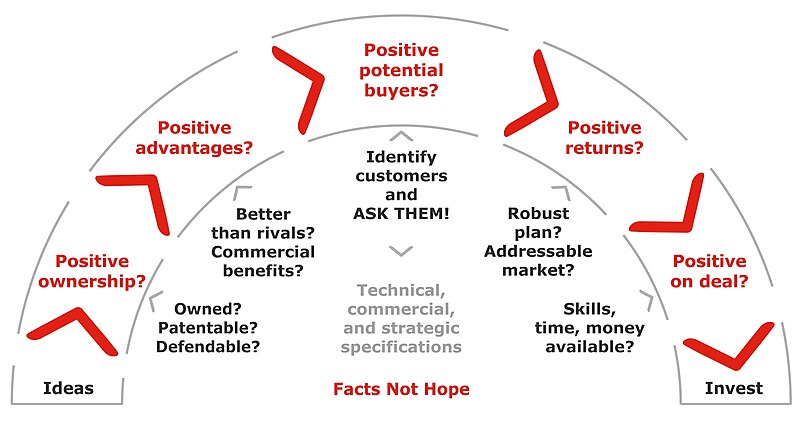
The results show that market uptake can be predicted quite well using a simple set of five option selection principles (questions), which are the same for all three windows. This approach was tested with data of 291 companies, out of which 6 had positive answers to all questions. The five questions analyze technical, commercial and strategic specifications.

Source: https://commons.wikimedia.org/wiki/File:Technology_Bridge_by_Guenther_Dobrauz_Saldapenna.jpg

1. Positive ownership?
2. Positive advantage (to the costumer)?

Note: Deal screening needs to be performed very efficiently. As 80% of the opportunities have been filtered out after the first two questions (50% of the reviewed opportunities in this study were not found to be cleanly and legally owned by their proponents and a further 30% offered no advantage above already existing products and services) it is recommend by the author to use them first.

3. Positive potential buyers?
4. Positive returns (possible)?
5. Positive on deal?

In practice we have found the last question to be among the most important. A positive investment decision has to fit the availability of skills, time and money of the investor at a given time. Even the best deal in your pipeline will not have a full chance to perform at its potential if you – as the investor – lack resources. Startups and investors should think about this point very carefully!

We like this approach, even though we found some critics concerning the missing factor “team” discussing it. Team quality or qualification is not analyzed at all. If you would process this model stand-alone, you would most likely miss to investigate one of the most important potential success- or failure factors of an early stage startup. Venionaire Capital provides popular services for technical valuation and due-diligence support. Our clients (startups or investors) profit from our unbiased insights, high quality research our proprietary mix of valuation and analytic models. Over the past few years we have developed a number of extensions for standard models and some internal models for technology- and company valuation. We work closely together with a number of universities and leading academic professors. Contact us to find out more.

How to value Startups

Work hard and grow fast! Take your opportunity and work global. Digital technologies allow startups to address global markets. It has never been as easy to build such a scalable business. Aside from a fabulous idea, a great team and a phenomenal product, receiving enough funding is essential to succeed on a global scale. As viral growth is rather considered a myth or a so called black-swan than a standard – it is hard work and still quite capital intensive to achieve an international brand awareness for your product.

Unfortunately 90% of all startups will neither receive an Angel Round, nor a Venture Capital investment. So the question is: “Why is it so tricky to get early stage funding?” Most startups usually do not have strong enough historic financial records, which may be inserted in a “standard” business valuation framework. As a result banks and other “traditional” investment institutions, will not be able to calculate the risk of default and will therefore back off. What remains are Business Angels and Venture Capital Funds, who are specialized in high-risk investing and usually provide much more than just money – so called “smart-money”.

In order to come up with a valuation, early-stage investment professionals will take factors like competition, technology risk, capability and quality of the founder team, attractiveness of the market and scalability of a business case, into account. Hence the fact, that most of those highly scalable enterprises focus rather on traction, than on revenues and profits in early stages – they will have a quite significant burn-rate in their first years. Investors and startups will find it difficult to consider this fact regarding classic valuation concepts, and therefore need to use different valuation approaches.

Two main questions remain:

“What is the Enterprise Value of a startup?”

and,

“How do you measure this Enterprise Value?”

There is no such thing as a one and only, true value for a startup company. There is a set of valuations, which all need to be considered and paired with negotiated deal-terms – combined they may be used to set a specific price for a transaction. In order to understand the full picture it is necessary to avoid a selective analysis. The following standard valuation approaches are determined by different external and internal circumstances.

We usually differentiate between, three standard approaches for Enterprise Values (EV):

1. Fair Market value – the value of an enterprise determined by a willing buyer and a willing seller – both conscious of all relevant facts – to close a transaction.
2. Strategic value – the value the company has for a particular (strategic) investor. The positive effects like synergy, opportunistic costs and marketing-effects are considered and calculated for this valuation approach.
3. Intrinsic value – the measure of business value that reflects the entrepreneur’s in-depth understanding of the company’s economic potential.

Fair Market Value

The “Fair Market Value” implicates full knowledge of all the “relevant” facts on both sides. In other words, information symmetry between Startup and Investor – in practice this will be highly unlikely to establish. In case of a young company, without meaningful track record and often a lack of understanding of the product on Investor’s part, it is more likely to have systemic information asymmetry. Because of the nature of startups, it is tough to determine a “Fair Market Value”. Market values of startups will turn out arbitrary, as stakes of privately held companies are infrequently traded assets.

To overcome this problem investors tend to compare the transaction to other deals within a peer-group, which as a group executed a large number of transactions. This sample delivers a statistical figure, also known as a Multiple. The weak side of this method should be adequately considered, as there is a considerable incomparability of Startups. Never the less it is a benchmark.

Strategic Value

The “Strategic Value” is deeply influenced by the Investor himself. A strategic investor always carries a hidden agenda. There are synergies, opportunistic costs and potential advantages in terms of market competition, among other factors, which will lead to a certain strategic premium. This premium could eventually lead to a higher valuation of a startup he is willing to acquire.

It is difficult for startups, to get a feeling for this strategic premium an investor might be willing to pay. This premium will most likely appear if you have a very good understanding of the buy-side industry, the specific buy-side company, or if there are a view companies in competition for a transaction. On the other side strategic investors may be highly valuable partners for startups, if they have troubles to overcome difficulties, in terms of go-to-market or production scaling. Synergies with a strategic partner in this sense could be a huge asset and eventually lead to a discount of a startup valuation.

Deal parties will need to weigh out carefully who will profit the most out of a deal. A Startup and its potential investor need to evaluate how much worth support, experience, contacts and knowledge of markets have. On the other hand, they need to value the amount of savings (e.g. cheap external R&D), additional returns or the ability to hold a market position, an investor may enable due to a partnership.

The valuation is strictly correlated with potential future synergy effects, and is usually implemented through premiums or discounts to a certain Multiple or a given valuation (so called “Anchor”).

Intrinsic Value

Also known as the fundamental value it requires detailed knowledge about the company, product, market, current trends and a good feeling for probabilities in future business development. A qualitative and quantitative analysis of the business model is necessary to estimate the future impact on the market. Technological competitors, advantages and disadvantages also need to be considered as key risks.

One of the most common valuation approaches in this case is the Discounted Cash Flow method. This method has been criticized a lot. A Valuation is calculated through the sum of discounted future cash flows (so called “present value”). The discount factor is another critical factor, it determines the riskiness of the business case. The discount factor is a composition of the required rate of return (ROI), the time value of money and a risk premium, which is directly correlated with the deviation of future cash flows and other aspects of the startup. Small changes of the discount factor lead to large changes of the valuation. Hence there is no uniform Methodology (yet) to determine the risk-premium, the output of the DCF method is not satisfying for many cases.

Conclusion

We have introduced three standard valuation approaches and explained the backgrounds for potential tensions and conflicts, when it comes to negotiations and the complex question of a company valuation. Early stage startups offer great chances, but bare various risks, which are hard to calculate.

Some Business Angels and early stage Venture Funds concentrate primarily on founder teams – as they believe there is no point in calculating any models. This approach is not as trivial as it sounds. Current studies have shown that it is hard to find reliable criteria for successful teams and that statistically investors will not do very well if they only trust on their expert knowledge and life-experience. From aprofessional perspective I would call this “gambling”, which certainly does not mean that it will definitely lead to a fiasco – sometimes gamblers win too, the odds are just not good enough for us. In a professional transaction process investors and startups will build up trust, take external research into account, calculate a couple of models for negotiations and eventually find a deal structure, which takes most of the considerable likely hoods into account.

One of the most complex valuation questions may be solved easily if you define clear terms along side your investment. In practice professionals will consider external advice and research to obtain a different and unbiased point of view. They will compare valuation concepts, weigh synergies and will consider premiums and discounts. Offers will come with a Term-Sheet, which will show a valuation and a corresponding deal-structure.

We consider deal-structuring as an art! Even with drifting valuation beliefs it is easily possible to close satisfying deals for both sides – if you find the right structure. Contact us to find out more!


Co-Author: Sasan Haji-Hashemi, Senior Analyst – Venionaire Capital

WHERE TO FIND US

VIENNA, OFFICE (HQ)

Babenbergerstraße 9/12,
A-1010 Vienna, Austria (EU)
office@venionaire.com

SAN FRANCISCO, USA

1355 Market St. #488
San Francisco CA 94103
sfo@venionaire.com

NEW YORK CITY, USA

122 East 37th Street
First Floor
New York, NY 10016
nyc@venionaire.com

LONDON, UK

Gable House, 239 Regents Park Road
London N3 3LF
office@venionaire.com

Luxembourg, LUX

28, Boulevard F.W. Raiffeisen
2411 Luxembourg
office@venionaire.com

LOOKING FOR FUNDING?

FOR STARTUPS

Venionaire Capital exclusively invests through the European Super Angels Club, for more information and application please go to the website. We do not accept direct investment proposals via this website.